
I may have stated before, in previous Daily Post editorials, that I think the seven people who’ve been serving recently on the Pagosa Springs Town Council are some of the most thoughtful and intelligent people in our little rural community.
But we all can develop unreasonable obsessions.
My own obsession happens to be writing about local governments — and the ways they affect our community, for better or worse.
The Town Council met for a ‘work session’ on April 7 to discuss the potential acquisition, by the Town government, of additional acreage atop Reservoir Hill, adjacent to the Town’s existing downtown Reservoir Hill Park.
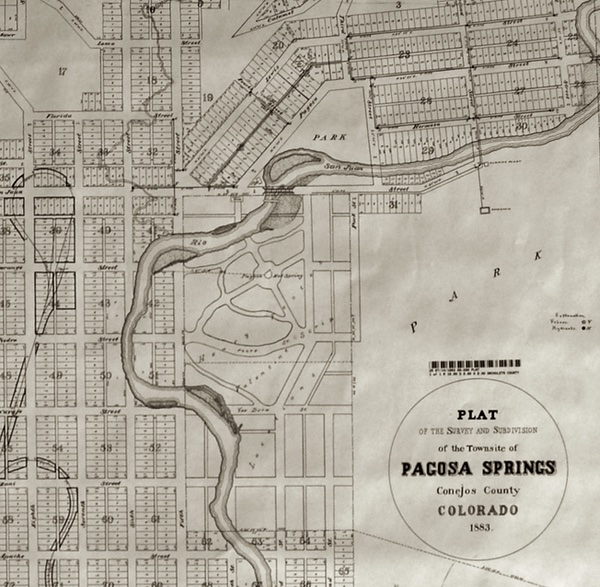
For a bit of history… Reservoir Hill was already designated as a “park” in the original 1883 survey of the Pagosa Springs town site. Note the designation “PARK” just east of the hot springs location on this 1883 map.
Municipal parks were still a rather new idea in 1883, although the city of Boston had created something resembling a municipal park in 1728. It was used mainly for cattle grazing, however.
In The Politics of Park Design: A History of Urban Parks in America, author Galen Cranz identified four phases of park design in the U.S. In the late 19th century, city governments purchased large tracts of land on the outskirts of cities to form “pleasure grounds”: semi-open, charmingly landscaped areas whose primary purpose was to allow city residents, especially the workers, to relax in nature.
As time passed and urban areas developed, these parks began to accommodate other purposes, such as zoos, golf courses, and museums. According to the Trust for Public Land, the three most visited municipal parks in the United States are Central Park in New York, Lincoln Park in Chicago, and Mission Bay Park in San Diego.
Reservoir Hill Park on Pagosa didn’t make the list. Perhaps the intention of the Pagosa Springs Town Council is to remedy that situation?
You can view the April 7 work session on the Town’s website and get a more complete understanding of that government’s intentions regarding Reservoir Hill. But I’d like to offer a brief summary of the 80-minute work session, and offer some opinions. No final decisions were made at that work session.
The session began with brief introduction to a proposed municipal purchase of additional open space atop Reservoir Hill, delivered by Council member Brooks Lindner, who has been leading the research effort.
“The GOCO recreation-oriented funding might not depend on us just preserving the land, but also in showing how the site would be used, managed and aligned with our broader recreational planning. So a clear ‘use-management’ framework really strengthens our argument for funding. So that’s kind of what we are trying to focus on here today…”
The “GOCO recreation-oriented funding”, to which Mr. Lindner is here referring, would come from the Great Outdoors Colorado (GOCO) Fund.
In 1990, Colorado Governor Roy Romer and Natural Resources Executive Director Ken Salazar formed a citizens committee to address a question. “What should Colorado do to sustain and enhance our outdoor resources — our parks, trails, wildlife, and open space — for future generations?”
Eventually, the committee proposed a trust fund to invest in the future of Colorado’s outdoors. A ballot initiative proposed redirecting up to half of Colorado Lottery proceeds each year. On November 3, 1992, this plan was approved, with 58% of voters in favor.
Colorado became the only state in the nation to invest lottery proceeds this way. and it’s still the only state with this type of program. One way to describe GOCO: it’s the only parks and recreation funding system supported almost entirely by gambling addicts.
From the GOCO website:
…These are the places that GOCO has helped open up and protect. Places we share. Places we take care of. Since 1992, GOCO has invested a portion of the proceeds from the Colorado Lottery to help outdoor organizations — including local governments, nonprofits, and Colorado Parks and Wildlife — complete more than 5,900 conservation and recreation projects in every corner of this spectacular state we call home. And that makes us all winners…
The Town of Pagosa Springs has received numerous grants from GOCO over the past three decades, and as a result, has greatly expanded its parks and recreation infrastructure and programming.
The expansion has also applied to the Parks & Recreation budget. Back in 2006, the Town’s Parks & Recreation budget was $1.7 million including capital projects. Last year, the Town spent $3.2 million on Parks & Recreation, including capital projects.
I personally have no objection to municipal governments funding parks and recreation programs. My father worked for many years providing youth activities for the Rec Department in Oakland, California, and my first two jobs were with municipal recreation departments, also in youth activities.
But it seems to me the aims of governments here in Archuleta County are increasingly directed at adult activities and infrastructure. This makes a certain kind of sense, as younger families move away and retirees increasingly arrive.
Two of the more recent recreational investments made by the Town were on the east end of downtown. A 3.6-acre riverfront parcel once home to Bob’s LP was purchased for $882,000, to provide better recreational access to the San Juan River, and reportedly, a new boat ramp has been constructed and parking improvements have been made, at a cost of $190,000 as part of Phase One. The Town website indicates that a public meeting is scheduled for June 2026 to consider additional investments.
The Town Council also approved the purchase of a 12-acre parcel on the hillside behind Tractor Supply, with no Council consensus about how the parcel would be developed, but some Council members seemed to view it as an extension of Reservoir Hill Park.
On April 7, the Council heard a presentation from the Parks Department, proposing the purchase of 491 acres adjacent to Reservoir Hill Park. For recreation.
Cost of such a purchase?