
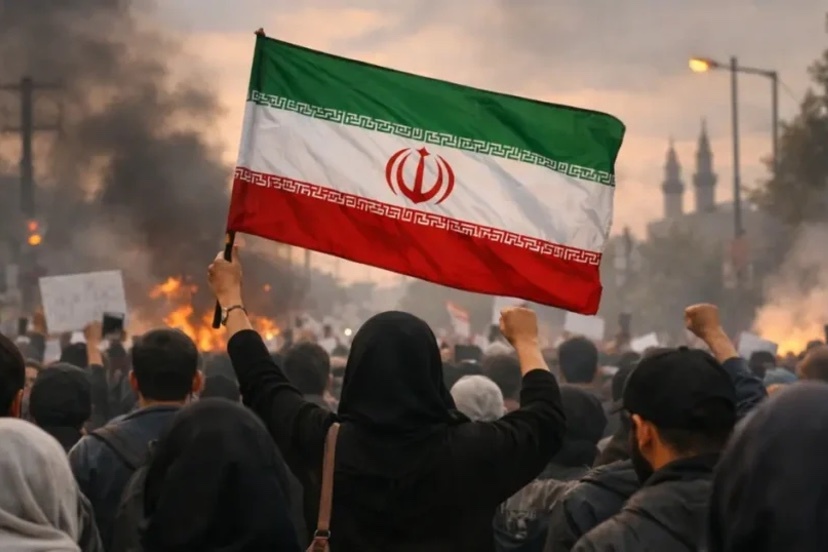
A few weeks ago, we saw scenes of Iranian people in the streets of Tehran and elsewhere in the country, protesting their government. I hoped they would succeed, bringing down their cruel regime.
But last week, we learned that the Trump administration policy would be to unleash “impending strikes” that “would take their country ‘back to the Stone Age,'” according to the Wall Street Journal.
Will the U.S. attacks manage to avoid those young people who protested, who hate their regime, who crave economic and political freedom, who now have to hide from strikes from above, as well as Iranian Revolutionary Guard thugs on the ground? Will they miss the elderly, who are just looking for their next meal, who often rely on basic services just to get by?
As with anyone who questions the policy of our administration, there will be the implication that one somehow is in sympathy with their rapacious regime. Of course not. But if our government thought an airstrike taking out one leader would make a difference, I’d recommend reading about how the Iranian regime is organized, with multiple institutions and interlocking power structures, probably constructed for this eventuality.
Some of this recent talk, reminiscent of Curtis LeMay’s Vice-Presidential candidacy, is egged on by those who believe there’s a positive relationship between the number of explosions and subjugation of a foe. It’s worth noting that LeMay pushed this policy during the Vietnam War.
As Nathan Layne from Reuters reports, “While acknowledging that Americans are concerned about the prospect of a protracted conflict, CPAC senior fellow Mercedes Schlapp used a session featuring two Iranians shot by security forces during 2022 protests to press the case for a war she said would liberate its people. ‘The madness needs to stop. We’ve got to make Iran free again and we are going to make sure America stands strong by their side,’ Schlapp, a senior adviser to Trump during his first term, said during the session titled ‘MAGA vs. Mullah Madness.'”
But Layne adds, “Trump, however, no longer talks of regime change in Iran and the air strikes by the U.S. and Israel over the past four weeks have not triggered any popular revolt against the Iranian leadership.”
It’s hard to generate a public uprising during a bombing campaign.
If the plan is to have a free Iran, how many outstanding future leaders might be killed by strikes designed to send the country back to the Stone Age? How will Iranians feel about Americans if such hell is unleashed and massive casualties follow? We’re talking here about people, not infrastructure or energy resources, though Americans have to be asking what’s up when they learned our government lifted sanctions on Iran to allow them to sell oil and removed sanctions on Iran’s ally, Russia, even though Ukrainians have been helping us stop Shahed missiles that Iran sold to Putin.
America probably has power like no other to send a country back to the Stone Age. But we are also historically an intelligent nation, able to solve complex problems, in politics, economics, and even space. And we’re a nation that once aspired to represent the high moral ground.
A bombing campaign aimed at replacing the Iranian regime might also kill potential leaders who we hope will be aligned with us in the future, to be free and economic partners.
And we also have to think about how many of those innocents who want a different regime will die if the Trump administration continues on the current path.
John A. Tures is Professor of Political Science and Coordinator of the Political Science Program at LaGrange College, in LaGrange, Georgia. His first book, “Branded”, is available on Amazon. He can be reached at jtures@lagrange.edu.