
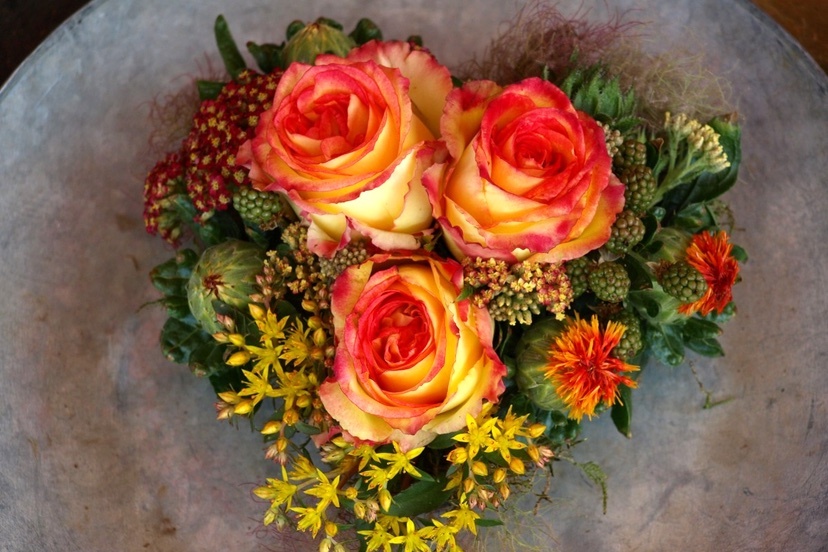
Southern Living Magazine recently published an article by Betsy Cribb Watson, explaining how I can keep my flower arrangements looking fresh longer.
Why You Should Put a Penny in Flower Water For Longer-Lasting Blooms
Quote:
Putting a penny in flower water keeps flowers alive longer because copper is a fungicide. This means the metal naturally kills the bacteria and fungi that are trying to camp out in your flowers’ vase and shorten the life span of your stems.
But before you empty your piggy bank looking for pennies to plop in your vases, take note. The date the penny was minted matters — a lot.
Pennies minted before 1982 were made of 95% copper, while the pennies we use today—those made after 1982—are made of 97.5% zinc and are given only a thin copper coating…
This information caused me to inventory the coins in my piggy bank, and I was able to find 13 pennies that were minted in 1982 or earlier.
Not that I ever buy flowers. But I wanted to know, just in case.
And it’s quite possible these old pennies are now worth more than a penny, or that they will be, soon.
From a story in The Conversation, written by Morgan Bazilian, Colorado School of Mines, and Adam Charles Simon, University of Michigan:
Demand for copper is surging because of demand from new technologies, but suppliers are struggling to keep up, and they are likely to fall further behind in the coming years, resulting in shortfalls globally. Even though copper prices are at historically high levels, the financial risk involved in mining means that prices will need to go much higher before mining companies see profit in addressing the supply shortage…
Copper is abundant in the ground, but there’s not enough being extracted to be able to meet the demand. That’s because investors want higher and more reliable returns than copper mines currently offer, and the industry faces complex permitting processes and can’t find enough workers. Our analysis found that for new technologies to continue to develop, and for the global economy to continue to grow, even higher prices are ahead.
Are we surprised to learn that higher prices await us? Ha, ha, ha. Nope.
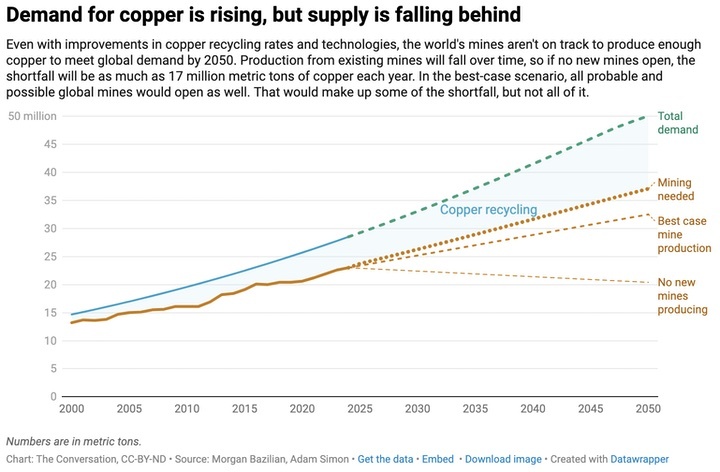
The Conversation article included this graphic:
Even if mining companies and investors get off their fat butts and start opening new mines, we’re still looking at tough times ahead.
It appears, however, that Americans have bulked up our copper infrastructure nicely. We’ve built about 400 pounds of copper per person into our existing economy… electrical wires, copper plumbing, automobiles…
…my little Subaru reportedly contains about 45 pounds of copper.
Puts my penny collection to shame.
The most populous country in the world — India — lags far behind the U.S. with less than 2 pounds of copper per person.
I wonder how they even get by? I feel sorry for anyone in India who’s trying to keep a flower arrangement looking fresh.
The writers from The Conversation have a pessimistic view of the future, but haven’t totally given up on us.
Existing mines will have decreasing amounts of ore available and will produce less copper in 2050 than they do in 2025. Yet even if all known copper deposits with known mine-opening dates go into production as scheduled, copper supplies will not keep up with demand.
Our best-case scenario has global mine production at about 30 million metric tons of copper a year by 2050. But to keep pace with global economic development, the world will need 37 million metric tons of mined copper a year by then.
To meet that additional need, more mines will need to be opened, and extra production developed – including extracting residual copper from old mine debris that was previously viewed as having too little copper to be worth processing.
The worst possible outcome, I guess, would be if everyone in India and China wants to have 400 pounds of copper per person.
That would be, like, 2.9 billion people times 400 pounds. That comes out to 530 million metric tons. Even the best case scenario suggested by the experts is, like, the entire world could produce 50 metric tons.
And we all know very well which country will expect the lion’s share of that 50 metric tons.
But, I mean, has anyone else been willing to stop minting pennies?
I don’t think so.
Underrated writer Louis Cannon grew up in the vast American West, although his ex-wife, given the slightest opportunity, will deny that he ever grew up at all. You can read more stories on his Substack account.