
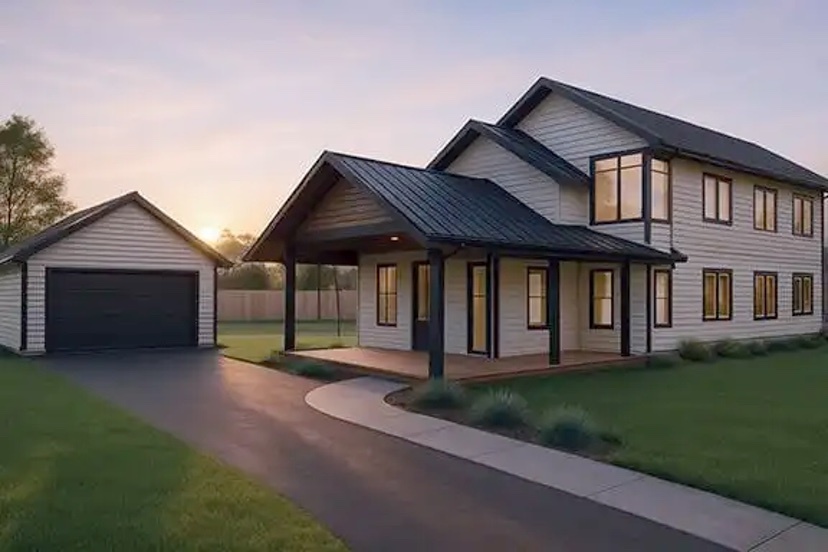
Illustration courtesy Aspen House website.
From the Archuleta Board of County Commissioners’ March 3 work session agenda packet, a letter addressed to the Colorado Department of Local Affairs (DOLA) begins like this :
Dear Members of the Review Committee,
I am writing to express my strong support for A Safe Place in Pagosa, Inc., and its application for a Building Development Grant to complete construction of Aspen House in Archuleta County.
For more than ten years, A Safe Place in Pagosa has worked tirelessly to address a critical and longstanding gap in our rural community — the complete lack of supportive housing for adults with intellectual and developmental disabilities. Aspen House represents a transformational solution that will provide safe, stable housing combined with meaningful supportive services for some of our community’s most vulnerable residents…
Aspen House is a project of A Safe Place in Pagosa, Inc., a nonprofit created by Patricia Brown and Carolyn Paschal in 2015 to provide a safe home that would support their adult children with developmental disabilities. They expanded their vision to include additional families facing the same circumstances in the Pagosa Springs area.

When adults with developmental disabilities reach the age of maturity, they age out of various state support programs. Parents of these disabled adult children sometimes wait 10 years or longer to move up the waiting list for state or nationwide facilities.
Aspen House is projected to be a $2.4 million 8-suite licensed group care home serving adults with I/DD — that is, Intellectual and/or Developmental Disabilities. The corporation purchased a vacant parcel on Vista Boulevard and has thus far raised about $1.7 million in fundraising, donations or commitments of in-kind services.
From the BOCC letter of support:
Through extraordinary local collaboration, the project has reached a monumental milestone. General contractor Tim Brown and a coalition of local building partners have committed over $1 million in donated labor and materials, significantly reducing overall construction costs. Because of this generosity and more than a decade of determined fundraising, over 75% of the project funding has now been secured — positioning Aspen House to qualify for the Building Development Grant program.
Aspen House will be the first fully supportive group home in Archuleta County dedicated to adults with intellectual and developmental disabilities. Currently, individuals requiring this level of support often must leave the community — and their families — to find appropriate housing. This project ensures they can remain in the place they call home…
Executive Director Pattie Copenhaver shared the following 5-minute video with the County commissioners on March 3.
From the Aspen House website:
A qualified support team will assess each resident and create an Individualized Program Plan (IPP) for them based on their specific needs and desires. Round-the-clock care will be provided for the safety of the residents. The program also includes wrap-around resources such as recreation, therapy, community engagement and vocational support services. In addition, all services and programs will be available to non-resident community members that qualify…
Building housing in Archuleta County is hard work. Perhaps harder than it needs to be.
But we can do hard work… even if it sometimes takes 12 years to make things happen.
A few things we might note about the Aspen House project. For one, it will serve a select population that might otherwise find it impossible to purchase or rent a home on their own. For another thing, it will establish a group-living situation that will likely reduce the “per-resident” cost of round-the-clock care and building upkeep.
Also, the group-living arrangement will provide the opportunities for social interaction among the residents.
As we watch the cost of single-family housing skyrocket in Pagosa Springs, there’s a tendency to either throw up our hands and declare the housing problem “insoluble”… or to imagine that governments and nonprofits can somehow subsidize housing for anyone and everyone struggling to find suitable housing.
I don’t accept either of those conclusions. But I do believe our expectations and assumptions about how housing should look, and function, will need to change significantly if we are going to seriously address the housing problem in Pagosa Springs.
For example. Why is “group-living” a good idea for people living with I/DD… but is not generally considered a reasonable option for the rest of us?
As mentioned on Friday in Part Seven, a group of 18 local leaders met at the Ross Aragon Community Center last Thursday to discuss our local housing crisis. The participants had been invited by the community’s Housing Coordinator, Jeff Sams, and represented various government and nonprofit entities that are involved — in one way or another — with housing. The entity with the most representation was the Town of Pagosa Springs, represented by Town Manager David Harris, Town Clerk April Hessman, Community Development Director James Dickhoff, Town Planning Commission member Brian Reid and Town Council member Gary Williams.
The Town government has made several changes to its land use policies in recent years, including limitations on the number of dwellings allowed to be converted into vacation rentals, fee deferrals and waivers, and allowances for creative solutions to be explored.
Meanwhile, Archuleta County… the unincorporated areas where 85% of the population lives… and where maybe 95% of the privately-owned land still remains vacant of dwellings in vast areas dedicated to so-called “Agricultural Ranching”… has done relatively little to adjust its policies since writing its first Community Plan in 2001.
There is now an opportunity for Archuleta County to seriously rethink land use policies. The County is required to update its comprehensive plan — the document called the Community Plan — by the end of December 2026.
Why is this update required? Because state legislators perceive a statewide crisis, and is demanding that local communities make plans to address it.
That crisis? Simply stated: housing.
Bill Hudson began sharing his opinions in the Pagosa Daily Post in 2004 and can't seem to break the habit. He claims that, in Pagosa Springs, opinions are like pickup trucks: everybody has one.