
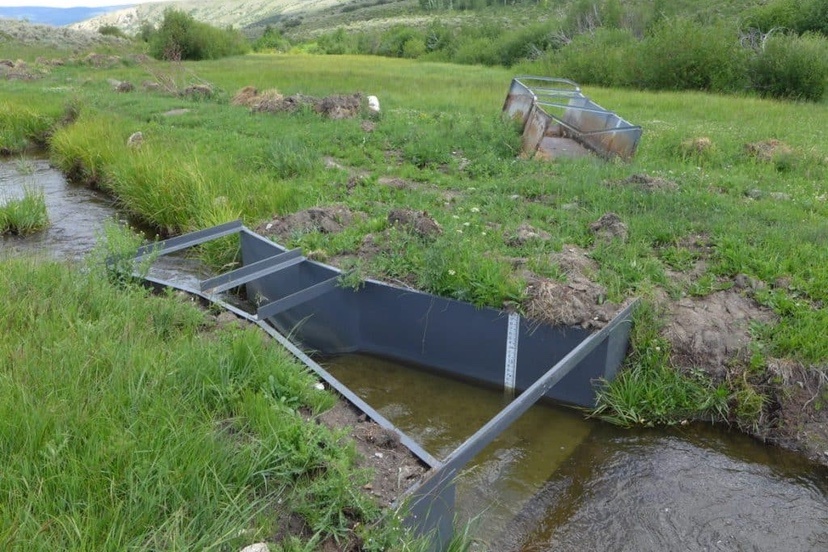
Photo: A Parshall flume is a critical, self-cleaning, open-channel flow meter used to measure irrigation water with high accuracy.
We concluded Part Five yesterday with a question.
The Archuleta County 2017 Community Plan will be updated this year to include “water supply information” — as required by state law — to include:
A water supply element developed in consultation with entities that supply water for use within the county or region to ensure coordination on water supply and facility planning. Nothing in this section requires the public disclosure of confidential information related to water supply or facilities.
The coordination of water supply and facility planning seems like a sensible idea, as does consultation with the entities that supply water.
We noted that the planned ‘Interactive Community Forum’ planned for Wednesday, March 25 — and open to the general public — will include a discussion of “Water Concerns”.

Water is certainly a subject of major concern in the American West, and the concern has been heightened as the two largest water reservoirs in the U.S. — Lake Mead and Lake Powell — slowly approach ‘dead pool’ conditions.
The particular state law that requires Archuleta County to include a “water supply element” in its Community Plan update — SB24-174 — is aimed specifically at “Sustainable Affordable Housing Assistance”. The law seems to aim at making sure people have ‘sustainable’ access to water, especially if they live in affordable housing.
No doubt the folks living in Archuleta County have ideas and concerns about our local water situation. Some have rather strong opinions, I hear.
But the question from yesterday:
Who, exactly, should our Archuleta County government be consulting, when including the “water supply element” in the upcoming Community Plan update?
As also mentioned yesterday, here are the entities that provide drinking water in Archuleta County. They also provide certain other services:
Pagosa Area Water and Sanitation District, annual budget (all services) $24.7 million
Aspen Springs Metro District, annual budget (all services) $477,000
San Juan River Village Metro District, annual budget (all services) $90,000
Piedra Park Metro District (Arboles), annual budget (all services) $45,000
Disclosure: I currently serve as a volunteer Board member for the Pagosa Area Water and Sanitation District (PAWSD), but this editorial reflects only my own opinions, and not necessarily those of the PAWSD Board or PAWSD staff.
I know very little about three of these districts, but I am fairly familiar with PAWSD, having written occasional editorials about that district over the past 20 years, and currently serving on the Board of Directors.
I noticed an editorial yesterday on BigPivots.com, written by journalist David Marston, about “water supply” concerns in nearby Durango. The article bore the headline, “Durango Waits for a Water Crisis”
According to Mr. Marston:
Right now, [the City of Durango] has 10 to 30 days of water stored in its Terminal Reservoir, which holds 267 acre-feet. That’s annual water consumption for about 600 households; Durango has over 9,000 households. The city depends mainly on the Florida River, with large draws of summer water from the Animas River. When the two rivers flow normally, the taps run. If both rivers dry up or clog with debris from fires, the city could run out of water within weeks.
Back in 2011, the City of Durango bought 3,800 acre‑feet of water storage in Lake Nighthorse, south of town, for $6 million… but currently has no pipeline to deliver that water to city residents. Reportedly, the pipeline would cost about $100 million.
PAWSD, the main drinking water supplier in Archuleta County, serves about 5,000 households — slightly more than half the number served by the City of Durango. But PAWSD has access to about 15 times the reservoir storage found in Durango’s Terminal Reservoir…about 3,950 acre-feet of total usable storage capacity in five reservoirs. (And about the same amount Durango would have if they built a $100 million pipeline to Lake Nighthorse.)
But both PAWSD and the City of Durango have diversion rights in flowing rivers and creeks. As long as those rivers and creeks are flowing freely — and are not impacted by wildfire debris — both communities have plenty of available water.
Of course, you always need a plan for drought, right?
Information about PAWSD water availability and drought policy was published in its 2020 ‘Drought Management Plan’ which you can download here.
And if you are updating the Archuleta County Community Plan, you probably want to plan for growth. For example, can PAWSD serve all the new households that might arrive here over the next 50 years?
Quite honestly, this is a ridiculous question to ask, because we can’t come close to knowing the answer.
During the 1990s, Archuleta County’s population was increasing by about 7% per year. Over the past 20 years, however, the growth has been less than 2% per year. At that rate, it will take about 50 years for the population to double. But according to the Colorado State Demographer, Archuleta County lost population during 2024.
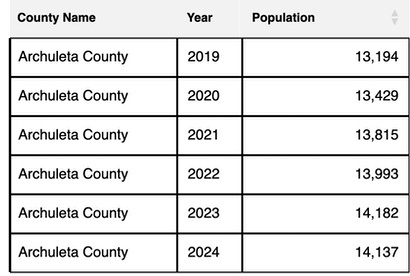
But can we predict population growth for even the next three years… let alone the next 50 years?
Can we predict the climate and precipitation for the next three years?
Let’s not pretend that we can.
We can, however, predict with some confidence that PAWSD will have sufficient water supplies for the next three years, knowing that we have 3,950 acre-feet of storage capacity, and that PAWSD sells about 1,300 acre-feet of water per year.
But most of the water used in Archuleta County — in fact, about 94% of the water used in Archuleta County — is not drinking water. It’s water used for agricultural irrigation. Most of our water is used to irrigate hay fields, to grow grass for cows.
This water is not provided by PAWSD or any other water district. It arrives through a relatively primitive system of irrigation ditches controlled by “ditch companies”.
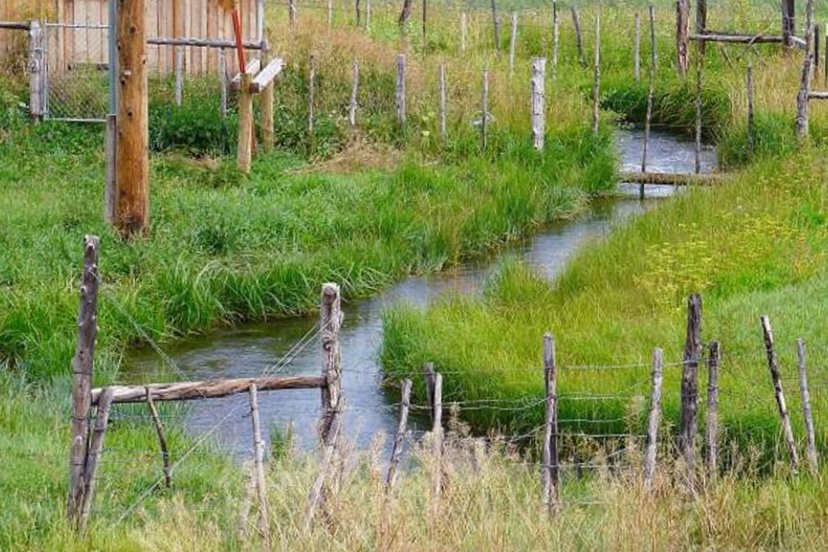
SB24-174 demands “A water supply element developed in consultation with entities that supply water for use within the county…” to be included in the soon-to-be-updated Archuleta Community Plan,
If 94% of the water diversions in our community are controlled by ditch companies… might the BOCC want those ditch companies to be consulted during a Community Plan update?