
If we can believe what we read in magazines nowadays — and that’s a legitimate question — a skinny, gap-toothed kid from Brooklyn walked into an information booth next door to the Radio City Music Hall in New York City, in the autumn of 1953.
The sign overhead said, “Vermont”.
He stopped in, and headed back home with a brochure titled “Vermont Farms and Summer Homes for Sale.”
According to Jill Lepore, Harvard professor and staff writer at The New Yorker, writing in an article titled “When Bernie Sanders Headed for the Hills”, Bernie Sanders finally made his first trip to Vermont eleven years later, with his new wife, and bought eighty-five mostly-wooded acres for $2,500, as a summer retreat. The couple finally moved to Vermont permanently in 1968, when so many young people were also heading for the hills to escape the corporate military-industrial complex America had become.
Professor Lepore tells us that Vermont didn’t have much to offer to the people actually living there in 1968, if they happened to be farmers. Vermont had spent the past 20 years selling itself as a tourist destination, and city-dwellers from the East Coast were buying up bankrupt farms and driving up property values.
In 1945, there had been twenty-six thousand family farms in the state. Twenty years later, when Sanders bought that patch of land, fewer than nine thousand farms were left…
Three-quarters of Vermont was farmland by the 1850s; three-quarters of the state is now forest. But during the 1970s, it looked like the farmland might have a chance to make a comeback…
Much of the New Left, disillusioned with electoral politics after the fiasco of the Democratic Convention in Chicago, went back to the land… By some estimates, a hundred thousand young people moved to Vermont between 1965 and 1975; by another, they set up more than a hundred communes. They kept the state rural, but they changed its politics. They started food co-ops and opened vegetarian restaurants and founded artists’ coöperatives and hooked up shortwave radios and published papers like the ‘Vermont Freeman’, a twenty-cent newspaper that was something of a radical, countercultural counterpart to ‘Vermont Life’, and whose editor distributed it out of the back of his VW…
Bernie Sanders began writing articles for the Vermont Freeman in 1969, and a front-page teaser for one of his articles works just as well for the rest of them:
‘Bernard Sanders views the ills of our troubled and dying society.’
Professor Lepore notes that this front-page teaser could easily have as a slogan for Sander’s 2016 and 2020 Presidential campaigns.
…he wrote about the wretchedness of city life (“the air is poisonous, the noise deafening, and the streets are dangerous to walk” ) and the hard lives of such “miserable people” as his father, taking the train from Brooklyn to Manhattan to do “moron work,” packed into subway cars with a faceless mob, then taking the train back at night to “family, dinner, arguments, TV and sleep”…
“The years come and go, suicide, nervous breakdown, cancer, sexual deadness, heart attack, alcoholism, senility at 50. Slow death, fast death…”
Given that kind of life in the city, who wouldn’t want to escape… and settle in Vermont?
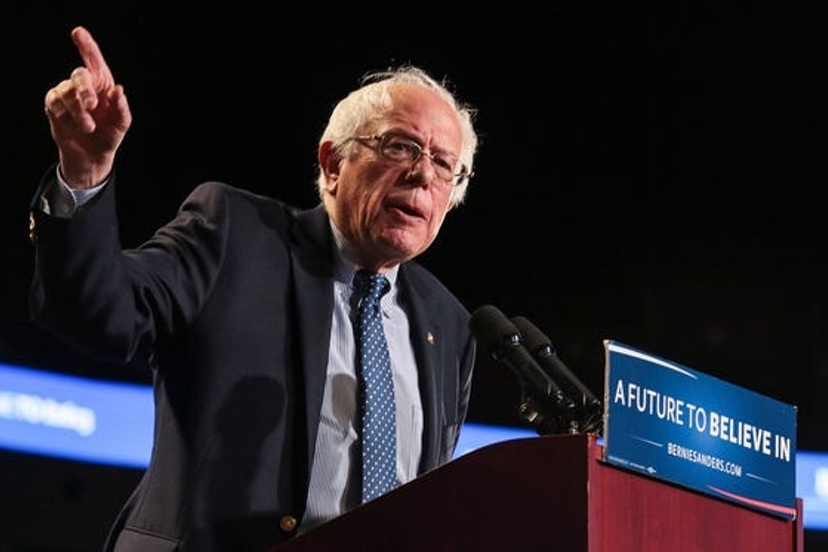
By 1971, Bernie Sanders had already begun running — unsuccessfully — for political offices, campaigning on the claim that tourism was ruining Vermont and driving its residents into poverty.
Tourism, Sanders argued, was having a “devastating impact” on the state’s economy. Men and women who’d lost their farms and their factory jobs were working as “chambermaids and burger flippers,” while out-of-state developers were getting rich and the skiers at Stowe were driving Porsches and BMWs.
He finally won his first election — as mayor of Vermont’s largest town, Burlington — in 1981. In 1991, he was elected to the U.S. House of Representatives — Vermont’s lone Representative — and in 2007, to the U.S. Senate.
He has been a notoriously ineffective legislator, having introduced only three bills between 1991 and 2020 that became law, two of which concerned the names of post offices…
Meanwhile, Vermont’s full-time residents have struggled to survive economically. Dairy farms have disappeared, down from more than four thousand farms in 1969 to fewer than six hundred.
Opioid addiction has devastated Burlington, and much of the rest of Vermont, too. Property taxes have risen by an average of forty per cent since the start of the COVID crisis, as fugitives made their hopeful escapes from New York and New England, contributing to rising land values, increased taxes, and bigger utility bills for longtime locals.
If this story sounds a bit like Pagosa Springs… well, maybe it should.
Except the fugitives, in our case, have arrived mainly from Texas, Arizona, and California.
…After Bernie Sanders left Burlington for Washington, D.C., he mostly said the same things he’d been saying since the ’70s, except louder. “Never before in American history have so few media conglomerates, all owned by the billionaire class, had so much influence over the public,” he declared in 2024. “Today, we have a government of the billionaire class, by the billionaire class, for the billionaire class.”
This is, unfortunately, true,
Is there a way to get off the hamster wheel, locally?
From Professor Lepore:
Despite the risk of flooding on lower ground, hilly, chilly Vermont is a destination for climate refugees. Other types of farming are replacing dairies. A lot of farmers are growing hops, hoping to make Vermont for beer what the Napa Valley is for wine. The state has about the best rural broadband program in the country, opening doors for small businesses and digital nomads alike…
…Back-to-the-land movements seem to come in thirty-year cycles: the United States is due for one, and, who knows, maybe a hundred thousand Gen Z-ers, fleeing Brooklyn, will turn up in the next ten years, wearing canvas Carhartt pants and carrying iPads and knitting needles and glossy seed catalogues. More people, in short, are likely to move to Vermont…
Our local leaders have been very supportive of rural broadband, here in Archuleta County, in hopes that thousands of Gen-Zers will show up with their iPads and seed catalogues.
But so far, there’s very little housing they can afford. Only tourists and part-time summer people are arriving, in ever-larger numbers.
“You want fries with that burger?”
Bill Hudson began sharing his opinions in the Pagosa Daily Post in 2004 and can't seem to break the habit. He claims that, in Pagosa Springs, opinions are like pickup trucks: everybody has one.