
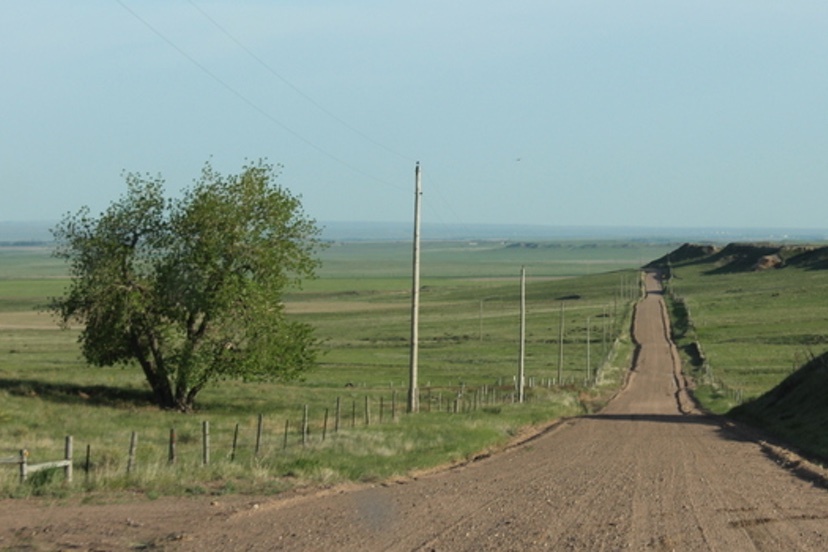
Logan County, Colorado. Photo/Don Best.
This story by Allen Best appeared on BigPivots.com on December 16, 2025. We are sharing it in two parts.
Economic development officials in Logan County almost fervently want to believe that a data center will be part of a local boom.
The data center could produce up to a thousand construction jobs, a potential $15 billion capital investment, and between 50 and 100 permanent, high-paying technical and management careers, said Andrew Fritzer, chair of the board of directors for the Logan County Economic Development Corporation, at an October meeting covered by the Sterling Journal-Advocate.
“This project represents a once-in-a-generation opportunity to transform the local economy and secure long-term benefits for the people of Logan County,” he said.
In imposing the moratorium on data centers in October, the Logan County commissioners stressed that they hoped it would be brief. They, too, hope for tax base.
The story in northeastern Colorado in some ways echoes that of a rural area of New Mexico. “A Mysterious Company Came to Town With a $165 Billion Idea,” was the fetching headline in the New York Times. “As wealthier areas are pushing back against huge AI data centers, speculators are pitching places like Doña Ana County, N.M., on their vision. Local officials are eager for a deal — even if they don’t quite know the terms.”
Business writer David Segal summarized the tensions in New Mexico and at least part of the conversation in Colorado: “Naysayers contend that the astounding outlays are inflating a bubble that will end with a calamitous pop. Once that happens, they predict, the country will be covered with a lot of empty buildings, perfect for laser tag and not much else.”
Are we in a bubble in this data center-building spree? And will it soon burst, similar to the dot-com bubble of the late 1990s that imploded in 2000?
Trae Miller, executive director of the Logan County Economic Development Corporation, told Big Pivots that he sees hyperscale data centers being a good fit for rural areas. The level of workers is meaningful but not overwhelming, he said. “In a lot of urban areas, it’s underwhelming. You talk about the number of jobs, and they don’t get excited.”
Miller said he has had several conversations about potential data centers, but the Granite Renewables project is the most serious. He wasn’t even aware of it until September. During our November conversation, he worried about the message the moratorium sends.
“We want to make sure that we are sending a positive message to the market about the interest in and value of siting these types of projects in rural communities. I really do think that there are good opportunities, and when done the right way, they can be very beneficial to all parties. I hate to see the mortarium because it sends a negative message to the market.”
County commissioners say they do not want to stand in the way of economic development but do want to be prepared. Revising solar and wind regulations were already on the agenda and data centers were added to the planning commission’s to-do list in October.
“We had no idea that anybody was contemplating data centers in our area until we started talking about putting a moratorium on solar to clean up our regulations,” Brownlee, the county commissioner, told Big Pivots.
“Data centers weren’t really on our radar. We had asked P&Z to work on battery storage about a year ago. They were working on it but there was no urgency. Our intent was in no way to hold things up for a long period of time. We were originally thinking about a 60-day moratorium to get our ducks in a row.”
Commissioner Jim Yahn is of a similar mindset. “I’m not opposed to moving as quickly as we can, but you have to understand, this is all new to us. We want economic development with this, but we don’t want to look back 10 years down the road and have regrets because we did something in haste,” he said at the October meeting, according to the Journal-Advocate account.
Water and energy?
Data centers need massive amounts of energy, and they also require water. The South Platte River is nearly the exclusive source of water, and that water is already disputed. See: “What exactly is Nebraska’s dispute with Colorado about?” Oct. 16, 2025.Logan County, if not as cool as Cheyenne, remains cooler than any place in Texas or Virginia.
That means renewables and “flexible gas generation” and having access to the broader electrical grid.
“Our facilities are engineered for resilience, sustainability, and energy independence.,” says the company. Data center owners do want that independence. They want to control their own destiny.
What does that mean in practice? Solar and natural gas are clearly in the cards. With 4,000 acres, that could be a lot of solar.
The county already had regulations governing wind and solar development. These regulations need only a little tweaking, Brownlee and Yahn said. For example, existing regulations are too lenient, in the eyes of some residents who want greater setbacks from public roads.
The county is likely to adopt a higher fee to cover the cost of third-party evaluations of code compliance. The county has a two-person planning and building review staff.
A specific concern is about the need to revegetate areas formerly used for dryland farming. The goal will be to avert dust storms or water erosion. “This is something that needs to be done prior to any solar panels going on the ground,” said Yahn, who manages two reservoirs, North Sterling and Prewitt, in addition to his duties as a commissioner.
The Colorado Energy Office has provided useful resources in helping revise regulations for these shifts in energy. At the same time, the commissioners are adamant that they do not want the state dictating local regulations. That is a common attitude in eastern Colorado, but not all that different from the attitudes of local governments across Colorado.
In the case of batteries, concerns are being addressed about impacts to local all-volunteer firefighting departments. NextEra Energy, a major energy company in Colorado and other states, offered to provide sample regulations. As well, say the commissioners, the county has been consulting other counties to see what can be useful.
Yahn has concerns about the location of data centers near Minute Man Missile silos. He points out that one center near Warren Air Force Base, outside of Cheyenne, had to be closed because it was too close. Could data centers or renewable energy within a mile of those missile sites be a problem? He has also vowed to work to ensure the data center does not result in higher prices for farmers.
As for solar, Logan County today has just a handful of smaller solar projects, 30 acres and 5 megawatts or less in size. The solar component could be Colorado’s largest.
Today, the largest is at Pueblo, on 1,800 acres owned by Rocky Mountain Steel proximate to the Comanche Generating Station. The project, Bighorn, had a capacity of 348 megawatts, allowing the steel mill to claim with just a few asterisks that it produces solar-made steel.
What would grandpa think?
When my grandfather died in 1980, solar remained in its infancy, a still very expensive way to generate electricity. Now, it’s among the cheapest ways, second only to electricity produced by the giant wind turbines. Wind turbines already dot the horizon near where he was born and conceivably the land now used to grow wheat will grow electricity to be used in computers for who knows what purpose.
It’s part of the family story that when he was still a young boy, maybe 5 or 6, my grandfather was taken by horseback to Sterling, his first visit to the big city. Cresting a hill, he saw the South Platte River Valley for the first time and its abundance of trees.
“What do you see,” he was asked.
A lot of cows, he guessed. On the prairie homestead, trees were scarce.
Later, he drove a motorcycle to San Francisco, went to France in World War I and flew on a jet to Alaska. I wonder what he would think of this prospective island of computers in a sea of solar panels.
Allen Best publishes the e-journal Big Pivots, which chronicles the energy transition in Colorado and beyond.