
This story by Allen Best appeared on BigPivots.com on November 13, 2025. We are sharing it in two parts.
In putting out the RFP for small modular reactors, Denver International Airport last summer got out in front of its skis.
Now it is doing what it should have done last summer, asking for many ideas about many technologies, not just one.
“We’re asking the private sector to think out of the box,” said Washington at the DIA forum. “We’re not limiting them. So this will include small modular reactors, or nuclear. This will include hydrogen, geothermal, wind — all of those things we’re asking, ‘Give us proposed solutions’.”
Unmentioned was the fact that the City of Denver is currently renegotiating its franchise agreement with Xcel Energy. It’s not clear whether that fact plays into this request. What this amounts to, though, is the prospective creation of something resembling a new utility. Washington acknowledged that the airport might be able to sell the electricity to others.
“If we are energy independent as an airport, if we are our own power company, we can then sell excess power to development to create a new revenue stream,” said Washington. “That is not the sole reason we’re doing all of this, but that is a residual benefit if we are power independent.”
“Considering the complex energy demands of airports and the surging adoption of electric vehicle technology, the need for airports to decrease reliance on the aging US power grid is significant,” said two researchers in a January 2025 article called “Airport Electrification” that was published in the Journal of Aviation Technology and Engineering.
Part of a theme
Energy resilience has emerged as a major concern at airports. This concern is triggered, at least in part, by extended electrical outages. Delta estimated that an 11-hour outage caused by an electrical fire at Atlanta’s Hartsfield-Jackson airport in 2017 cost up to $50 million. Schedules of 30,000 travelers were disrupted.
The Government Accountability Office in 2023 identified 321 outages that lasted at least five minutes at two-dozen U.S. airports from 2015 to 2022.
As the New York Times noted in March, DIA has two dedicated substations, each of which can power the whole facility, providing redundancy in an emergency. It also has two backup generators.
Resilience — making sure the lights are on — has been a major driver, but as the CEO of the Pittsburg airport told a New York Times reporter in early 2025, that airport’s investment in natural gas and solar had saved the airport $1 million annually.
“The traditional energy infrastructure airport operators have relied on for the past half-century may not be able to keep pace with ballooning power requirements,” said Juan Macias, the CEO of AlphaStruxure, in a February 2024 posting at Cipher. “For many airports, it’s time to think outside the grid.”
What DIA plans could be called a microgrid. Many hospitals and university campuses have them. They are electrical networks that can operate within the context of the larger electrical grid but with enough generating capacity to operate when outside electrical supplies are unavailable.
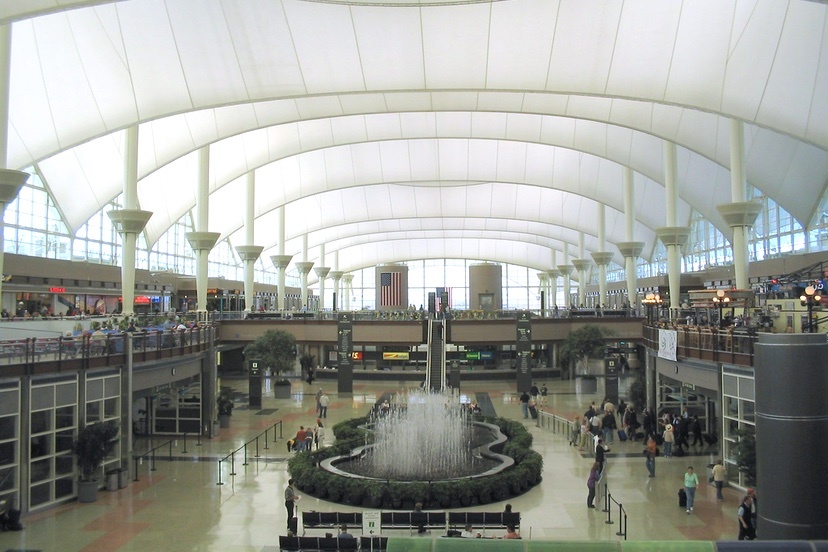
DIA’s existing 11 solar arrays can collectively produce 50 megawatts of electricity. .
DIA already self-generates electricity. The 11 solar arrays at the airport can together produce 50 megawatts of electricity. It also has the largest energy performance contract in Colorado, said Washington. And it is also taking measures to save water. “And, of course, we’re working with Xcel Energy to install some other things as well,” he said.
“We’re concerned that the supply of power and energy may not be available at the pace that we’re building now,” said Washington.
Respondents to DIA’s request for information will be asked to consider physical requirements of the generating capacity, the site requirements, the impacts, the operations, and the security. This RFI is to be posted by January, with a deadline of April, then an unspecified number of months for evaluation and then more community input.
“We will then determine what is the best path forward for the alternative energy options for this airport,” said Washington. “We’re not limited to any energy source.”
Washington has a way of speaking that is at once folksy and forceful. At the meeting, he commented on food compared to the burritos served at a previous community outreach meeting.
“They were okay, but they were like, gut busters,” he said. “This is the good stuff.”
It’s not hard to imagine him being in the military, and he was. Growing up on the South Side of Chicago, he was expelled from high school. That prompted him to join the U.S. Army, and there he did well at Camp Carson, near Colorado Springs.
In 2000, Washington joined metropolitan Denver’s RTD as assistant manager, becoming general manager in 2009. RTD then was building the FasTracks expansion of commuter rail. In 2015, Washington left to manage the Los Angeles Metropolitan Transportation Authority for six years before returning to Denver in 2021 to run DIA.
DIA certainly has a powerful economic wake. The airport credits itself as spawning $47 billion annually in economic activity. “We’re the largest economic hub west of the Mississippi right now,” said Washington.
Traffic at DIA is down, but Washington assured his listeners that it is temporary. “I haven’t seen too many Canadians come down lately, but they will be back. The numbers will rebound.”
That will include more international flights. DIA has added flights to Dublin, Rome, and Istanbul in the last few years, and Washington reported being “very close to a flight” to Africa.
In what Washington called the “near term,” DIA expects to have 50 new gates located within what he called “walkable complexes” as it looks toward accommodating 120 million passengers annually. “And all this will take power and electricity.”
Outside the terminal itself, DIA plans a consolidated rent-a-car facility with a capacity for between 15,000 and 17,000 spaces. Current capacity is 12,760. The complex will have more cars but also EV chargers and other new electrical needs that collectively will require 40 megawatts. Again, the comparison is to DIA’s existing overall use of 45 megawatts.
New transportation connecting the terminal with this facility will require electricity. The airport currently has 250,000 annual trips of buses shuttling passengers between rental cars and the terminal.
Changes to the often-congested Pena Boulevard are planned. A north entrance to DIA remains a possibility. Work is underway for a new $500 million baggage-handling system.
Currently 40,000 people work at DIA. In the expansions now planned, said Washington, the airport will have around 60,000 employees.
Again, why not Xcel?
But again, why is DIA now thinking it needs to provide self-generation? In the Q&A, Washington got a question that mentioned Coca-Cola.
A 570,000-square foot aluminum and plastic bottling plant near DIA had been planned since at least 2023. The company announced in August that it was going elsewhere in Colorado. In part, it said, it was doing so because Xcel Energy had failed to supply electricity to the site, according to City of Denver documents and a city council member cited by The Denver Post.
“Xcel Energy and Denver International Airport could not figure out a time-efficient manner to get Coca-Cola power to build out there, and then they all started pointing fingers at each other,” Stacie Gilmore, the council member, told the newspaper. Xcel pointed to lack of commitment by the bottling company.
Others have complained about the slowness of Xcel to deliver electricity. In February, the Post reported that real estate developer Brightland Homes sued Xcel, claiming that service and installation delays of Xcel in metropolitan Denver had caused the builder lost sales.
As for DIA, most of us use that name. Washington and others call it DEN, the airport code in international traffic. In that international lexicon, DIA had already been appropriated for an airport in Qatar before DIA debuted in 1995.
Allen Best publishes the e-journal Big Pivots, which chronicles the energy transition in Colorado and beyond.