
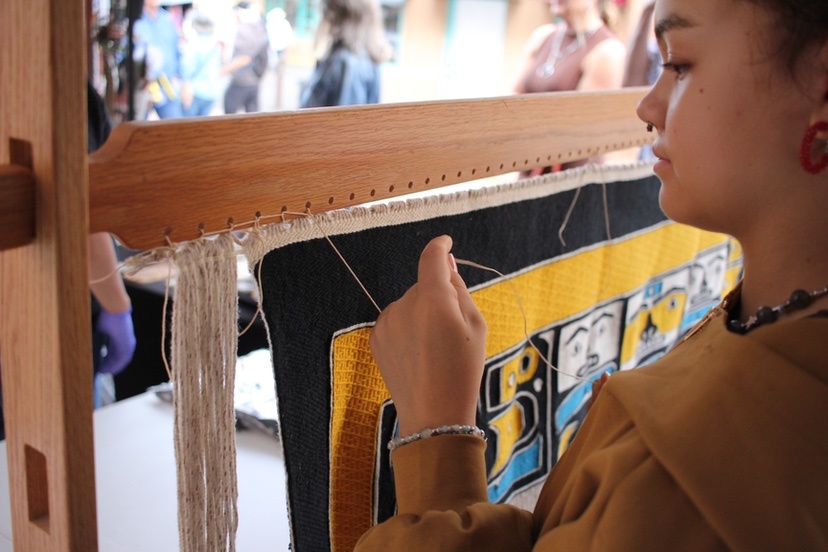
Photo: Amelie Haas attaches her aunt Lily’s Chilkat ceremonial robe to the loom, early Saturday morning, in preparation for the 2025 Santa Fe Indian Market, August 16 & 17.
As my granddaughter Amelie and I headed for the city of Santa Fe on Friday morning, driving south on Highway 84, we passed through a series of Pueblos… Ohkay Owingeh, Santa Clara Pueblo, Pueblo of Pojoaque, and last but not least, Tesuque Pueblo.
Which is to say, we drove past a number of casinos.
Leaving the Pojoaque pueblo, we began to see billboard advertising the Tesuque Casino, and each billboard shared the same thrilling message:
“All New Machines”
They weren’t advertising “Bigger Payouts” or “Better Food” or “More Non-Smoking Areas”. Just “All New Machines”.
Although I typically visit Santa Fe two or three times a year, I haven’t tried out the new machines at the Tesuque Casino. Nor did I ever try the old machines. I was raised by my parents to view gambling as a dangerously addictive activity that has — ultimately — a negative impact on your family’s bank account.
We didn’t stop in Tesuque to try the new machines. I can, however, imagine how entertaining the new machines might be, if we reflect on the advances in computer technology over the past 30 years. Also, I can imagine how addictive the new machines might be, considering that even our cell phones become more addictive with each passing week, even if we’re simply checking a social media account and there’s no chance to win any money.
Machines in general — and digital machine in particular — are projected to play a larger and larger role in our daily lives, as they become more “intelligent” and more “agile”.
And as they become more “entertaining”?
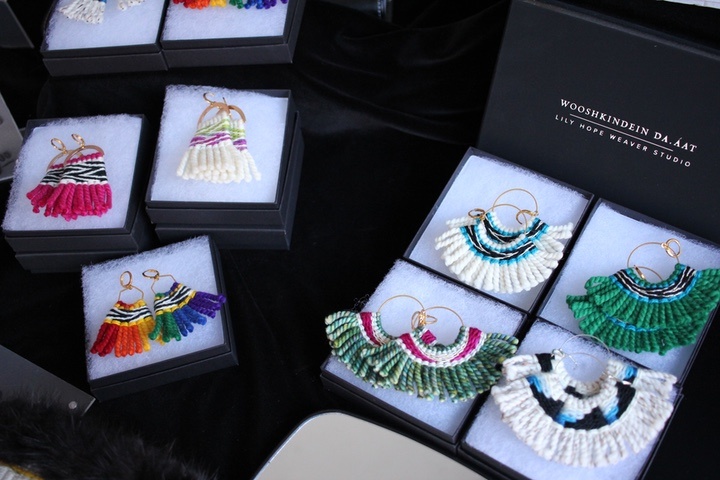
My daughter, Lily Hope, had booked a booth at the Santa Fe Indian Market this past Saturday and Sunday and had invited Amelie to help her deal with the mostly-well-heeled customers expected at the market.
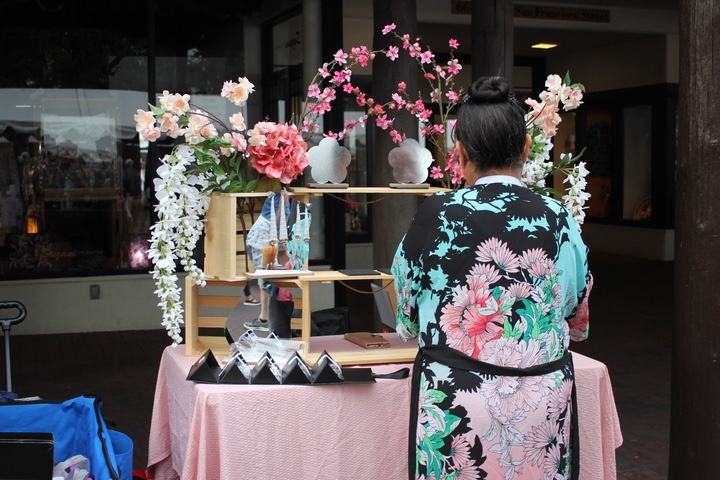
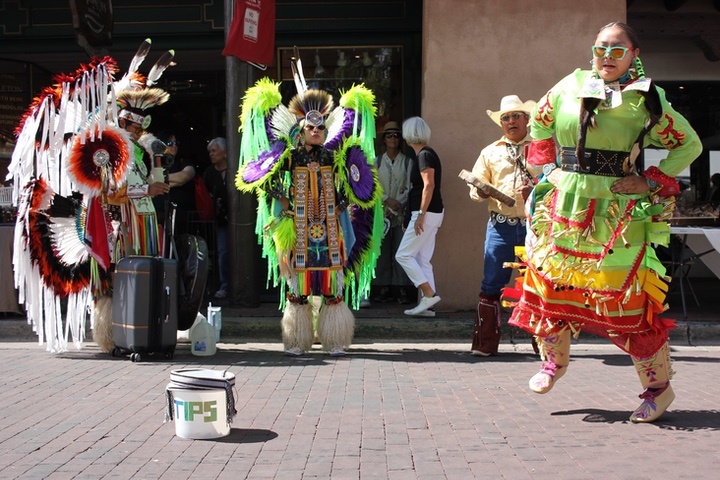
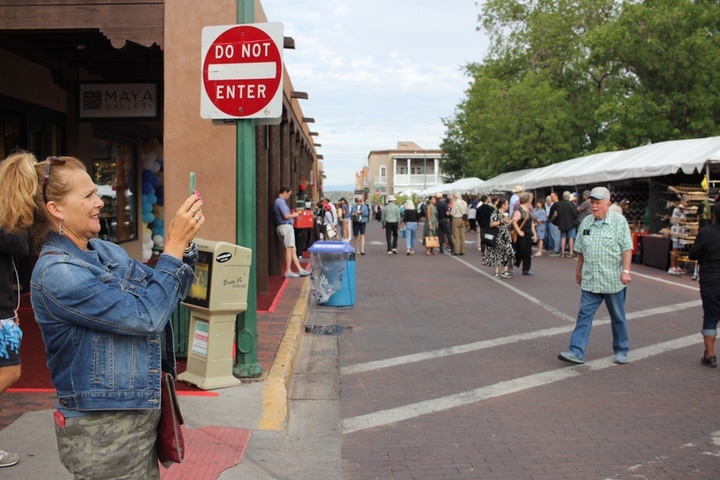
Reportedly, the market was expecting 100,000 visitors to show up over the weekend, to gaze upon and possibly purchase various types of authentic Native American art — mostly jewelry, but also paintings, weaving, fashions, sculpture, baskets, and miscellaneous other objects of art — created by about 1,000 Indian artists.
Some people these days prefer a different term, rather than “Indian”. Some prefer “Indigenous” or “Native American”, But the name of the event is Santa Fe “Indian” Market.
Lily’s mother Clarissa, who passed away in 2016, belonged to the Tlingit Indian tribe of southeast Alaska, thus providing Lily the appropriate tribal heritage for participating in an authentic Indian Market.
Whatever non-Native heritage I have contributed to Lily’s personal qualities could be quietly ignored. Only Native heritage counts at Indian Market.
The Santa Fe market is reportedly the largest and most prestigious Indigenous art market in the world, and is presented by the Southwestern Association for Indian Arts (SWAIA). Now in its 103rd year, the annual August market brings together artists representing more than 200 Tribal Nations from across the U.S. and Canada.
It’s free and open to the public.
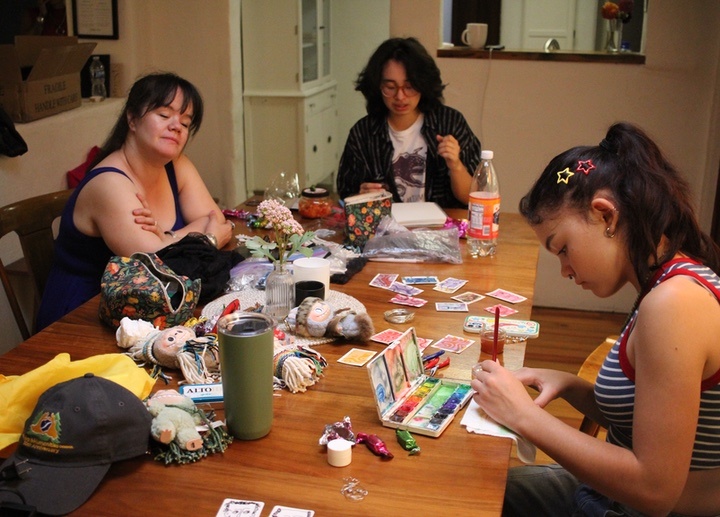
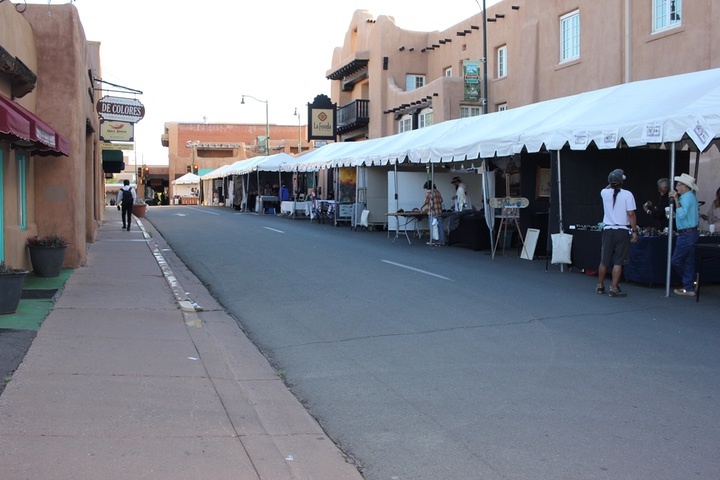
The attraction for 100,000 market visitors is not merely that each art piece is made by a person with an authentic Indian heritage, but also that the art pieces are made mainly by human hands. Not by machines.
Of course, some of the art materials are manufactured by industrial processes. Hardly any modern artists make their own paints from finely-ground minerals, or weave their own canvas, or smelt their own silver or bronze metal. But in some cases, the materials are harvested directly by the artist’s family. Some of the traditional rug weavers, for example, still raise sheep, spin their own wool, and use plant-based dyes harvested locally.
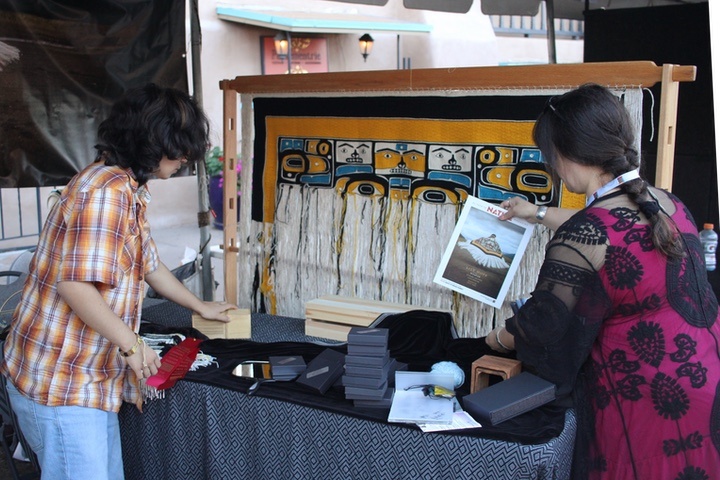
Lily is known mainly as a weaver of Chilkat and Ravenstail robes, highly valued ‘blankets’ worn in ceremonies in southeast Alaska and along the west coast of Canada… and also displayed, less ceremonially, in museums as examples of Indian artwork. At Lily’s booth, she displayed one such ceremonial robe — in progress — that she’s weaving for the de Young Museum in San Francisco. You can see that robe hanging from the loom in this next photo.
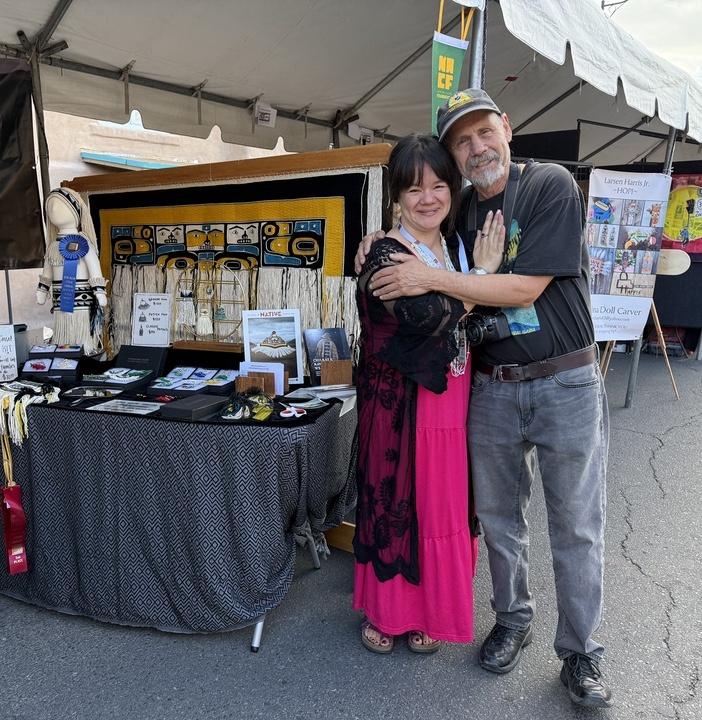
On Friday evening, SWAIA hosts a juried exhibit of selected participants’ art, where ribbons and cash awards are given. Lily had submitted three pieces for the exhibit and had won three ribbons in her category.
The Indian Market is something of a gamble for the artists, paying for a booth in a competitive show featuring 1,000 other artists… and hoping to sell enough art to make the weekend worthwhile. For some artists, this show provides a year’s worth of income; for other artists, they will be lucky to pay for their booth fee.
This is the second year that Lily and her son Nicholas have traveled down from Alaska to participate in the annual market, and each year is something of a learning experience, naturally. In Lily’s case, she discovered that she had not brought enough ‘higher-end’ work — pieces in the $3,000-and-up price range that could satisfy art collectors.
Will she return next year for another round?
Only time will tell.