
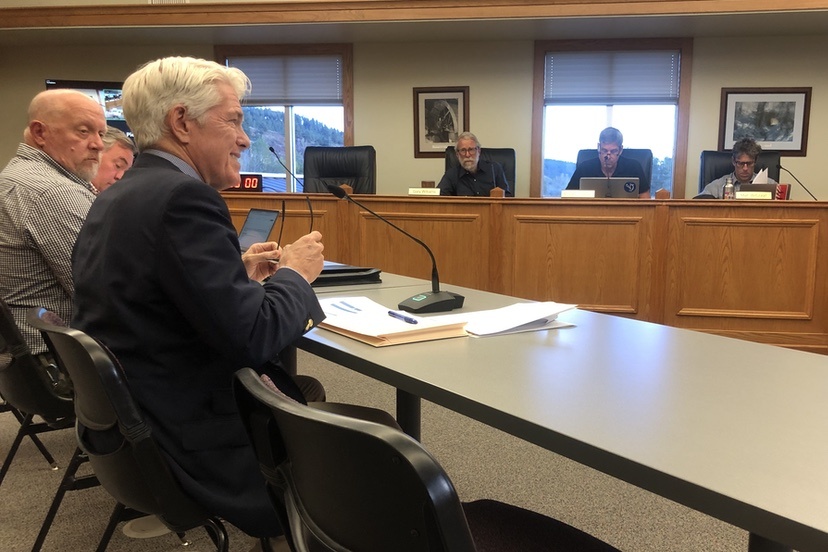
Photo: Financial consultant Joey McLiney presents a possible funding plan to the Pagosa Springs Town Council acting as the Board of the Pagosa Springs Sanitation General Improvement District. October 2024.
As mentioned in Part One, the Pagosa Springs Town Council on Tuesday evening discussed at some length, and then voted unanimously to approve the first reading of Ordinance 1014.
The ordinance will place a proposed sales tax measure on the November 4 ballot, if the Council approves the second reading later this month.
You can download the ordinance here.
According to the Town charter, ordinances must be published following a ‘first reading’ to allow two weeks for the citizens of the town a chance to read and understand the ordinance, prior to the ‘second reading’ vote. The Council also has an opportunity to make changes to the ordinance during that two-week period.
The ordinance specifies the following ballot title, written in ALL CAPS as required by state law:
SHALL TOWN OF PAGOSA SPRINGS TAXES BE INCREASED $3,675,692 IN THE FIRST FULL FISCAL YEAR AND BY SUCH ADDITIONAL AMOUNTS AS ARE GENERATED ANNUALLY THEREAFTER FROM THE IMPOSITION OF A SALES TAX OF 1.00% AS SET FORTH IN ORDINANCE NO. 1014, (SERIES 2025); SUCH TAX INCREASE TO BEGIN ON JANUARY 1, 2026, TO:
• CONSTRUCT, RECONSTRUCT, IMPROVE, REPAIR, BETTER, EXTEND, OPERATE AND MAINTAIN SEWERAGE AND WASTEWATER REUSE FACILITIES TO SERVE THE TOWN, INCLUDING FACILITIES OF THE PAGOSA SPRINGS SANITATION GENERAL IMPROVEMENT DISTRICT, AND
• FUND SUCH PURPOSES, SUBJECT TO ANNUAL APPROPRIATION BY THE TOWN, BY PLEDGING THE REVENUES FROM SUCH SALES TAX FOR PAYMENT OF CONTRACTS, LEASES, LEASE-PURCHASE AGREEMENTS, AND BONDS, WHETHER ISSUED BY THE TOWN OR THE DISTRICT
AND SHALL THE TOWN BE AUTHORIZED TO COLLECT, RETAIN AND SPEND THE PROCEEDS FROM SUCH TAX AND ANY INVESTMENT INCOME EARNED FROM SUCH PROCEEDS AS A VOTER-APPROVED REVENUE CHANGE UNDER SECTION 20 OF ARTICLE X OF THE COLORADO CONSTITUTION?
YES: _____
NO: _____
There are some interesting details in this relatively short ballot title, and we can look at them in a moment.
At first, it wasn’t clear that the Council had enough votes to pass the ordinance on Tuesday, when two of the Council members — Brooks Lindner and Mat deGraaf — suggested that a November election date might not allow sufficient time to properly stage a successful campaign.
Two members of the audience — both town voters — made the same argument, and urged the Council to delay the election in April 2026. The November election mail ballots will be sent out in mid-October, meaning that supporters of a proposed sales tax would have about 9 weeks to successfully sell the tax increase to the town voters.
The Town government is legally forbidden from spending tax revenues to support or oppose ballot measures.
Council member Brooks Lindner wondered why the planning committee had chosen to pursue a vote in November 2025 rather than in April 2026, and he did not — in my humble opinion — get a clear answer on that question.
It’s common knowledge that, when multiple tax increases appear on the same ballot, placed there by multiple government agencies, it’s typical that all of the requests will fail. So when a local government plans a tax measure, they like to know that no other proposed tax increase will be on the same ballot.
It sounds like no other government is planning on putting a tax issue on this November’s ballot, and also that no government is planning on proposing anything in April. So I wasn’t clear, myself, why the Council would want to try for November, with such a short runway. Tax increase campaigns are more typically scheduled to last six months or more. Any campaign on this tax issue would have about 9 weeks from final ordinance approval until the ballots are mailed.
Council member Leonard Martinez argued vigorously for a November election, and also suggested that he might be willing to step down from serving on the Council, in order to head up the election campaign. He said he has asked for legal advice from the Town Attorney Bob Cole on that question. Can a sitting Town Council member head up a tax increase campaign aimed at benefiting the Town ?
“The reason I asked the question in that way is, that’s how important I think this question is. I don’t want there to be any kind of misunderstandings or confusion or anything that derails this, given the guidance that we have from staff and Town Council, and when we can participate.”
“I have my own opinion, and we’re all permitted to have our own opinion, but I’m willing to go farther if that’s what’s needed, because that’s how important I think this is.”
The estimated Town revenues that could be generated by the sales tax, if approved, would be limited to “$3,675,692” for the first year. Typically, tax increase ballot titles overestimates the expected first-year collections.
Sales tax collections have been increasing year over year in Archuleta County, so we might expect this new sales tax to generate in excess of $37 million during the first ten years. The projected cost of the repairs and upgrades to the Pagosa Springs Sanitation General Improvement District (PSSGID), as stated in recent advertising by the Town, is in the neighborhood of $80-100 million.
A couple of other details from the ballot title.
The tax would be collected by the Town of Pagosa Springs — not by the Sanitation District — but would be transferred to the Sanitation District for repairs and upgrades…
…to include “wastewater reuse facilities”.
“…OPERATE AND MAINTAIN SEWERAGE AND WASTEWATER REUSE FACILITIES TO SERVE THE TOWN…”
I can’t say, this morning, that I understand what “wastewater reuse facilities” are. Does this indicate plans, by the Town, to begin “recycling” wastewater effluent for local community uses? I’ve reached out to the Town staff asking for clarification of that term, and I may know more by the time I write Part Three of this editorial series.
Then we have this language in the proposed ballot title:
“…AND SHALL THE TOWN BE AUTHORIZED TO COLLECT, RETAIN AND SPEND THE PROCEEDS FROM SUCH TAX AND ANY INVESTMENT INCOME EARNED FROM SUCH PROCEEDS AS A VOTER-APPROVED REVENUE CHANGE UNDER SECTION 20 OF ARTICLE X OF THE COLORADO CONSTITUTION?”
According to the Colorado Constitution — specifically, Section 20 of Article X, also known as the TABOR Amendment — governments in Colorado are theoretically limited in the amount they can grow their tax revenues, year over year. The stated purpose of the TABOR Amendment, approved by the voters in 1992, was to restrain government growth to keep it consistent with overall economic growth in the state. The above paragraph, if approved by the voters, would allow the Town government to retain all of the revenue it collects from the sales tax, with no TABOR-induced limitations.
In general, the TABOR Amendment has failed to restrain government growth the way its authors intended, due in part to ballot language similar to what the Town plans to include in their sales tax measure.
On Tuesday, the ‘first reading’ of Ordinance 1014 was approved unanimously by the Council. It still needs to have a second reading, and that’s reportedly scheduled for Tuesday, August 19.