
Colorado’s wildfire risk has continued to increase over the years and more communities are at risk of wildfires…
— from Colorado legislation SB23-166, signed into law in May 2023.
Archuleta County Development Director Pam Flowers brought a batch of Power Point slides to the Board of County Commissioners’ work session on June 17 to illustrate a discussion about a 2023 law called SB23-166, also known as:
Establishment Of A Wildfire Resiliency Code Board
It might appear on first glance, that this law will make home construction more expensive, precisely at a time when most working families are already struggling to afford a new home.
That’s one possible outcome.
Another possible outcome is that people will once again begin building their homes out of clay soil, also known as adobe. Back in the day, adobe was a preferred building material throughout much of the American Southwest, for many reasons, including fire-resistance and also adobe’s tendency to naturally moderate the temperatures within the home.
But the particular advantages of adobe didn’t figure in the June 17 discussion about the new wildfire resiliency law. The discussion did, however, touch on numerous other details of the law.
The act established a Wildfire Resiliency Code Board within the Colorado Department of Public Safety “for the purposes of ensuring community safety from and more resiliency to wildfires by reducing the risk of wildfires to people and property through the adoption of statewide codes and standards.”
This new Board consists of 21 appointed voting members with specific government or industry qualifications and 3 non-voting members. The Board was required to promulgate rules, by July 1, 2025, concerning the adoption of codes and standards “for the hardening of structures and reducing fire risk in the defensible space surrounding structures” within the WUI (Wildland-Urban Interface) in Colorado.
The WUI is defined as:
That geographical area where structures and other human development meets or intermingles with wildland or vegetative fuels.
I would guess this means, “not downtown Denver but most of the rest of the state”.
According to County Development Director Flowers, the new rules require the Archuleta County government to adopt additional building codes — either, adopt the code written by the Wildfire Resiliency Code Board (WRCB), or else a similar code that “meets or exceeds the minimum standards of the codes adopted by the board within 3 months of the date the board adopts its codes.”
The Board appears to have adopted its code on June 1, 2025. You can download it here (43 pages).
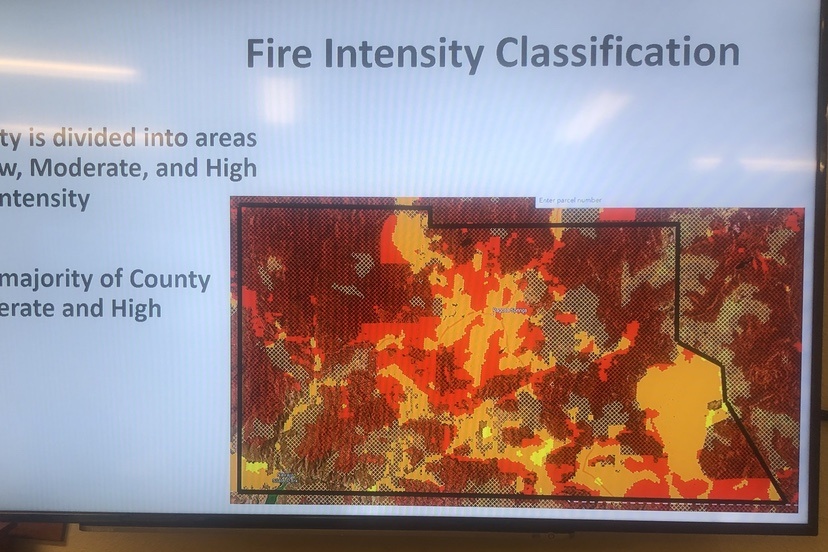
During her presentation, Ms. Flowers shared a PowerPoint slide show that included a map of “High, Medium, and Low” Fire Intensity zones, as defined on the state WRCB website. It’s shown at the top of this article.
“Red” indicates “High/Private property”… “Orange” indicates “Medium/private property”. The “Brownish” zones are “High/National Forest” and the “Greenish” is “Medium/National Forest”. Roughly speaking.
As we can see, the entire county is pretty much ready to ignite.
From the WRCB code:
Structures and parcels identified with moderate to high fire intensity classifications shall be constructed and maintained in accordance with the provisions for Class 2 structure hardening and site and area requirements.
Reportedly, the map is in “draft” form, and as I understood the presentation, the BOCC could modify the map with new information, if anyone has the time and inclination.
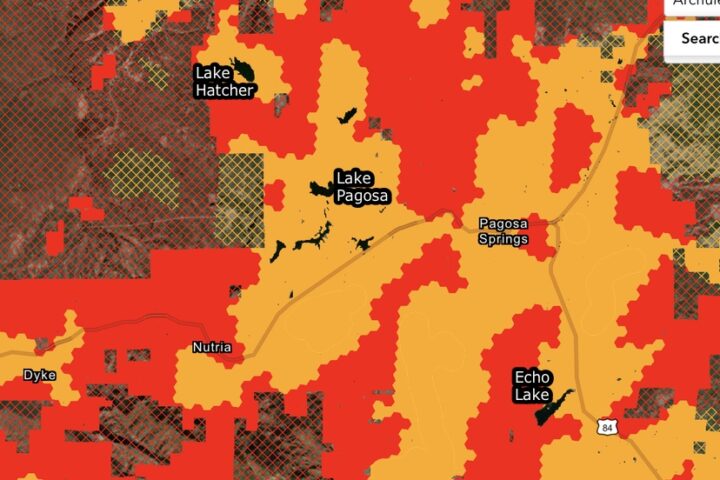
As it stands now, the entire populated core of Archuleta County is in High and Medium Fire Intensity zones. Here’s a closeup of our urban and suburban core:
Here are the steps Archuleta County is required to take:
- Define the wildland-urban interface and identify areas within it;
- Adopt minimum codes and standards based on best practices to reduce the risk to life and property from the effects of wildfires;
- Identify hazards and types of buildings, entities, and defensible space around structures to which the codes apply.
Then, the code needs to be enforced, on private property. (Not in the National Forest, I assume. Nor on Tribal Land.)
Archuleta County is not known for its ability to enforce its existing Land Use Regulations on a consistent basis. We can probably guess that this new set of codes will simply add to the difficulties.
Enforcement protocols need to be in place within three months of the County adopting its new code.
Ms. Flowers explained that the new building codes would apply mainly to new construction, although major remodeling projects might also face code enforcement.
Back in 2023, the Colorado Municipal League (CML), which lobbies the legislature on behalf of numerous Colorado communities, opposed the passage of SB23-166, arguing that the General Assembly — dominated by legislators from big urban areas — does not typically understand the challenges faced by rural towns, and that land use decisions and code adoption is properly the role of local communities, especially when those residents have limited financial resources.
From the CML position paper in 2023:
The layering of state mandated building codes will increase the costs of housing in areas that are already experiencing a housing crisis.
Local control over building and land use codes is necessary and appropriate for local governments to properly respond to the unique needs of their own communities.
State mandated codes and enforcement do not take into account the resources available to different communities.
The legislature is delegating broad and vague authority to an unelected board that local communities will have minimal input on.
But the law was passed and signed by the Governor in May 2023. Archuleta County now has three months to adopt the WRCB building code, or write a similar but equally strict code, and must begin enforcing that code on January 1, 2026.
Home builders have six months to get their homes built before the new (and more expensive?) rules go into effect.
I’m not clear, yet, if SB23-166 applies within the Town of Pagosa Springs? The Town is a ‘Home Rule’ municipality and, as such, is free to make local decisions that may differ from those imposed by the State on statutory counties like Archuleta County.
Bill Hudson began sharing his opinions in the Pagosa Daily Post in 2004 and can't seem to break the habit. He claims that, in Pagosa Springs, opinions are like pickup trucks: everybody has one.