
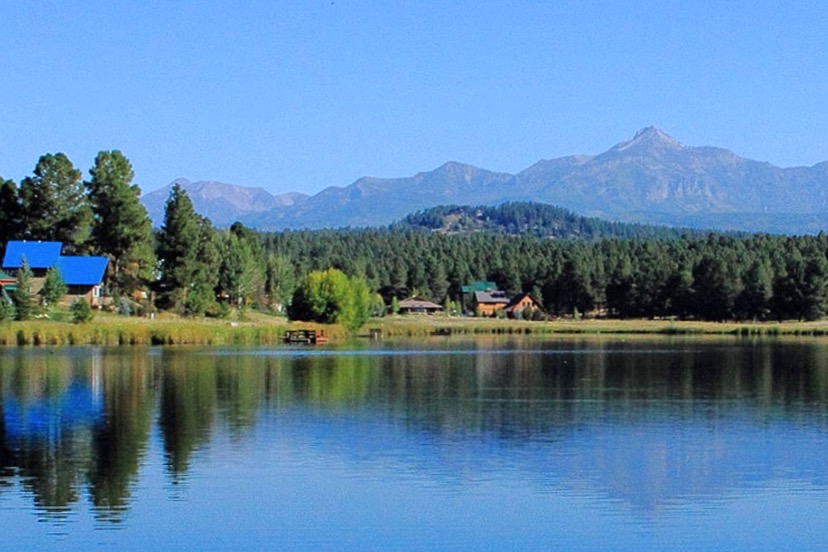
At its July 25 meeting, the Pagosa Area Water and Sanitation District (PAWSD) Board of Directors discussed issues and high costs relating to outlying areas of the district’s water system…
— from a Pagosa Springs SUN article by reporter Josh Pike.
When I arrived in Pagosa Springs in 1993, I was part of a population growth spurt the likes of which had never been seen in Pagosa history. During the decade between 1980 and 1990, Archuleta County’s population had grown by 46%…
…And then, between 1990 and 2000, the population increased by another 85%… within ten years, nearly doubling the number of local vehicle trips on our maintenance-challenged county road system, and also nearly doubling the amount of treated water needed to wash our clothes, water our lawns, and flush our toilets.
The population growth slacked off after 2000, and between 2010 and 2020 had settled down to a more modest growth rate. About 1% per year.
Certain elected and appointed officials and business leaders would like to see population growth happening at the higher 7% rate we saw around the turn of the millennium. The rest of us… maybe we prefer the 1% rate?
I’ve heard a number of people, lately, make the claim that Archuleta County is once again seeing explosive growth, but if we are to gauge current growth by the annual number of water and sewer connections, we’re not even close to 1990-2000 levels.
Disclosure: I currently serve as a volunteer member of the Pagosa Area Water and Sanitation District (PAWSD) board of directors, but this editorial reflects my own personal opinions, and not necessarily the opinions of other PAWSD board members or PAWSD staff.
Beginning in about 2000, our local leadership realized that unchecked population growth had certain negative effects, and they began developing policies to ensure that “growth paid for growth” in terms of infrastructure maintenance and expansion. It appeared, back then, that we were going to keep growing at 7% per year, so our leaders embraced the idea that newcomers should be asked to contribute financially, according to their impacts, to mitigate the negative repercussions in what was formerly a quiet, rural, agricultural community.
Some of those same elected and appointed officials and business leaders might believe they were partly responsible for the “wonderful growth” between 1980 and 2010 — and might feel that their decisions and policies made a big difference. I don’t buy that idea, myself.
In my humble opinion, Pagosa’s growth just prior to ,and just after, the turn of the millennium had to do with beautiful scenery, clean air — plus a national trend of people trying to escape from crime-ridden cities.
Oh… and also, reasonably-priced homes and vacant land in our county.
Those days are behind us, as regards crime-ridden cities… and especially, as regards reasonably-priced housing. Archuleta County has become the most expensive place to live in southwest Colorado, according to Region 9 Economic Development District. More expensive than nearby Durango.
So, getting back to the idea of “growth paying for growth”. During last month’s PAWSD board meeting, we heard from District manager Justin Ramsey about a certain unpleasant situation.
Back in the days when endless growth was perceived as a positive good with no downside, PAWSD was happily including new subdivisions as they were developed, without thinking too much about the long-term implications. One of the outlying subdivisions included into the system was Elk Park. The subdivision includes maybe 50 lots, with what Mr. Ramsey estimated at a “5 or 10 percent occupancy rate.” That is, lots of expensive water infrastructure getting very little use. And thus, generating very little income to the district.
But the situation is even more unplesant, because, due to the distance of Elk Park from the water treatment plant, and due to the lack of water circulation, the district is dumping “maybe 2.5 million gallons of water on the ground” each month to maintain the required chlorine levels.
“We’re not even collecting enough from them to pay for our losses of the water we’re wasting,” Ramsey said. “It’s a subdivision that we never should have taken on. It’s costing us a fortune.”
He added that there are some homes being built in the area, for which PAWSD will have to build larger storage tanks in order to provide the required pressure.
“We’re going to spend several million dollars out there, in a subdivision where we’re already losing money in, and what’s really sad — and I’m not much of a bleeding heart — but when you really think about it, we have single-wide trailers here in Vista that are supplementing these million-dollar homes out there, and their water system…”
“We need to come up with a plan.”
Elk Park may be a problem, but other outlying subdivisions such as Eagle Peak, Mill Creek, and Log Park are also expensive for PAWSD to serve, and which are not “paying their own way” in Mr. Ramsey’s opinion. “When we talk about fair and equitable … I think we need to do something with that.”
Regular Daily Post readers are aware that we often discuss ideas like “fair and equitable” in these pages. And it hardly seems “fair and equitable” if families living in single-wide trailers are subsidizing million-dollar homes in Elk Park.
Mr. Ramsey mentioned two possible approaches to the higher cost of serving outlying areas.
Make these outlying subdivisions into their own separate PAWSD service areas, subject to alternate fee schedules…
…or eject them from the district.
Ouch.
PAWSD Programs Manager Renee Lewis suggested that PAWSD could make Elk Park a “bulk customer,” whereby the subdivision would buy water from PAWSD, but would be responsible for distributing it to homes in the subdivision — and for maintaining the water infrastructure within the subdivision.
The board discussed potential approaches to addressing these areas, and PAWSD board member Gene Tautges noted that these outlying areas were included into the PAWSD system during a period of “damn the details, just growth, growth, growth.”
Ramsey explained that a potential solution to some of the issues at Elk Park would be to locate a fill station in Aspen Springs, farther out Highway 160, which would likely send enough water through the Elk Park system to keep the chlorine levels legal. That solution has its own financial and political challenges.
I understand why PAWSD originally included these more “expensive” outlying subdivisions — “expensive” in terms of their property prices and also “expensive” in terms of PAWSD operations. As Mr. Tauges noted, growth was once the name of the game. (And still is, for some people.)
What I don’t fully understand — as a fairly new PAWSD board member — is the extent of our legal obligation to continue serving outlying subdivisions according to traditional arrangements.
The only thing constant is change. To what degree can PAWSD change its historical operations in the county’s outlying areas… in the service of overall fairness… without landing in a lawsuit?