
This story by Jordan Rau appeared on KFF Health News on July 20, 2026. We are sharing it in two parts.
Sam Ato Timaloa, a paroled sex offender who also served time for attempted murder, had dementia and an acute intolerance of noise — especially from roommates at Sunrise Post Acute, a nursing home in Banning, California. Over four months in 2025, a state investigative report found, Sunrise switched Timaloa’s room eight times, the last into one occupied by Attilio Cecchetto, 92, a retired tile installer whose dementia led him to frequently moan, mumble, and yell.
Overnight, a nurse aide walked into their room and saw blood splattered on the floor, walls, and ceiling, according to a grand jury transcript. Cecchetto’s face “looked twisted and smashed,” the aide testified. A Banning city police officer testified that Timaloa, 77, told him that he had punched Cecchetto twice.
“He just kept saying that Attilio was being too loud: ‘He talks too much,’” the officer said.
Cecchetto died two days later from blunt force facial trauma.
“You get placed in a facility like this to be taken care of, not to be murdered,” one of his sons, Gino Cecchetto, said in an interview. “This was completely preventable at many different points.”
Timaloa pleaded not guilty to assault. The charges were later upgraded to murder, and a judge ordered a mental health evaluation. The judge will rule as early as August on whether Timaloa is competent to stand trial.
PACS Group, the nursing home chain that owns Sunrise, denied negligence. “We strive to provide quality care to everyone we serve, and our hearts continue to go out to the Cecchetto family for their loss,” PACS spokesman Brooks Stevenson said in an email.
In nursing homes primarily occupied by impoverished people as well as posh assisted living facilities that cost upward of $10,000 a month, agitated residents have shoved, punched, bit, and kicked others. They have wielded canes, walkers, pens, a plate, a mop stick, a shoe, a belt buckle, and even the footrests of wheelchairs as weapons, federal inspection reports show.
How often these altercations take place nationwide is unknown, but an in-depth study of 14 assisted living facilities in New York state led by Cornell University researchers estimated 1 in 7 residents experienced aggression within a month, including verbal, physical, or sexual acts. Their separate study of 10 New York state nursing homes estimated 1 in 5 residents experienced an altercation in a month. Researchers have found that these assailants are disproportionately likely to have dementia.
The diseases that cause dementia can impair brain circuits involved in impulse control and threat perception, raising the risk of aggressive behavior. Residents with Alzheimer’s disease and other dementias constitute more than 900,000 of the 2.2 million people living in these settings, many of which include specialized memory care units.
Often, altercations involving a resident with dementia erupt after danger signals are missed or ineffectively addressed, according to a KFF Health News examination of court records, police reports, and state and federal inspection reports.
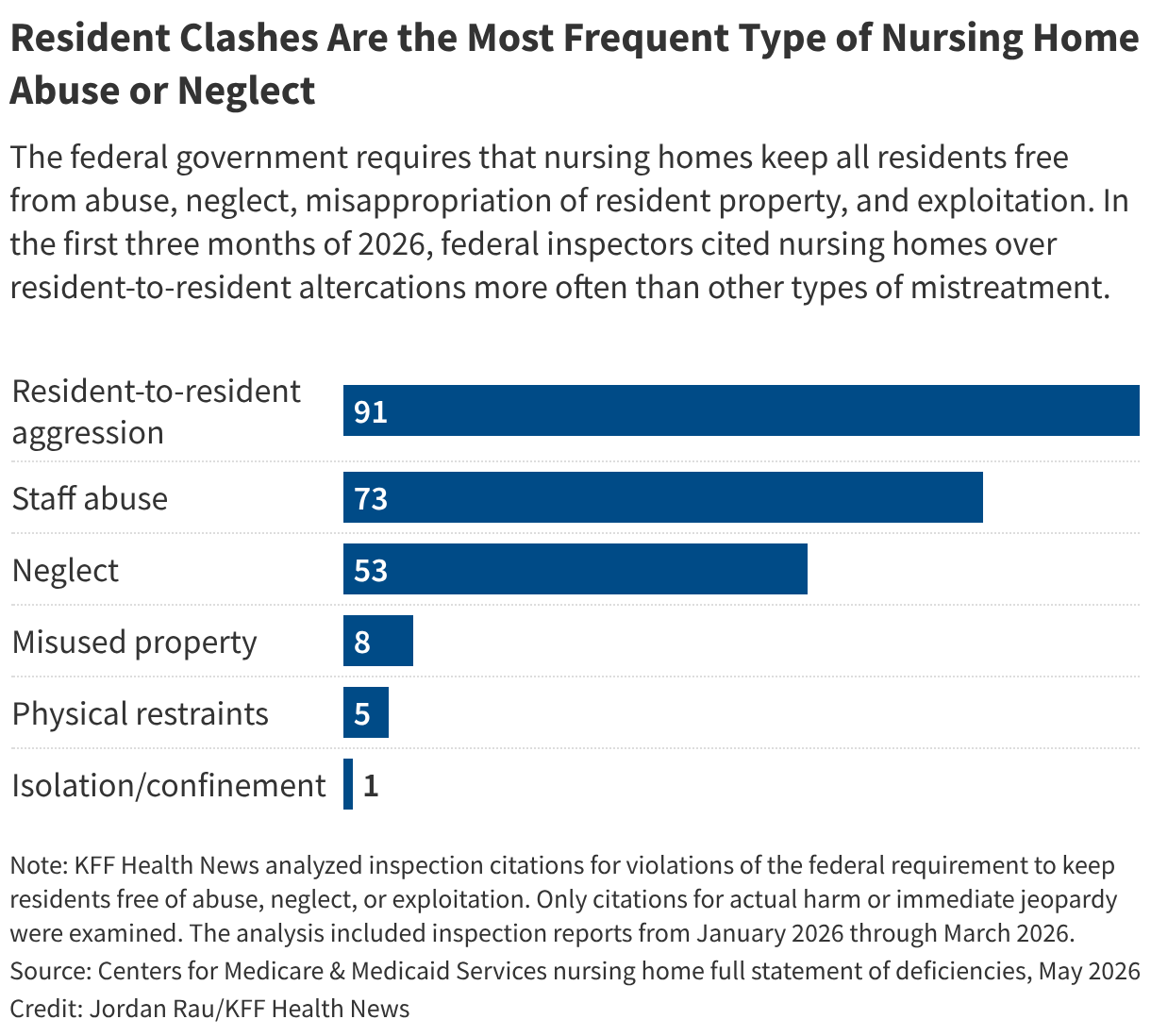
Since the start of 2024, the federal Centers for Medicare & Medicaid Services has faulted nursing homes at least 700 times for failing to protect residents from physical, sexual, or verbal abuse by other residents, CMS inspection reports show. The federal records do not include assisted living facilities, which are regulated by states.
In the first three months of this year, CMS cited nursing homes more often for resident-to-resident abuse than for any other type of abuse, neglect, or exploitation, including abuse by employees, the reports show.
The long-term care industry says not every clash can be averted. Presbyterian Homes & Services, a nonprofit Christian chain of senior living facilities, said in a statement: “Caring for individuals living with advanced dementia is complex, and behaviors can change in ways that are difficult to fully predict or prevent, even with clinical interventions in place.”
Eilon Caspi, a dementia consultant and researcher who studies resident-on-resident altercations, said that usually there is a specific unmet need that precedes an altercation. “In the vast majority of incidents,” he said, “there are warning signs in the months, weeks, days, hours, and sometimes minutes and seconds prior.”
Fertile Battlegrounds
One psychological theory about Alzheimer’s, the most common dementia disease, holds that as the brain’s networks deteriorate, the balance shifts between the prefrontal cortex, which helps govern judgment and self-control, and limbic regions including the amygdala, which helps process fear and threat responses.
As cognition clouds, people lose the ability to understand what is happening around them and to put distress into words, researchers say. Pain, infection, medication side effects, and other physical and emotional distresses may be expressed through shouting, intimidating gestures, kicking, pushing, or punching. Long-term care facilities can be triggering environments, with intimate care often delivered by a changing stream of aides whom residents can’t recognize. Amid noise, close quarters, and rigid routines, interactions become flash points.
“You don’t feel safe, because you don’t know these strangers who are coming in and taking off your clothes,” said Al Power, a geriatrician and an advocate for alternative models of care for people with cognitive issues. “These things will be distressing to anybody.”
The Cornell researchers found verbal altercations were the most common type of aggressive interaction but estimated 4% of assisted living residents and 5% of nursing home residents in their studies experienced physical assaults in a month.
Another Cornell study found that Connecticut police were called to nursing homes for resident-to-resident clashes more often than allegations of staff abuse, theft, and residents wandering away without supervision combined. A national analysis of survey data from the Centers for Disease Control and Prevention calculated nearly 8% of residents in assisted living facilities engaged in physical aggression or abuse toward other residents or staff members.
Many of the physical aggressions KFF Health News identified in CMS inspection reports were perpetrated by residents with diagnoses of dementia, schizophrenia, or other cognitive disorders. In some physical altercations, both residents were aggressors, while other fights were one-sided. Sometimes the residents were roommates.
Laura Mosqueda, a geriatrician at the University of Southern California’s Keck Medicine in Los Angeles and a senior adviser to the National Center on Elder Abuse, said: “What worries me is that we just end up blaming two people who have either cognitive impairment or severe, uncontrolled mental health issues, when they’re supposed to be in an environment where people are safe.”
‘Only a Matter of Time’
Gladys Lynch, a retired department store accountant, transferred into the memory care unit at Harbor Crossing in White Bear Lake, Minnesota, in September 2025. Her monthly cost was more than $10,000, according to an invoice provided by the family.
One of Lynch’s daughters, Rebecca Norton, installed web cameras in her room and often saw another resident inside. “Every day I looked at it, this woman would be walking into my mom’s room, harassing her, digging through her things, using her bathroom, yelling at her,” Norton said in an interview. She informed Harbor Crossing’s administration, and the facility said it would start locking her mother’s door.
Norton emailed a Harbor Crossing administrator a list of issues with her mother’s care. “My biggest concern,” she wrote, was that her mother’s door was not consistently locked and the webcam showed the woman had again entered, rummaged through the bathroom, and taken a couple of adult diapers.
Unknown to Norton, Harbor aides had raised concerns about the other resident, who like Lynch was new to Harbor Crossing’s memory unit, according to a Minnesota Department of Health report. Diagnosed with Alzheimer’s, severe dementia with agitation, depression, and anxiety, the woman was confused, had difficulty communicating her needs, and hit aides.
Aides repeatedly reported that the woman had “ongoing aggression, entered other residents’ apartments, invaded others’ personal space, and was difficult to redirect,” the health report said. They said medications had been ineffective and pressed for new ones. The report said one nurse told the woman’s doctor it was “only a matter of time before” she “hurts another resident.”
Captured on Camera
On the last day of September, she entered Lynch’s room and resisted leaving, the state report said. The next morning, she reappeared. Video of the incident was described in the police and state reports and reviewed by KFF Health News. It shows Lynch guided the woman out and appeared to attempt to lock the door, but the woman opened it and returned once more.
The woman declared it was her house, went into Lynch’s bathroom, used the toilet, and then returned to the room Lynch was in. Lynch can be seen repeatedly pressing the alert pendant around her neck to signal nurses for help.
The video shows the woman was almost out of her apartment door when she attempted to touch an object near the door. Lynch put her hands up to block her. The woman slapped at her hands and said, “I’m going to kill you if you don’t quit it.” She pushed Lynch, who fell, her head hitting the floor and blood seeping out.
Aides arrived 13 minutes after she had initially pressed her pendant, the state report said. Lynch suffered a brain hemorrhage and fractures to her eye socket and ribs, according to the state report. She died in the hospital five days later at age 96; the medical examiner’s office declared it a homicide.
Norton said her mother was kind and pleasant and never combative. “My mom deserved better than what they gave her,” she said.
Prosecutors declined to bring charges, according to the police report. The state investigation concluded Harbor Crossing was responsible for neglect because it was aware the woman “exhibited violent and aggressive behaviors” and yet had failed to put in place effective interventions. Harbor Crossing has requested the state reconsider its findings.
In June, Suzanne Scheller, the attorney for Lynch’s family, filed a wrongful death lawsuit against Presbyterian Homes, which owns Harbor Crossing.
Presbyterian said in a statement: “We are deeply saddened by the loss of Ms. Lynch, and our thoughts remain with her family and all those impacted.” It declined to comment further on the incident or the lawsuit.
KFF Health News is a national newsroom that produces in-depth journalism about health issues and is one of the core operating programs at KFF — an independent source of health policy research, polling, and journalism. Subscribe to KFF Health News' free Morning Briefing.