

The challenges Colorado faces with respect to the high expense and limited availability of child care are well established. We can expect child care to be at least somewhat expensive because it requires labor-intensive services provided specifically for the age of the child. Additionally, the economics of operating child care centers are challenging.
A new report by the Common Sense Institute looks at possible rules or regulatory changes that could be made in Colorado to improve availability and affordability without compromising safety. The recommendations covered in this report fall into three categories:
1. Reducing child care operating costs by addressing labor expenses
2. Increasing child care availability by making it easier to open and operate child care centers
3. Expanding home-based and small center options by overcoming local hindrances
“Child care providers operate under challenging economics and regulatory burdens,” said Tamra Ryan, the study’s author and CSI Coors Economic Mobility Fellow. “It’s possible to simplify rules and regulations while keeping health and safety of our children at the forefront. Colorado can find a smarter way.”
Most of the recommendations provided have precedents in other states. Those states’ child care costs are shared for comparison; however, it is important to note there are many factors driving cost and availability of child care and no single change will entirely solve the challenges we currently face.
The cost of real estate, facility investments to meet regulatory requirements, and staffing all contribute to high, unavoidable costs that must be shouldered by families for the much-needed centers to stay afloat.
Between 2017 and 2024, the cost of center-based infant care increased 40 percent, a rate greater than the rate of inflation.
Families with higher household incomes may choose to spend more on child care. Consistent with that pattern, a state-by-state comparison of median household income and average child care costs shows a strong positive correlation. Figure 2 shows that a state’s median annual household income is strongly correlated with the price of child care for infants and toddlers.
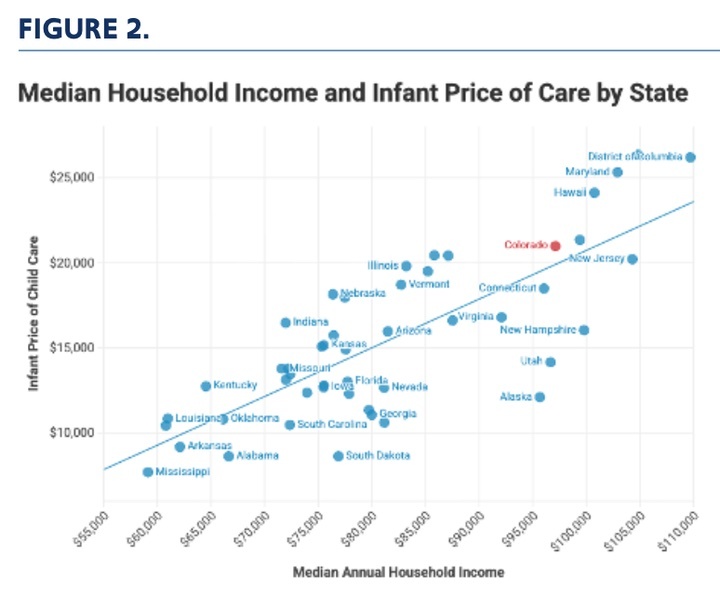
Note that a strong correlation is indicated by a correlation coefficient greater than 0.70. The correlation between states’ median annual household income and infant care prices is 0.78, while the correlation with toddler care prices is 0.75.
This indicates that states with higher median incomes tend to have high child care costs. When affordable child care is unavailable for low-income families, it leads to demand substitution in which parents find cheaper, perhaps lower quality care — or they depart from the workforce, leading to potential long-term impacts on employability and wealth-building for those parents and families.
Local zoning laws can inhibit opening new child care centers, particularly smaller, residential centers. Improving Colorado’s by-right-siting to automatically treat child care facilities as a permitted use could expand supply and help bring down costs.
Although center-based child care is widely unaffordable, high prices are not an indication that child care centers are profiting. In most situations, the price charged does not actually cover the costs for each child. In fact, the cost of care consistently exceeds the current price in Colorado.
The Pagosa Daily Post welcomes submissions, photos, letters and videos from people who love, and care about, Pagosa Springs, Colorado. More information available at 970-903-2673 or pagosadailypost@gmail.com