
The newly-resurrected League of Women Voters of Archuleta County has been scheduling monthly meetings focused on important issues facing our community, such as road maintenance, housing, health care, and water resources. Archuleta County is also in the process of scheduling community meetings to collect input from area residents, on these topics.
We’ve been sharing stories about the same issues here in the Daily Post… and we appreciate hearing from our readers when they send us links to informative articles.
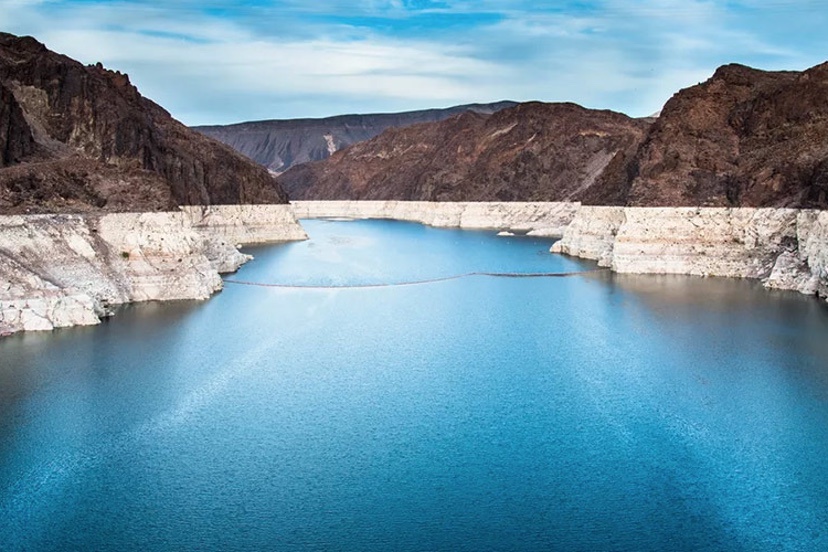
A few days ago, journalist Kenny Torrella posted a story about the Colorado River crisis on the website, VOX.com. As many Daily Post readers know very well, the seven states that divert water from the Colorado River and its tributaries — Colorado, Wyoming, Utah, New Mexico, Arizona, Nevada and California — have been negotiating a new agreement for sharing the water… without success… as they watch the two largest reservoirs in America, Lake Powell and Lake Mead, approach “dead pool” conditions.
Dead pool means the water level has dropped below the openings to the penstocks, and the dam can no longer generate hydroelectricity nor pass water downstream.
This crisis has resulted from a number of factors, including a series of relatively dry years since 2001.
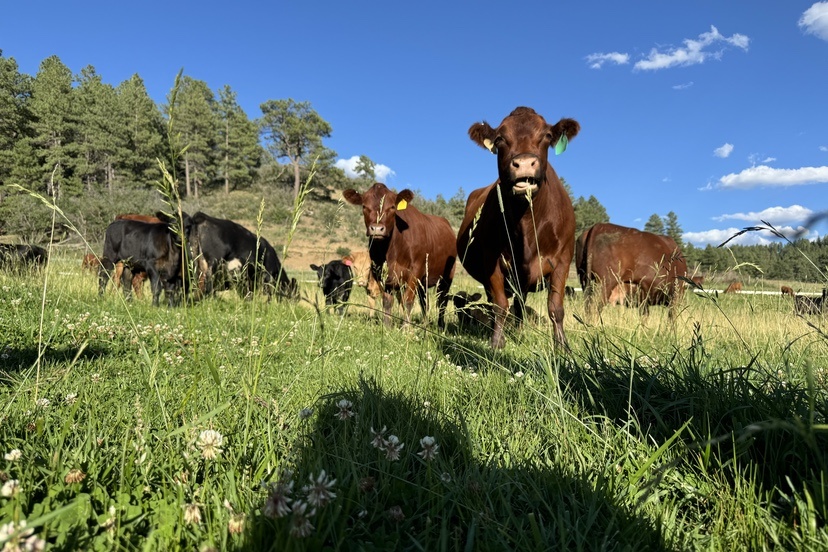
But also, cows.
Not that cows drink a lot of water. But they consume generous quantities of alfalfa and other types of hay, and those crops require water. We might even say, an inordinate amount of water.
As western reservoirs slowly run dry, citizens are being encouraged to replace their lawns with xeriscaping, and take shorter showers. But these conservation measures amount to literally a drop in the bucket compared the extravagant use of water by the cattle industry in the American West.
Here’s the chart from Mr. Torrella’s VOX article:
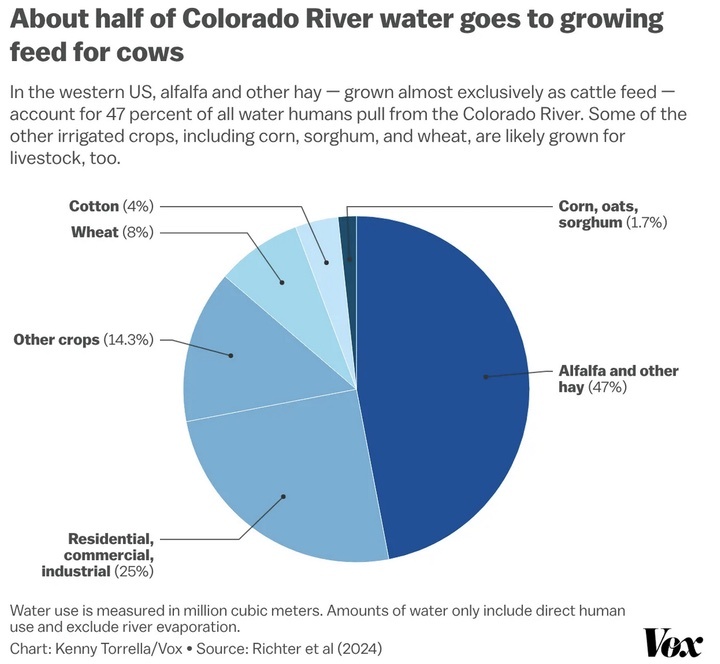
If this graph is accurate, then nearly 50% of all the water diverted from the Colorado River and its tributaries is used to irrigate alfalfa and other types of hay. Even more water is used to irrigate wheat, oats, sorghum, corn, and other crops often used in cattle feed.
Agriculture — not cities and towns, not industry, not golf courses or swimming pools — consumes about 80% of all water diverted from rivers in Colorado. And cattle feed is responsible for the lion’s share of those diversions.
Here in Pagosa Springs, cattle ranching and hay production accounts for about 92% of all water diverted, according to the U.S. Geological Survey.
From the VOX article:
The Colorado River Compact states failed to reach a Valentine’s Day deadline for a deal on how water would be apportioned for the next two decades, with the current rules set to expire this fall. If the states don’t agree to more ambitious cuts soon, the federal government could step in and unilaterally decide for them.
Is it possible for the seven Colorado River Basin states to significantly reduce their water use, to match the reduced amount of water flowing down the Colorado River since 2022?
And perhaps more importantly, can they do this without changing the way water is allocated to agricultural users?
Mr. Torrella writes:
All told, animal feed accounts for at least 47 percent of ALL water pulled from the Colorado River — yet the imprudence of devoting so much water to one industry receives little to no attention in public discussion over the West’s water crisis.
What’s more, the millions of cows in the American West are themselves fueling climate change in a non-insignificant way with their ‘methane-rich burps’, which in turn accelerates the water shortages for the river.
Unlike Mr. Torrella, I’m hesitant to blame the declining water levels in Lake Powell and Lake Mead on “methane burps”. Nor is it entirely clear what causes the changes in precipitation in the American West. Scientific analysis of tree rings has suggested that periods of drought, just as serious than what we’ve seen during the 21st century, took place centuries before the arrival of beef and dairy cattle.

The Colorado River, during periods of above-average precipitation, flows at about 17 million acre-feet per year. (One million acre-feet equals about about 280 billion gallons… although that comparison may not be terribly helpful.)
Recently, the River has been flowing at about 13 million acre-feet. If Mr. Torrella’s chart is accurate, 6.5 million acre-feet are being used to grow hay. That’s more water than the entire state of Colorado uses annually.
Meanwhile, the seven Basin states continue to battle over a new agreement to replace the 1922 Colorado River Compact — an agreement signed immediately following a period of exceptionally high river flows. (See the spike at the beginning of the blue-shaded area of the tree-ring chart above.)
It appears, at this point, that we have a lengthy period of expensive and unpleasant litigation ahead of us, during which our two largest reservoirs could very well become dead pools.
But there’s a way to avoid this dreadful outcome, if policymakers — along with food companies and we consumers — would address the cow in the room, and seriously question our meat- and dairy-centric dietary habits.
Bill Hudson began sharing his opinions in the Pagosa Daily Post in 2004 and can't seem to break the habit. He claims that, in Pagosa Springs, opinions are like pickup trucks: everybody has one.