
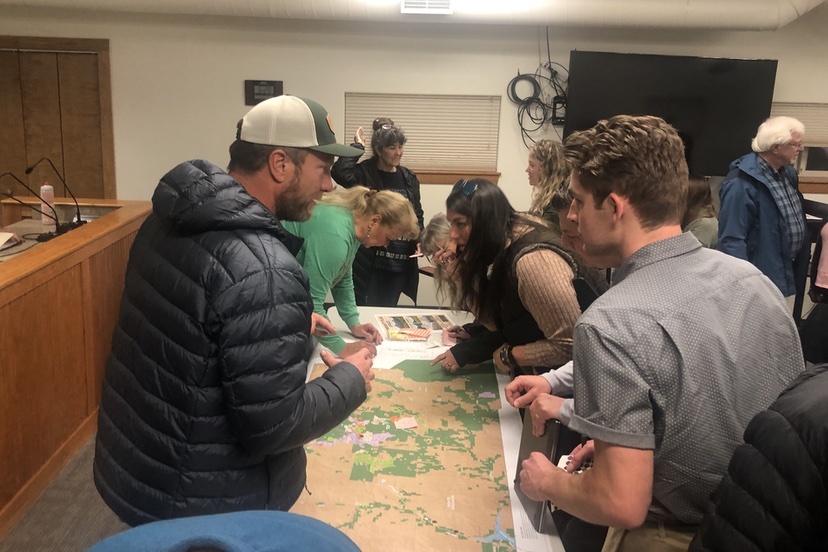
Photo: Community residents attach Post-It Notes and adhesive dots to a large map at Archuleta County’s ‘Interactive Community Forum’ on February 17, 2026, to indicate their concerns about community growth.
Community stories easily slip down the black hole of “misinformation” — even in a small town — as illustrated by the social media conversation I’ve been referencing in this editorial series.
Even in a small town, where we know many of our neighbors by name, and where we see them in the grocery store, in church, at the gym, at the basketball game, on the hiking trail… it’s still hard to tell the information from the misinformation.
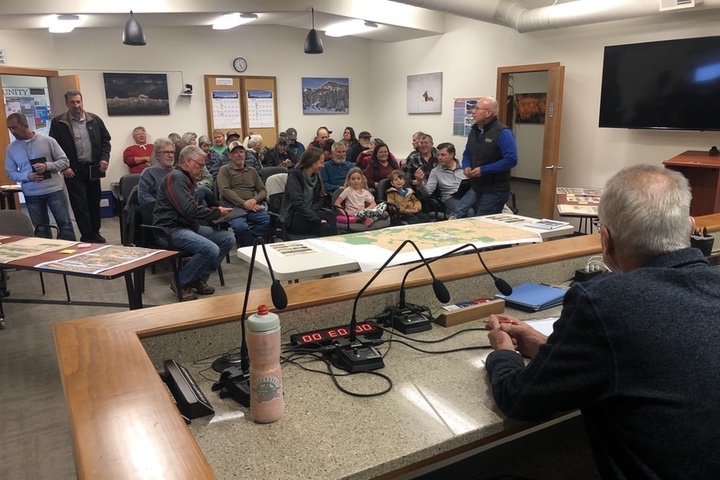
In Part Three of this editorial series, I mentioned that I recognized most of the three dozen participants at Tuesday’s ‘Interactive Community Forum’ hosted by the Archuleta County commissioners and staff. As activists or concerned citizens, many of these folks have shown up, over the past few years, at the same political events and community meetings I’ve attended. Most are retirees, and thus have time to attend these kinds of events. Most are also relatively well-informed about how our local governments function… and how and when they fail to function well.
The new County Manager, Longinos Gonzalez Jr., led the February 17 forum by introducing key topics and guiding the audience input. Community input might be particularly important at the present moment, because the state of Colorado passed a new law requiring communities to update their ‘comprehensive plans’ by the end of December 2026.
This updating process will involve community forums like the one held on Tuesday.
You can download Archuleta County’s existing 2017 plan — its “Community Plan” — here.
The new state law specifically requires updated plans to include strategies for addressing local housing crises. Practically speaking, every community in Colorado is experiencing a housing crisis.
Related to the strategies for housing, each plan must include an analysis of water resources and potential future water demand.
Disclosure: I currently serve as a volunteer Board member for the Pagosa Area Water and Sanitation District (PAWSD), but this editorial reflects only my own opinions, and not necessarily those of the PAWSD Board or PAWSD staff.
Water resources were not discussed at Tuesday’s Forum, but Mr. Gonzalez explained that the County will be holding these forums on a monthly basis, so an analysis of future water needs will be a featured topic, I assume, at a future gathering.
We have two local water districts in Archuleta County. PAWSD treats and delivers drinking water drawn from Fourmile Creek and from the West Fork of the San Juan River, and treats wastewater at the Vista Treatment Plant. The San Juan Water Conservancy District (SJWCD) does not treat or deliver water. It was formed by the voters in 1987 to develop additional water storage options.
PAWSD and SJWCD are currently engaged in litigation over the future of the Running Iron Ranch, purchased in 2008 as the site for a planned Dry Gulch Reservoir. Practically speaking, that reservoir is no closer to being built than it was in 2008.
PAWSD data, based on over 50 years of water service, suggests that a small reservoir at Dry Gulch might be needed someday — in another 50 years? — and PAWSD has been engaged in negotiations to facilitate an easement on the Running Iron Ranch for just such a small reservoir.
Meanwhile, a 2022 water demand study commissioned by SJWCD suggests that a very large reservoir is desperately needed in the very near future.
Sufficient water supplies are crucial to a growing community. There are, however, various methods for ensuring “sufficient” water supplies. One is through conservation measures.
Pagosa Springs has been amazingly successful in conserving water over the past 25 years. Although the population has increased by about 32% since 2001… and although tourist visits may have more than doubled… PAWSD delivers less water as it did in 2001.
This graph shows, with a red line, the amount of PAWSD water demand predicted prior to the purchase of the Running Iron Ranch. The blue line shows actual, documented water demand by PAWSD customers and businesses.
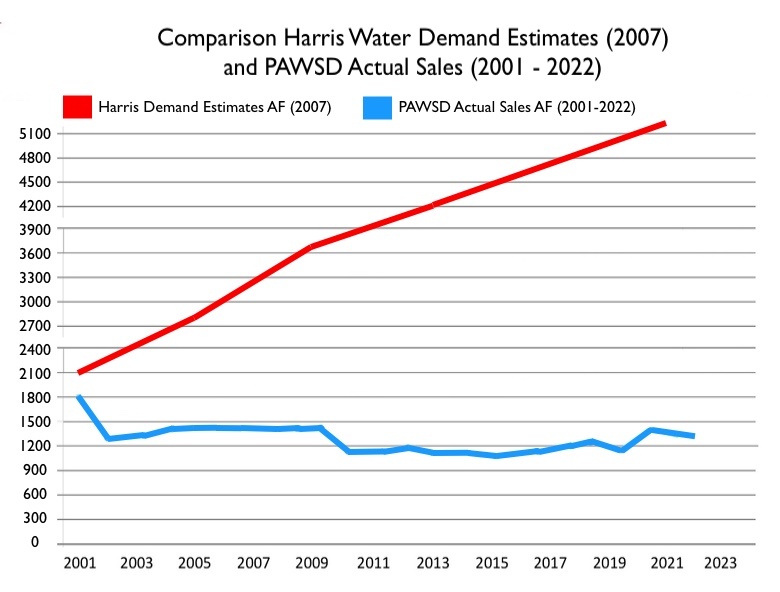
What this graph indicates is a complete disconnect between “predictions about water demand” and “actual water demand.” Consultants hired to predict future water demand in Archuleta County, over the past 25 years, have consistently been wildly wrong.
Unfortunately, SJWCD has chosen to use wildly inflated predictions to justify its push for a huge reservoir north of downtown Pagosa Springs.
The question that Archuleta County will need to answer, when updating its Community Plan this year: Do we want realistic water demand numbers in our Community Plan, or do we want wildly inflated numbers in the Plan?
Another aspect of community planning demanded by the state legislators and state bureaucrats, to be included in the County’s updated plan in a conscientious manner, concerns housing.
The County cooperated with the Town government last year to fund a 112-page ‘Housing Needs Assessment’ (which you can download here) and that study could provide much of the background data for the updated chapter on housing.
The Town and County are also funding a Housing Action Plan, underway this year, and that plan will be able to provide some ideas for addressing the local housing crisis.
But will the ideas go far enough?
The County has had a Community Plan — a comprehensive plan to guide land use decisions — since 2001, and that plan has had three updates since 2001. Nevertheless, the current housing situation in Archuleta County is something of a disaster for many working individuals and families — either in spite of the Plan, or because of the Plan.
I fear it’s partly because of the Plan. But it’s also due to issues beyond our local control.
Can we free ourselves from land use concepts that have resulted in more than 300 local families living in RVs and vehicles during Colorado winters?
What trade-offs are we willing to make? What trade-offs are we allowed to make?
The community is invited to a presentation about current approaches to Pagosa’s housing crisis next Tuesday, February 24 at 5:30pm at the Community United Methodist Church, hosted by the League of Women Voters of Archuleta County. The event is free.