
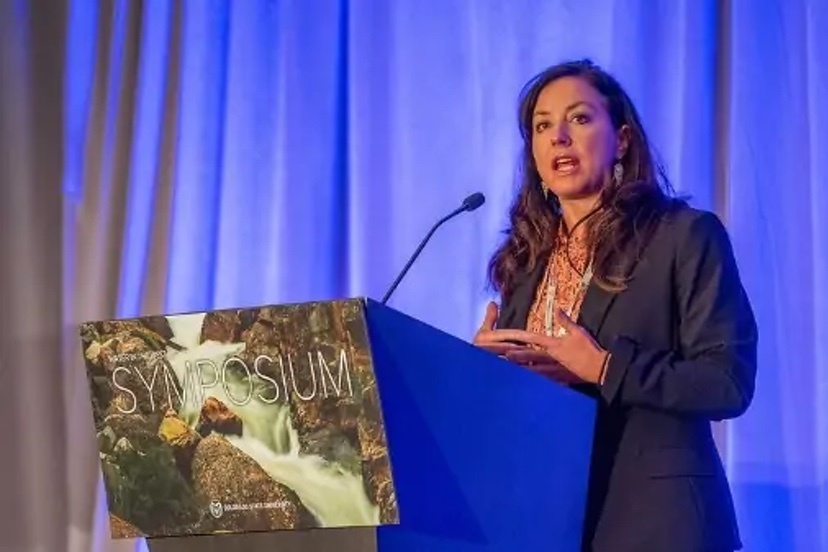
Photo: Becky Michell
This story by Allen Best appeared on BigPivots.com on February 2, 2026. The original article included the text of Becky Mitchell’s January 28 speech; we are sharing that speech as a separate article.
Becky Mitchell was particularly busy during the last week of January. On Wednesday, January 28, she opened the annual Colorado Water Congress conference with a 1,100-word speech that reiterated Colorado’s position in the stalemated Colorado River discussions.
Lower-basin states, said Mitchell, Colorado’s chief negotiator in Colorado River affairs, must fully come to terms with the changed realities on the Colorado River. “This means releases from Lake Powell must reflect actual inflows, not political pressure,” she said. “If reductions aren’t real, reservoirs won’t recover.”
The next day, Mitchell was in Washington D.C. along with Colorado Governor Jared Polis and the governors of five of the six other basin states. California Governor Gavin Newsom, who cited pre-existing family commitments, was the only governor absent.
The New York Times on Saturday reported that the governors achieved “no breakthrough — and whether they made progress was unclear.” Mitchell was quoted in that story saying upper basin states “cannot and will not impose mandatory reductions on our water rights holders to send water downstream.”
In other words, Colorado water users must live with the hydrologic realities, including this one of almost no snow. Colorado does not have the giant reservoirs of Powell and Mead upstream.
Others, including Eric Kuhn, the former general manager of the Glenwood Springs-based Colorado River Water Conservation District, have urged a new model based on proportionate cutbacks, not absolute numbers. That’s how the four upper-basin states among themselves apportioned their share of the river flows in their 1948 compact. Proportionately.
The 1922 compact used absolute numbers, i.e. 7.5 million acre-feet for each basin.
See: “Dancing With Deadpool on the Colorado River,” Big Pivots. Dec. 12, 2025.
The Colorado River Compact of 1922 among the seven basin states uses some language that can be interpreted very differently about delivery obligations. That is a long, involved story — that may eventually be decided by the Supreme Court.
The Arizona Daily Star, however, reported a nuance of possible importance in statements made by Mitchell and Polis afterward. Mitchell emphasized “voluntary” conservation in the upper basin, while Polis said Colorado remained “committed to working collaboratively to find solutions that protect water for our state, while supporting the vitality of the Colorado River and everyone who depends on it.”
An Arizona source told the Daily Star’s Tony Davis that some Upper Basin governors appeared open to possible mandatory, as opposed to voluntary, conservation measures. “I think the other Upper Basin states expressed a willingness to put water on the table in a way that Colorado has not,” said the source, who asked for anonymity to protect continued participation in interstate river discussions.
But again, Colorado insists that it already has mandatory cutbacks — the ones imposed by Mother Nature. Using the prior appropriation doctrine to sort out priorities, Colorado restricts uses even in the more water-plentiful years. This year, the most “junior users” will most likely not get water.
The black line in this chart represents snow-water equivalent in Colorado’s snowpack as of February 1 relative to 1991-2020, a time frame of which about two-thirds consisted of drought and aridification. The map below shows the snow-water equivalent as of January 31 by basin.
More can be found at the Natural REsources Conservation Service.
Amy Ostdiek, the Colorado Water Conservation Board’s chief for interstate, federal, and water information, made that point in remarks at the Water Congress the day after Mitchell’s speech.
“These reductions in the upper basin are mandatory. They’re uncompensated. They’re the job of each state engineer’s office to go out and shut off water rights holders when that water isn’t available. And what that means in practice is that many years you have pre-compact water rights dating back to the 1800s getting shut off.”
The complications of mandatory reduction of water uses also came up in a session with state legislators at the Water Congress.
Ken Neubecker, a long-time Colorado River observer affiliated with environmental groups, said mandatory cuts to Colorado River water use would require an amendment to Colorado’s state constitution and likely those of other upper-basin states.
Colorado’s constitution has been amended repeatedly since 1876, when Colorado achieved statehood, but the provision setting forth prior appropriation has not been touched.
“I don’t think you will get an amendment that will give the state any kind of authority to enact mandatory cutbacks beyond existing administrative cutbacks,” said Neubecker. “That’s just not in the cards.”
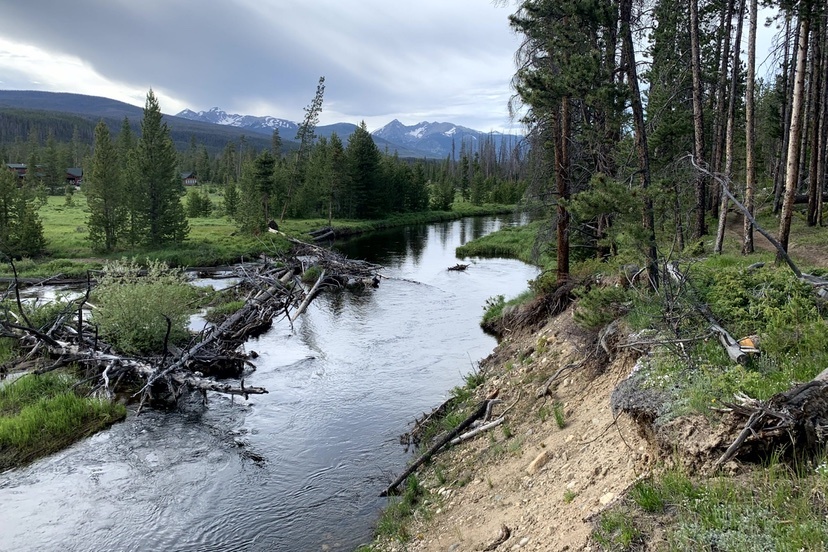
The upper-basin states also differ fundamentally with lower-basin states in that the lower basin states have just a few giant diversions, such as the Central Arizona Project and the Imperial Valley. The headwaters states have thousands of legal diverters. That also makes application of mandatory diversions more difficult.
These facts would together make mandatory cuts a legal and logistical nightmare to administer.
The Basin states have a deadline imposed by the federal government — as operator of the dams, including Hoover Dam and Glen Canyon Dam — to agree how to share a shrinking river.
Later this year, Mother Nature may impose an even harsher deadline if current thin snowpack continues to prevail. The statewide snowpack was 58% of average as of late January when the Water Congress conference was getting underway.
One barometer, if imperfect, of the snowpack is the snowpack on Vail Mountain. On January 15, the Vail Daily’s John LaConte reported that the Snotel measuring site at the ski area showed the worst snowpack reading in 44 years of measurements.
The opening of Vail’s Back Bowls also testifies to dryness of the Colorado River headwaters. As recently as 2012, a notoriously dry year, that south-facing ski terrain was not opened until January 19, according to David Williams of the Vail Daily. On January 26, he reported another foot of snow was necessary to open it.
In June 2023, Polis appointed Mitchell to her current position, as Colorado’s first full-time commissioner to the Upper Colorado River Commission. She had previously overseen the Colorado Water Conservation Board.
“Mitchell will now navigate the deep challenges of the Colorado River in this upgraded position, supported by an interdisciplinary team within the Department of Natural Resources and support from the Colorado Attorney General’s Office,” said the announcement.
“The next few years are going to be incredibly intense as we shift the way that the seven basin states cooperate and operate Lakes Powell and Mead,” Mitchell said in that 2023 announcement.
“Climate change coupled with Lower Basin overuse have changed the dynamic on the Colorado River and we have no choice but to do things differently than we have before.”
Allen Best publishes the e-journal Big Pivots, which chronicles the energy transition in Colorado and beyond.