
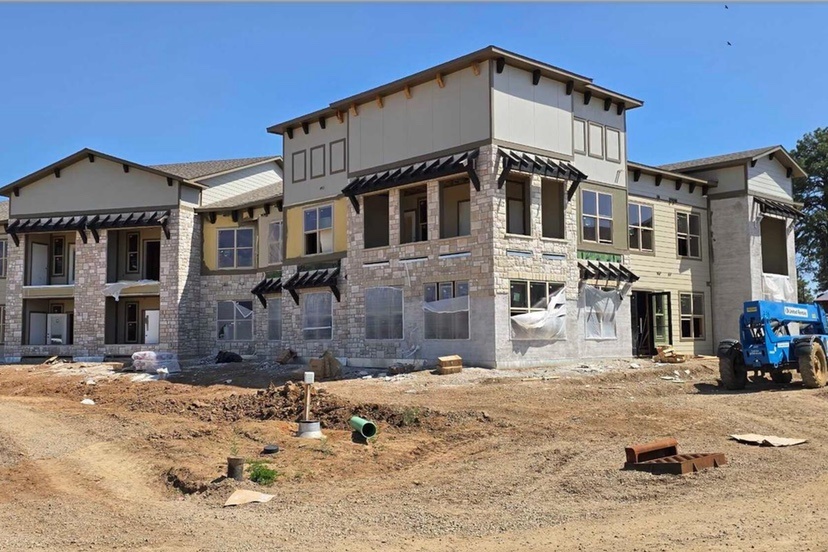
Photo: The Timberline low-income housing project on Alpha Drive, under construction in 2025.
This editorial series touched lightly, yesterday, on the “future water demand” issue. The Pagosa Area Water and Sanitation District (PAWSD) Board of Directors will be meeting tonight at 4pm at the Lyn Avenue office, with an executive session planned for a conference with the District’s attorney, Marcus Lock. The regular meeting will start at 5pm.
The closed-door executive session will focus on a lawsuit between PAWSD and the San Juan Water Conservancy District (SJWCD) concerning a reservoir project proposed for the Running Iron Ranch, north of downtown Pagosa.
That reservoir was originally proposed in 2003, following an historic drought in 2002, and following a period of rather fabulous population growth in Archuleta County. As mentioned yesterday in Part Three, population growth may have slowly ground to a halt, if we believe the numbers coming from the Colorado State Demographer’s office.
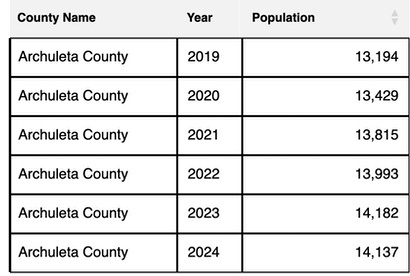
The lawsuit between PAWSD and SJWCD — if it gets resolved anytime soon — might have a bearing on the upcoming Archuleta County Community Plan update. That update is required to include…
…a water supply element and a strategic growth element.
How does Pagosa’s municipal water supply either promote or limit future growth?
What strategies will our County government put in place, to either promote or limit future growth?
A common assumption — by many community leaders, over many decades — has been that population growth will help the community solve its social, cultural, and infrastructure challenges. That hasn’t proven to be an entirely accurate assumption. Archuleta County now has about three times the population it had in 1990, but certain challenges have only become more serious…
…as suggested by the notice for a February 17 “Interactive Community Forum”.

Some of these challenges will be discussed in the County’s upcoming ‘Community Plan’ update, scheduled to be written this year.
The Community Plan revision needs to include not only water supply information… the plan must also reference the 2025 Regional Housing Needs Assessment… and the 2026 Housing Action Plan currently in the early stages of production. From the Colorado Legislature web page for SB24-174:
…the act requires the awarding entity to prioritize awarding grants to a local government that:
- Has completed and filed a housing needs assessment;
- Has adopted a housing action plan that has been accepted by the [Department of Local Affairs];
- Has reported progress to the department regarding the adoption of any strategies or changes to local laws identified in the housing action plan…
The state of Colorado views the housing crisis as a serious problem. Strategies and changes to local laws must be identified if the County wishes to continue receiving state grants for housing projects.
One interesting outcome from the federal government’s current descent into authoritarianism: some folks have become energized and willing to come together, to try and change the country’s political direction.
I might mention the revival of the non-partisan Archuleta County League of Women Voters as one such example. Our local LWV chapter was rather active a decade ago, hosting candidate debates and community forums, but then — for whatever reasons — ceased its activities.
Last year, a group of women revived the local LWV chapter — partly, I suspect, in reaction to what’s happening in Washington DC. But for the time being, the chapter seems to be focused mainly on local issues.
The Archuleta LWV will be hosting a panel discussion about housing issues, on Tuesday, February 24, at the Community United Methodist Church, at 5:30pm. The group has identified “housing” as one of our most important local issues, and is assembling a panel of Pagosa folks involved in addressing that issue. (As I learn more about who will be participating on the panel, I’ll share that info in a future story.)
Numerous American economists have argued that “a truly free market” built upon a capitalist business model — with minimal government intervention — has historically produced the best economic outcomes for the broadest range of citizens.
One problem with that assertion is, of course, that government can’t help but intervene in a myriad ways. The citizens demand government intervention, on a regular basis. And perhaps even more importantly, the capitalist business model demands government intervention.
Let’s consider, for example, housing in Archuleta County.
From the current Archuleta County Community Plan, adopted in 2017:
Chapter 4. Economic Development and Housing
Economic development is the process of adapting to the ever-changing global economy with the resources available to the local community. Change is the only thing that stays the same and Archuleta County has seen several cycles of economic change. While forestry and ranching drew 19th and 20th century settlers to the San Juan Mountains, the valleys now draw 21st century amenity migrants searching for homes with a view and an outdoor lifestyle…
Infrastructure, including broadband service and housing, are key to providing economic flexibility…
As we see implied in Chapter 4, “housing” is seen as an infrastructure component of “economic development” — an outcome that Archuleta County saw as one of their key government goals. Apparently, the County considered housing to be similar to broadband service in terms of economic success.
In the 19th and 20th century, people built houses to live in. By the start of the 21st century, housing had become “infrastructure” necessary to economic development efforts, to be promoted — in various ways — by the government.
Policy 4.4 – Archuleta County encourages construction of new affordable housing units.
Action Items:
- Develop incentives for developers to encourage them to build affordable housing units.
- Develop incentives to encourage integration of affordable housing within market rate developments.
- Recognizing that manufactured homes are affordable housing units, review current standards for design, landscaping, and screening new and existing manufactured home parks.
- Encourage infill development where infrastructure (paved roads, water and sewer) is available.
- Review provisions for Short-term Rentals (Lodging Units) to assure Long-term Rentals are not being negatively impacted.
As we look at these “Action Items” from 2017, no one would have guessed that the County would, in 2026, be encouraging people to live in RVs — converted school buses, Winnebagos, pickup campers, Airstreams, fifth wheels, pop-up campers — as a way to address a housing crisis.
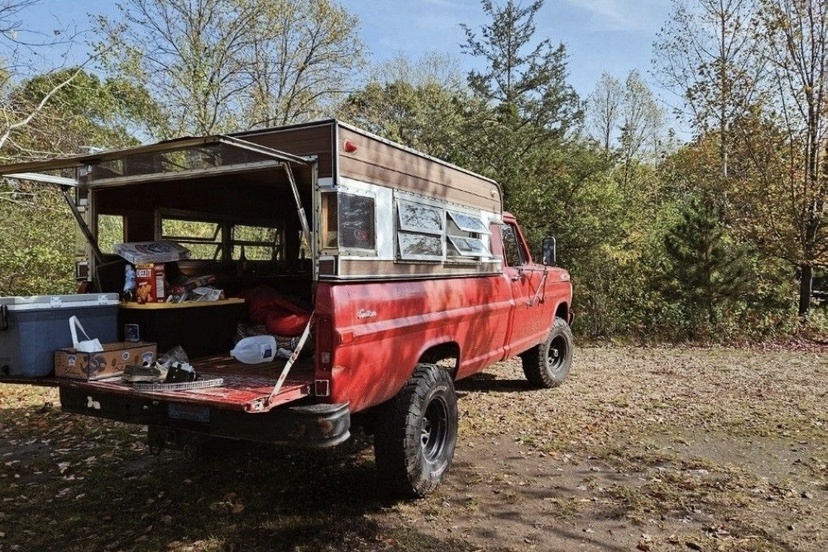
Last month, the Archuleta County Planning Commission recommended that families be allowed to live in RVs on a semi-permanent basis — even though the definition of an RV in the Colorado Revised Statutes define a “Recreational Vehicle” as “temporary living quarters”. From CRS 24-32-902:
“Recreational vehicle” means a vehicle designed to be used primarily as temporary living quarters for recreational, camping, travel, or seasonal use that either has its own motor power or is mounted on or towed by another vehicle.
“Temporary” doesn’t mean what it used to, in Archuleta County.
Tomorrow in Part Five, we’ll look a bit more closely at “Community character” and we’ll consider how new County regulations and plans will have to walk a difficult line between promoting “economic development” on the one hand, and the desire to ensure that “new development is compatible with community character and heritage…”