
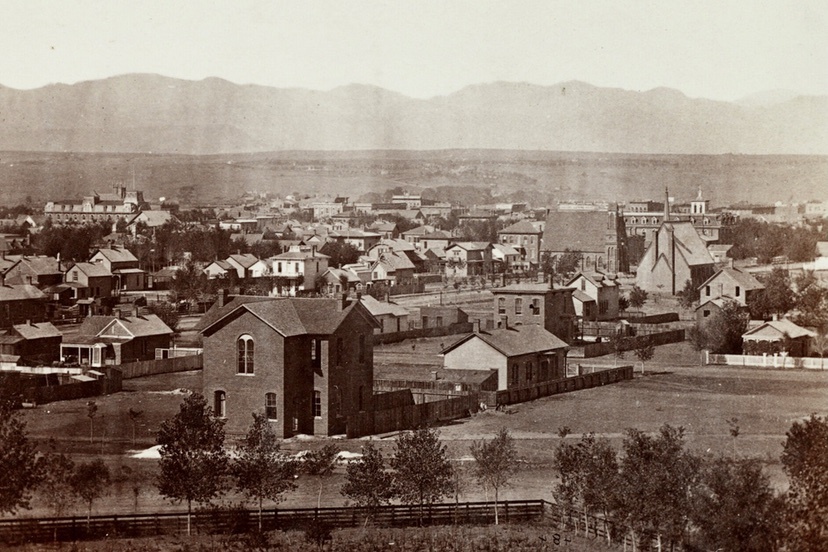
Photo: A west-facing view of central Denver in the 1870s. (Courtesy of Denver Public Library Special Collections, X-18618)
This story by Chase Woodruff is part of the ‘Colorado at 150’ series on Colorado Newsline. It appeared on February 6, 2026.
A welcome respite from freezing winter temperatures came to the northern Front Range on Sunday, February 6, 1876, reported the Denver Times. The warm weather caused the city’s churches to be “well filled with those who went to worship and those who went to see what their neighbors had to wear.”
“Every woman wore her finest feathers, and the streets upon the close of the morning service presented an unusually brilliant and attractive appearance,” said the Times.
The “usual number of Sunday runaways” befell those who went out for afternoon drives, the Times continued, including a two-horse carriage that “went tearing across the prairie in the direction of Julesburg for about four miles before the driver succeeded in checking them.”
Finally, in the evening, a “fellow (who) had been indulging somewhat freely in beautiful beer” made an accidental stop at the Lawrence Street premises occupied by the Colorado Territory’s small legislative assembly.
“Noticing the legislative halls lighted up, (he) took them for beer halls,” reported the Times. “Walking into the House, he took a seat at the table of the Sergeant-at-Arms, and called for his favorite beverage. As it did not come quickly enough to suit him, he muttered something about it being a ‘damned slow place,’ and left.”
By early February the territorial Legislature, consisting of a 26-seat House and a 13-seat upper chamber called the Council, was nearing the end of its 40-day session, the last in its 16-year history. A few blocks away, delegates to Colorado’s constitutional convention were hashing out the details of the state legislative body that would replace it, including the number of seats that would make up the new Senate and House of Representatives.
Civil rights for Black Coloradans
In the 1875 election, Democrats had won a majority of seats in the Council, the party’s only foothold in a territorial government otherwise dominated by Republicans. In the final days of the legislative session, Democrats used their Council majority to pick a fight over racial equality at Colorado’s new public university.
Democratic Council members Adair Wilson of Del Norte and Robert Morrison of Georgetown moved to amend a higher education bill to remove language prohibiting students from being denied admission on the basis of race. A 7-6 majority voted to strike the so-called “color clause.” Council member Bela Hughes, a Denver Democrat who later in 1876 would become the party’s nominee for governor, argued that striking the clause was “of little consequence,” because other legal protections ensured that Black students “could not be excluded in any event.”
Colorado Republicans didn’t buy that argument, and amid the impasse the bill failed to become law. A February 10 editorial in the Rocky Mountain News denounced the “highty-tighty attempt of the territorial Council towards the exclusion of (Black) pupils from the Boulder university.”
“(Democrats) would have the doors of an institution, supported by the money of Black citizens as well as white, shut against the former,” wrote the News. “Their action of course will bear no fruit, but the Democratic members of the Council should nevertheless be reminded that in this age of the world, and in what is presumably to soon become the youngest state in the Union … people are not to be debarred from any privileges, educational or otherwise, that should be theirs on account of their color.”
In spite of these lofty statements of principle, however, the University of Colorado is not believed to have admitted a Black student until 1896, when Franklin LaVeale Anderson entered its law school. Charles Durham Campbell is believed to have been the first Black student to receive a bachelor’s degree in 1912, followed by Lucile Berkeley Buchanan, its first Black woman graduate, in 1918.
The 1870 census had listed nearly 250 Black residents in Denver, about 5% of the city’s population, and that number only grew during the rapid growth the city experienced over the next six years.
Black Coloradans in 1876 included prominent Denver citizens like Edward Sanderlin, a pioneer who had opened one of the city’s first barbershops in 1859, and went on to become a well-known figure in local real estate and Republican politics. Clara Brown, another “fifty-niner,” had been born into slavery in Virginia and by the 1870s was known around the territory as a “successful miner and philanthropist,” according to the Rocky Mountain News, with properties in Denver, Central City and the mining camps of Boulder County.
Many others were painters, porters, blacksmiths, bricklayers, shoemakers and bookselling agents. Thomas Riley, baggage master for the Denver & Rio Grande Railway, lived at 565 Stout Street. Priscilla Millen, a mother of five residing on 13th Street, had raised her children in Denver since her husband’s death there in 1862.
Rufus Felton, a former Civil War infantry sergeant, worked as a whitewasher. Augustus Mosby, a messenger at Colorado National Bank, had settled in Denver with his wife Rebecca, a dressmaker and leader of the choir at Zion Baptist Church, where many Black Denverites had worshipped since its founding in 1865.
The legislature adjourns
On February 11, the assembly met for the final time before adjourning sine die. Lawmakers gave final approval to bills to adjust the salaries of territorial officers and set a territory-wide property tax levy of one-and-a-half mills for the 1876-77 fiscal year. But measures funding a new road in Gilpin County, creating an Uncompahgre County on the Western Slope and imposing new licensing requirements on small-town saloons were among the bills that were defeated.
With little business remaining before the lower chamber, there was “considerable levity” in the House as the evening dragged on. Members made speeches, rewarded the chief clerk with the gift of a silver coffee urn and silver tobacco box, and introduced satirical resolutions, including “a bill for an act to establish confusion in Arapahoe County,” judged by the News to contain “two or three very good hits.”
“The first section attaches Arapahoe County to Wyoming Territory,” the News reported. “A section referring to the Denver ‘land grab and court house ring’ is rather meaningless, if not stupid. Section Five declares the territorial and city offices vacated, and authorizes the mayor of Cheyenne to fill said positions with his surplus of street loafers.”
“About midnight,” said the News, “there was an irruption of beer, confectionery, cigars, pretzels, nuts, etc., into the chamber, which occupied the attention of the body for some time.”
Colorado Newsline is part of States Newsroom, a nonprofit news network supported by grants and a coalition of donors as a 501c(3) public charity. Colorado Newsline maintains editorial independence. Contact Editor Quentin Young for questions: info@coloradonewsline.com. You can support Newsline here.
Colorado Newsline is part of States Newsroom, a nonprofit news network supported by grants and a coalition of donors as a 501c(3) public charity. Colorado Newsline maintains editorial independence. Contact Editor Quentin Young for questions: info@coloradonewsline.com.