
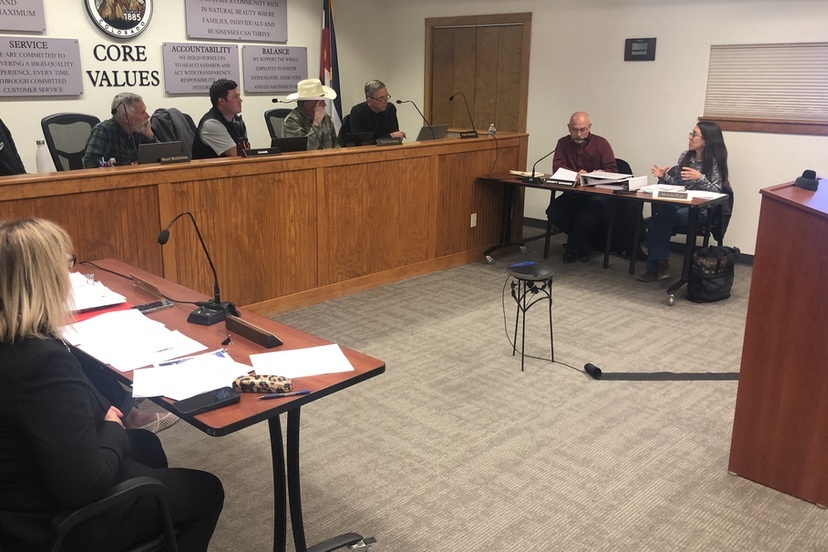
Photo: Archuleta County Planning Manager Melissa Ryan, far right, explains a feature of the proposed ‘RV Permit’ rules to her Planning Commission, January 22, 2026
About 20 movers-and-shakers from local government agencies and non-profits were invited to convene at 5pm yesterday evening to discuss the ‘Housing Action Plan’ required by state law SB24-174 (which you can download here). This was the first of four proposed meetings where these particular local leaders will help out-of-town consultants — led by Sarah McClain from Western Spaces — to create the our community’s Housing Action Plan, to then be submitted to the Colorado Department of Local Affairs (DOLA).
The meeting was held at Town Hall.
I was not able to stay for the entire meeting. I left early to attend the Archuleta County Planning Commission meeting, where the commission was planning to discuss a few changes to the County Land Use Regulations (LUR).
I mentioned these LUR changes in Part Five, yesterday. The revisions would establish two categories for people living year-round in RVs within the unincorporated county.
1. Recreational Vehicle Temporary Use Permits
2. Five-Year Utility-Connected RV Occupancy Permit
The County is currently granting Temporary Use Permits, allowing people to live in RVs on private property as their permanent residence, for up to 180 days. The permits are renewable, which allows the County Building Department to inspect the property on a regular basis. Although everyone recognizes that RVs are not meant for year-round living in a four-season climate like we have in Pagosa Springs, this County policy was established a few years ago as a “temporary” attempt to address the housing crisis, while we wait for a real solution.
The crisis has only gotten worse. Rising housing costs and utility costs and local taxes put increasing pressure on families.
As noted previously, there are (reportedly) about 300 families in the Aspen Springs subdivision living in RVs. Presumably there are other families living in RVs elsewhere in the county.
For many of these families, this is the only type of housing they can afford in the current Pagosa Springs economy, and with the current government regulations.
A limited number of these RV families have installed certified septic systems and have hooked up to permanent electrical service, and some of them have approached the County wondering why they need to be inspected — and pay a fee — every 6 months. In response to those questions, the County Planning Department proposed the creation of a new “Five Year” RV permit for those RVs that are connected to utilities and have a permanent wastewater system. These RVs would be inspected only every five years.
The wording proposed by the Planning Department was tweaked slightly by the Planning Commissioners, and recommended for approval by the Board of County Commissioners. The BOCC makes the final decision.
As I mentioned above, I left the Housing Action Plan Strategy Group meeting at Town Hall before its conclusion. The first part of that meeting concerned the data gathered by the consults for last year’s Housing Needs Assessment (HNA). Archuleta County and the Town of Pagosa Springs are required to use the data from the HNA to create a Housing Action Plan, to be submitted to DOLA by the end of 2027.
Just before I left the Strategy Group meeting, the consultants were discussing — briefly — the impact that Town and County land use regulations have on the worsening housing crisis.
I thought this was as perfect time to vent to the gathered leaders.
“So I’d like to share a horror story, reflecting on the issue of regulatory tools.
“The Archuleta County Planning Commission is meeting tonight to consider allowing people to live in RVs for up to five years. They’re revising their policy. It used to be, you had to renew your permit every 6 months, but they’re looking at land use regulations that will allow families to live in RVs for up to five years without having to be inspected every six months.”
At the same time, County regulations and commissioner actions actively discourage mobile home parks and tiny homes.
“I don’t know how many people would rather live in an RV than in a mobile home.”
According to the County LUR, you must own more than three acres before the County will allow you to put two dwelling units on your property. And that’s the maximum. Two dwelling units.
If you own less than three acres, you are allowed one dwelling unit.
I understand the philosophy behind these regulations. This has historically been a rural community. Millionaires come here and buy their trophy ranches, and they don’t want to see a mobile home park off in the distance.
“This is one of the biggest problems we have in our community. The County’s regulations.”
Yes, we also have the problem of the Pagosa Lakes Property Owners Association (PLPOA), because Pagosa Lakes was designed in the 1970s as a suburban wonderland, and purposely saddled itself with covenants and restrictions to keep out lower income families. To protect property values.
“But the county has thousands of acres that nobody can live on, because of County regulations. To me, this is a horror story — that we have a County government stuck in this mind-set that we don’t want people to live in the county. We don’t want to allow mobile homes, but we will let people live for five years in an RV. They’re already violating the law, so we might as well make it legal.”
As I packed up my laptop to head over the the Planning Commission meeting, I encouraged the gathered Strategy participants to speak with their County commissioners, if they — like me — find this situation to be unreasonable in a community suffering with a housing crisis.
At the Planning Commission meeting, chair Matt Nobles opened the floor for public comment on the proposed “Five Years in an RV” revisions, and I expressed basically the same complaint to the four commissioners.
I was told that the County is just beginning the process of rewriting its ‘Community Plan’ and that maybe… just maybe… some reasonable changes will come from that process.