
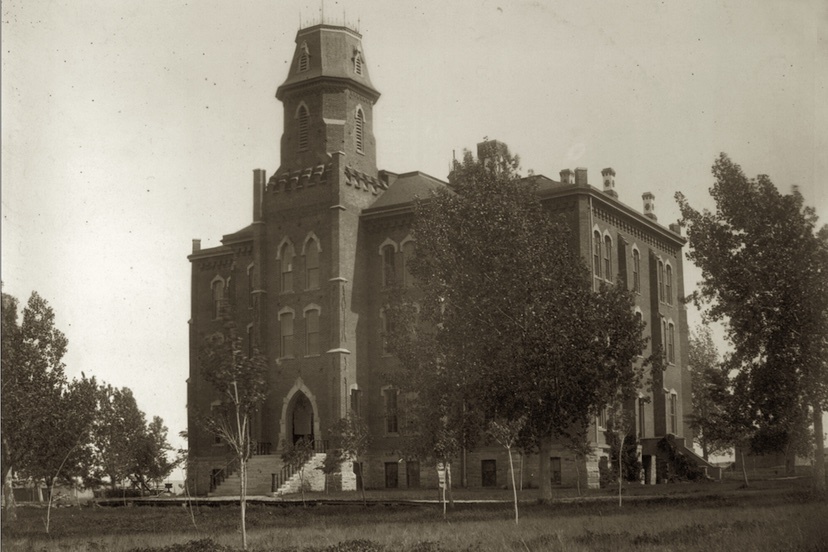
Photo: The University of Colorado building, completed in 1876 and later known as Old Main, is pictured in this 1889 photo. (Courtesy of Denver Public Library Special Collections, X-11769)
This story by Chase Woodruff appeared on Colorado Newsline on January 16, 2026. It’s part of Newslines’ Colorado at 150, featuring special reports on the people and history that define the state of Colorado.
On the morning of Jan. 15, 1876, the town of Boulder’s leading citizens gathered at the train depot to welcome a special passenger car carrying Colorado Gov. John Routt and about 50 other dignitaries from the territorial capital, who had been invited to inspect the future site of the soon-to-be state’s flagship university.
The trustees of the University of Colorado were eager to show off to their visitors the 55-acre site donated by the town to the new college, where a state-of-the-art $30,000 building — complete with gas light fixtures, soundproofed floors and a ventilation system — was nearly finished.
“The chapel is a fine room, and, indeed, so are all the rooms on the first and second floors,” reported the Rocky Mountain News on January 16. “The building committee are well satisfied with the manner in which the work has been carried on.”
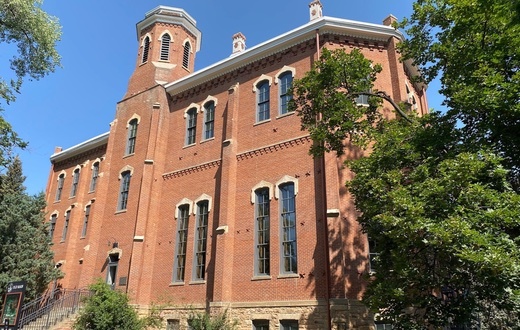
Known today as Old Main, the building recently underwent its third major renovation, and ranks among the oldest continuously occupied public buildings in Colorado.
The territorial Legislature had authorized the establishment of a public university as early as 1861, but momentum had stalled for more than a decade amid Colorado’s broader stagnation during the Civil War and its aftermath. In 1874, lawmakers finally agreed to appropriate $15,000 for the university’s construction in Boulder, on the condition that the townsfolk there raise the remainder of the necessary funds.
The cause of public education, or the “common school” system, was championed by several of the Colorado Territory’s most prominent citizens — especially among liberal Republicans, who viewed public schools as a crucial tool in remaking the United States an egalitarian republic in the Reconstruction era.
Routt and his fellow visitors, who included many members of the Legislature and the constitutional convention, which had convened in Denver, were welcomed in Boulder by a committee that included John A. Ellet, a former Union Army colonel and early CU booster. Public schooling, he told the assembled dignitaries, was “the palladium of our liberty.”
“It says to the rich man, you must contribute of your abundance to educate the child of your poor neighbor, so that a knowledge of the elementary branches shall be within reach of all,” Ellet said, according to The Boulder County News, calling on the Legislature to make a “liberal appropriation” for the new university, and to levy a new tax to safeguard its future.
“‘Oh!’ says one, ‘but there’s the taxes. You must not increase the taxes!’ The citizens of Boulder do not feel so,” Ellet continued. “We know that if we would enjoy the blessings which modern civilization confers, we must pay for them, and we are willing to do it.”
Boulder and the university trustees wanted the 11th and final territorial Legislature to appropriate the $30,000 needed to “put the university in operation during the Centennial year,” the Rocky Mountain News reported.
Lawmakers balked at that request, appropriating just $15,000 instead. Later in the year, Routt reported that Old Main, though structurally complete, still lacked furniture, and CU Boulder wouldn’t admit its first class of students until 1877.
A war of words
Boulder in 1876 was the setting for an old-fashioned frontier newspaper war. Proprietors Otto Wangelin and Robert Tilney had launched The Colorado Banner the previous year as a Democratic rival to The Boulder County News, an established Republican journal published by Amos Bixby and Eugene Wilder.
The simmering tensions between the two weeklies — the Banner published on Thursdays, the News on Fridays — boiled over in an editorial published by the Banner on January 20, 1876. Provoked by a minor dispute over whether the Banner had inadvertently made an “inexcusable thrust” at the conduct of one of Boulder County’s delegates to the constitutional convention, the Banner’s Democratic editors unleashed a torrent of invective against their Republican rivals.
“There are some men in this world who are happiest when they can lie,” bemoaned the Banner’s editorial.
“The efforts of the News ever since the Banner was started have been to run it down in the eyes of the people,” it complained. “The first note made of its rival was the prophecy by a dead beat that this paper would fail, the next was a charge that the Banner was opposed to public schools, a charge as false as it was malicious, then came a charge on an editorial of a possible suspension, and now is the News guilty of the above misrepresentations, gross and unjust, and which the News knows is as false as Satan.”
“What could be the object of the News in thus misrepresenting? Did it want to get on the soft side of our representative in the constitutional convention, and influence him against this paper?” the Banner continued. “The only other solution is that the News wanted to get off something smart, and that the underhanded nature again showed itself, and all because the Banner is gaining daily in circulation and patronage.”
After a series of changes in name and ownership, the two rival papers went on to merge in the mid-1880s, but the Boulder News and Banner would ultimately lose out to the Boulder Daily Camera, which published its first issue in 1890.
Colorado Newsline is part of States Newsroom, a nonprofit news network supported by grants and a coalition of donors as a 501c(3) public charity. Colorado Newsline maintains editorial independence. Contact Editor Quentin Young for questions: info@coloradonewsline.com.