
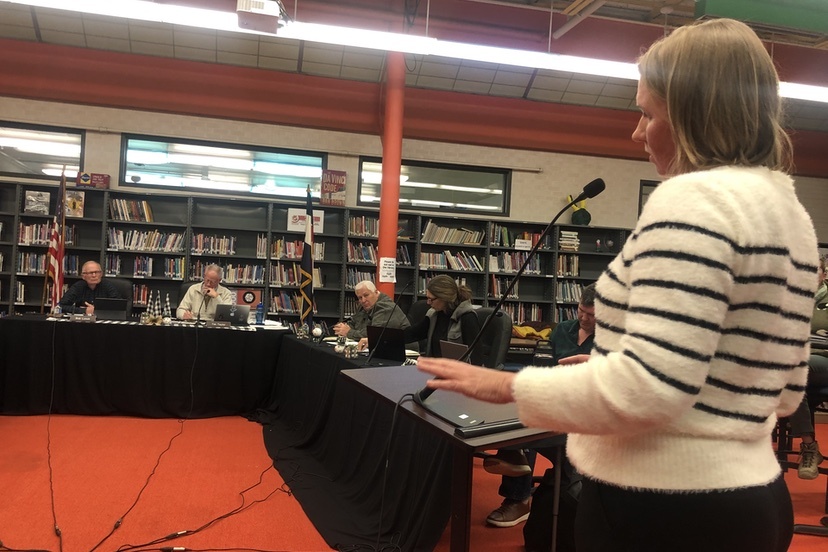
Photo: Local parent Elly Osmera speaks to the Archuleta School District Board of Education on January 7, 2026.
The Archuleta School District (ASD) School Board will be meeting for a second meeting this month, on Wednesday, January 21 at 6pm in the Middle School Library. Typically, the Board meets once a month.
According to a note sent to members of the Master Plan Advisory Committee, the School Board will take additional public comment at the meeting, and will likely make a final decision about which location — the High School campus, or a vacant 37-acre parcel on Vista Boulevard — to include in their application to the Colorado Department of Education BEST grant program.
I don’t expect the School Board to completely shift gears and suddenly realize that the Pagosa community is much more likely to support renovation of our three existing downtown schools — with a mill levy override of maybe $20 million? — than to increase their property taxes by $130 million for a shiny new PreK-8 facility.
I’ve certainly done my best to encourage the School Board and staff to shift gears, however.
For example, I’ve presented the historical evidence concerning Archuleta County elections.
Our community has regularly, and consistently, refused to approve large capital projects at the polls, for the past 20 years, beginning with a refusal, in 2004, to finance the Dry Gulch Reservoir project. (The property for that project was later purchased without voter approval.). The community voted down a proposal in 2011, to build a new K-8 school facility, by a margin of 3-to-1. In 2012, the community rejected a plan to construction a tourist-friendly amusement park atop Reservoir Hill. In 2014, the community voted down a proposal to build a municipal recreation center, also by a 3-to-1 margin. The community twice rejected a tax increase to fund a new (oversized?) Archuleta County jail. (The BOCC then built the jail anyway, using ‘Certificates of Participation’.)
In 2025, the Pagosa Lakes Property Owners Association rejected a $255 one-time assessment to fund a $2 million gymnasium for Association members… also by a 3-to-1 margin. By my estimate, the Pagosa Lakes subdivisions are home to about 75% of the voters in Archuleta County.
But while our community has consistently and regularly refused to support big new government buildings, we have at the same time approved tax increases aimed at making repairs and upgrades — including voting twice to support the ASD Mill Levy Override in 2018 and again in 2024, and in 2025, voting in favor of a 1% sales tax to upgrade and repair the Town’s sanitation system.
Historically, our community has been a fan of remodeling old buildings for new purposes. If I’m not mistaken, nearly every building in Pagosa’s downtown core dates from prior to 1950 — some are as old as 1900… and nearly all have been extensively renovated for new, more modern uses… in some cases, remodeled multiple times.
The 1924 school building on Lewis Street, for example…
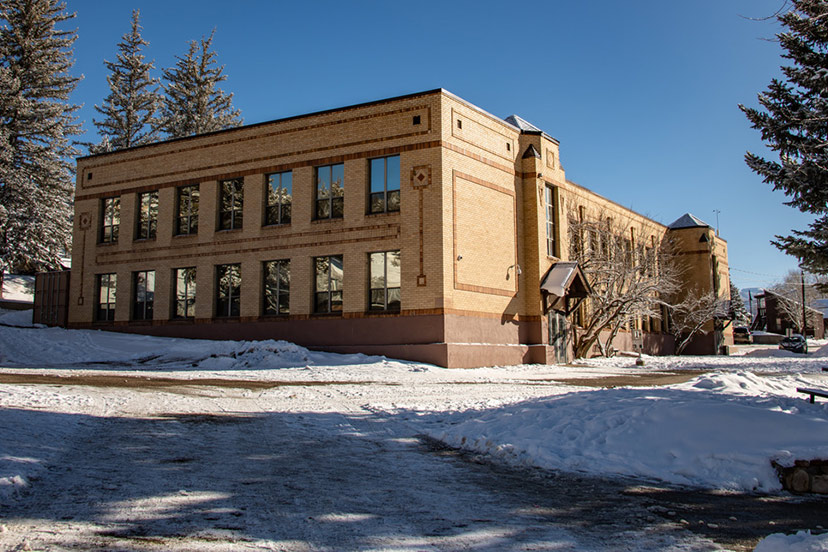
…was once the Pagosa Springs High School. Then, it served as the Junior High. It currently serves our 5-6 grade students. When the Colorado Department of Education inspected our school buildings in 2010, this 1928 building was in generally better shape than the Pagosa Springs High School, built in 1998. The High School was in even worse shape in 2025, according to a study by RTA Architects.
Sadly enough for our American society, newer buildings — typically — do not hold up as well as older buildings.
During the first half of the 20th century, the Pagosa Springs economy depended on the timber industry and ranching. Unlike certain other Colorado towns that blossomed with elegant brick buildings following the discovery of gold or silver or other precious metals — towns like like Durango and Telluride — no one discovered gold or silver in Archuleta County, so the community built out slowly, in a modest fashion.
As did our Archuleta schools.
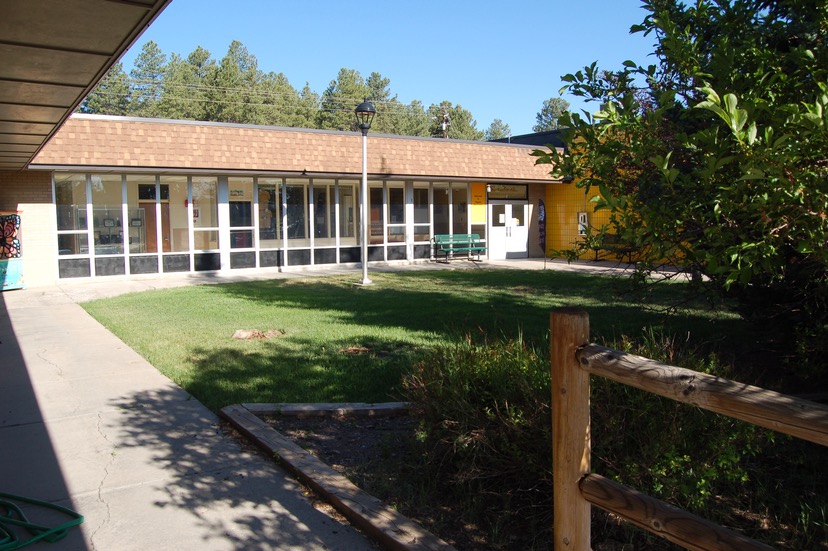
The main building at the current Pagosa Springs Middle School was constructed in the 1950s to serve as the High School, and was later remodeled and expanded as enrollment increased, adding a second gymnasium. That main building now serves mainly grades 7-8, while the adjacent 1928 building serves grades 5-6.
The current Elementary School was built in the 1960s and was likewise remodeled and expanded as enrollment grew. The school now serves Pre-K through grade 4.
All three school buildings have remained relatively functional for over 60 years.
During the meetings of ASD’s Master Plan Advisory Committee (MPAC) last year, the architect firm facilitating the meetings presented a document purportedly showing that students perform better, academically, in newer K-8 facilities than they do when elementary ages attend separate schools from middle school ages. You can download that document here.
However, if anyone bothered to research the studies quoted in that document, they would find that none of the studies were conclusive. You can read an Education Northwest essay about that little problem, here.
But we have access to many conclusive studies that there is one main driver of academic achievement and personal growth.
Excellent teachers.

Any particular building in which students meet and learn has relatively little to do with academic achievement or personal growth. As a local example, the students who meet and learn at the Pagosa Peak Open School — in what was formerly an office building — achieve roughly the same CMAS scores (Colorado Measures of Academic Success) as the students who meet and learn in ASD facilities that were specifically designed as school buildings.
Nevertheless, ASD could improve the learning environments in all our existing buildings for much, much less than the cost of building a new $130 million K-8 facility priced at nearly $1,000 per square foot.
For comparison, the former office building in which Pagosa Peak Open School now operates was purchased for about $110 per square foot. The 36,000-square-foot school recently spent about $1.2 million on safety-related renovations, funded largely through grants… and renovated its playground, also funded with grants, to the tune of $800,000.
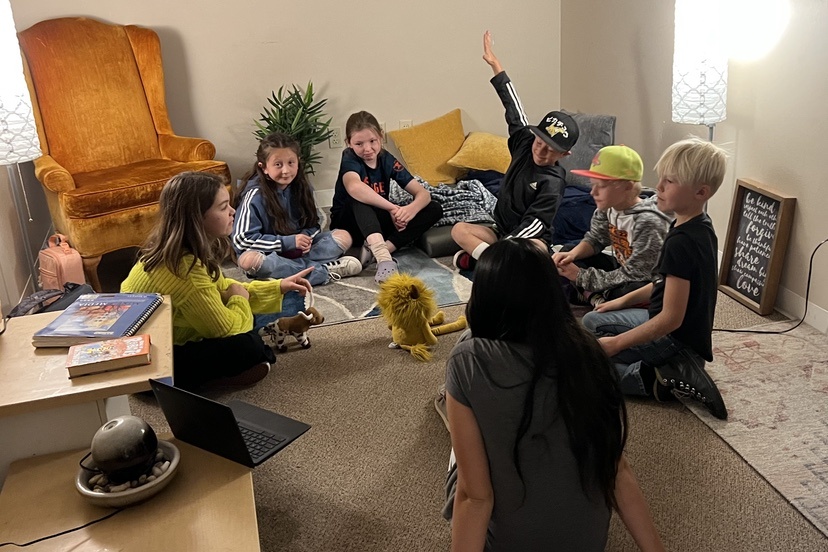
These significant renovations at PPOS did not increase anyone’s property taxes.
Why isn’t the ASD Board of Education taking the same kind of approach to our facilities?
You can ask them, if you wish, at their scheduled January 21 meeting, at 6pm at the Middle School Library.