
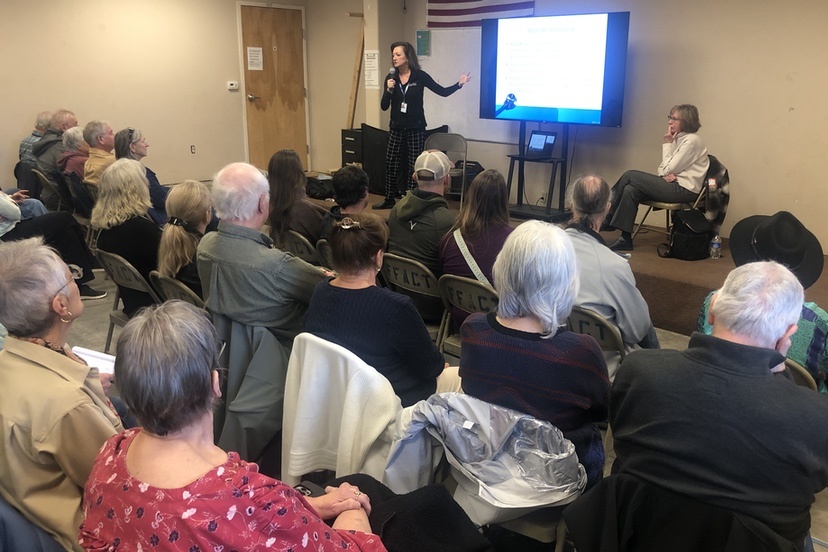
Photo: Pagosa Springs Medical Center CFO Chelle Keplinger presenting to the public in March 2025.
Pagosa Springs and Archuleta County have faced a number of challenging years lately… politically, economically, culturally. Not all of the challenges have been generated locally; some have resulted from national, or even international, circumstances. There’s not much we can do, here locally, about those situations.
But… we can do whatever we can.
Yesterday in Part Two, we considered a few happenings during the first quarter of 2025. Let’s continue down memory lane…
In April, I spent a couple of weeks writing an editorial series called “Taxpayers and the Entities They Support” — about the economic conditions in Archuleta County, beginning with a presentation by the Pagosa Springs Medical Center (PSMC) staff about the financial conditions at our local hospital — a facility largely funded through federal Medicare and Medicaid reimbursements. The continuation of those reimbursements were looking uncertain as Congress and the Trump administration moved forward with a purported mission of reducing the cost of our federal government.
The Upper San Juan Health Service District has been operating an ambulance service in Archuleta County since 1985 — a critical need in those days, because the nearest hospital was in Durango, 60 miles away. Then in 2006, the District asked the voters for permission to go deeply into debt to build a hospital in Pagosa, and the voters overwhelmingly approved the plan. Pagosa Mountain Hospital — to be later renamed ‘Pagosa Springs Medical Center’ — opened its doors in 2008.
The financial key to success was the ‘Critical Access Hospital’ designation, under which the new hospital would be reimbursed by Medicare for 101% of its costs for treating enrolled Medicare patients. The reimbursement at PSMC has since dropped slightly, to about 99% of actual costs.
Nationally, health care systems are typically reimbursed only about 80% of the cost of treating Medicare patients.
From what I could tell from a cursory visual survey of the people who attended 2025 presentation by PSMC CEO Rhonda Webb and CFO Chelle Keplinger, nearly everyone in the room appeared to be qualified for Medicare.

From my April editorial:
The Colorado Healthcare Affordability and Sustainability Enterprise (CHASE) collects a fee from general hospitals and uses it to claim matching funds from the federal government, increasing health care funding overall. CHASE published a report in January 2025 that included this chart:
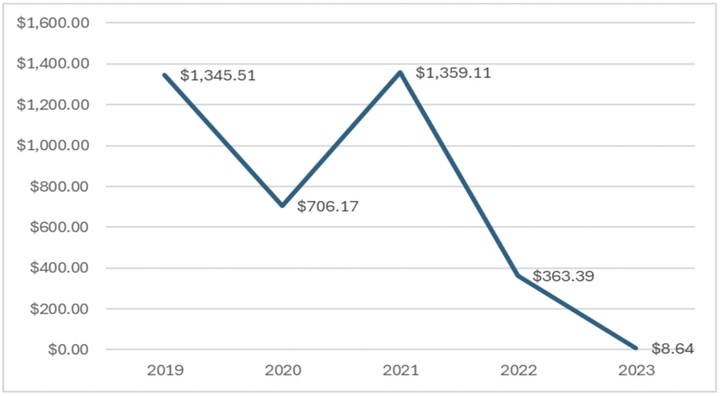
What we see here is Colorado hospitals retaining in 2019 — on average — about $1,300 per patient served, above their cost.
The average amount dropped in half in 2020, as people began avoiding hospitals during the COVID crisis in 2020.
Then the federal government backfilled the health care industry during 2021, and ‘payment less cost’ rose back up to 2019 levels. But something else happened in 2021. A large number of employees began leaving the health care industry, while at the same time, inflation hit the supply chain. In order to attract employees, hospitals had to increase salaries.
According to CHASE, in 2023, Colorado hospitals were retaining only $8.64 per patient in payments less costs. That’s not a typo. Eight dollars and 64 cents.
At the public presentation, CEO Rhonda Webb explained that PSMC’s margin per patient could be even less this year…
Especially if the Trump administration made significant cuts to Medicare and Medicaid.
Here’s CFO Chelle Keplinger, at the presentation:
“We don’t know how many people are going to start seeking their care in the Emergency Room. It’s a lot cheaper to do it in a primary care setting, but [Medicaid patients] currently have no limits and no co-pays. So if they’re seeking care in the primary care, they’re doing the right thing. But that doesn’t mean they will be able to afford that, going forward.
“Or how many people who simply won’t seek care. There’s going to be that population too.”
Ms. Keplinger noted that, while the Trump administration seems intent on cutting Medicaid, we also had a Colorado government looking at a $1.2 billion shortfall for 2025-2026, partly due to increased Medicaid costs.
Medicare and Medicaid together comprise 70% of the business at PSMC, Ms. Keplinger told the audience.
“So the loss of the provider fees to our facility — based off the 2024 numbers — would be $3.2 million. That’s a lot for us…”
But if Medicaid-expansion recipients are indeed deleted from the rolls, the shortfall at our local taxpayer-supported hospital might be $4.3 million.
“Worst case scenario,” she said.
That worse case scenario has not in fact unfolded, but challenges remain. Here’s a note from CEO Rhonda Webb, sent yesterday:
The federal One Big Beautiful Bill passed in July 2025 and will result in cuts to PSMC revenue over the next 7 years. In 2026, there are anticipated cuts to the number of Archuleta County residents currently covered by Medicaid (anticipated elimination of 3,771 adults and 208 children) as well as a reduction of Medicaid supplemental payments for an overall estimated 2026 reduction to PSMC’s revenue of $1.06 million
The only potential source of new federal funding is the Rural Health Transformation Program (RHTP) which is a federal grant opportunity for which Colorado HCPF/Medicaid applied in November 2025. This funding is not expected to provide a general influx of dollars to support Medicaid and it is not yet clear how or if PSMC can qualify for RHTP funds. There are many reasons why people need Medicaid support – they are often seniors, people with disabilities, children, pregnant women, or persons who work but wages are low – no matter the reason, PSMC will continue to care for the Medicaid population.
Thanks,
Rhonda
I find this statement encouraging.
“PSMC will continue to care for the Medicaid population.”