
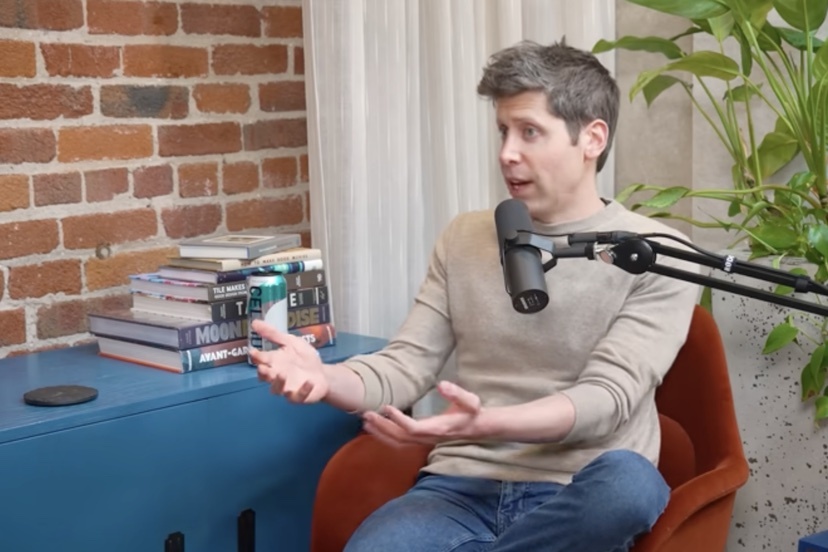
I came across a video last weekend — an interview with OpenAI CEO Sam Altman (shown above) on Theo Von’s “This Past Weekend” show — and it got me thinking about the future. Something I normally try not to do. Because, you know… the way things are going.
You can watch a brief excerpt from that video interview in this column, below.
A few of America’s wealthiest tech bros have weighed in recently on the idea that, pretty darn soon, we won’t have jobs in the future.
I say: bring it on, boys. I’d rather be watching football.
Of course, as I say that… maybe we won’t have any football to watch. Because football is sort of a job, for certain people. From what I can tell, a really hard job, in fact. A lot harder than writing humor columns. I mean, physically harder.
Who are these tech bros who want to predict a future life of leisure for us? Or, a life of boredom?
Bill Gates, for one.
“In terms of making things, and moving things, and growing food over time, those will be basically solved problems,” Mr. Gates told late-night host Jimmy Fallon last February. And we wouldn’t have to basically solve these problems ourselves, because AI is basically going to solve them for us.
He didn’t say anything specifically about still having to walk your dog, but we can assume that would also be basically solved. Somehow.
Society might have to reconsider the length of the work week, he said. Maybe the “weekend” could be five days long? That would allow for a lot of football to watch. If those jobs still exist.
Mr. Gates said humans will want to reserve some tasks for themselves. (Like watching football?) It’s not clear who exactly would do the ‘reserving’ of these tasks. The big tech companies seem to be making a lot of the decisions these days. So presumably a couple of the ‘reserved tasks’ would be ‘posting to social media’ and ‘watching ads on YouTube’.
Also, actual humans will still be required, I assume, to keep the marijuana industry alive.
Tesla CEO and former federal employee Elon Musk is on track to become the world’s first trillionaire. He predicts a future where AI and robotics will make everyone rich, in a world where we’re all benefiting from “universal high income.” Or so he wrote on social media last month.
“There will be no poverty in the future, and so no need to save money.” Work will be like a hobby, or like playing a video game. “Kind of sounds like heaven,” he wrote.
The mention of “heaven” may have been an unfortunate metaphor, however, because some people will interpret it to mean everyone is dead. Sure, technically, if we were all in heaven, there would be no need to save money. But if we all become trillionaires here on earth, and life is like playing video games, then heaven might actually be a let-down. Do they even have video games in heaven? No one really knows.
While Mr. Musk thinks we’ll all be extremely wealthy and enjoying life, other tech bros have a more nuanced outlook. Nvidia CEO Jensen Huang said in an interview with Joe Rogan that he sees a middle ground between a “universal basic income” and “universal high income”. He didn’t exactly explain, however, how “basic” the “universal basic income” might be.
CEO Huang warned that the concept of “AI-created abundance” shouldn’t focus solely on monetary wealth. “Like, for example, today we are wealthy of information,” he said in his December interview. “This is a concept, several thousand years ago, only a few people have.”
You can say that again. Several thousand years ago, people didn’t have shows like Joe Rogan or Jimmy Fallon.
Of course, when half of the ‘information’ we have is misinformation, maybe we shouldn’t be too excited.
At The New York Times’ Dealbook Summit in December, Anthropic CEO Dario Amodei said 20th century economist John Maynard Keynes may have foreseen how AI will change the workforce.
“[Keynes] suggested that maybe his grandchildren would only have to work 15 or 20 hours a week,” CEO Amodei said. “That’s a different way of structuring the society.” Plenty of hours left for walking the dog, that’s for sure.
In an interview with influencer Theo Von last summer, OpenAI CEO Sam Altman said he didn’t like the term “universal basic income”. He prefers “universal extreme wealth”.
But maybe it’s not actually “universal”?
The host, Theo Von, asked him to explain how the economics of the world’s vast new wealth would play out.
Mr. Von — wearing a Detroit Tigers baseball cap — looks and sounds like someone who’s more comfortable discussing sports betting than quantum computing, but Sam Altman clearly thinks a lot about our AI-driven future.
(Mr. Altman was drinking a can of ‘Celsius’ rather than a beer. Just something I noticed.)
Here’s a brief video excerpt from that interview.
If you watched this clip, you heard Mr. Altman suggest the idea that the world’s newly-generated “wealth” might, in the future, consist of “tokens”. He starts off with the idea that there’s about 8 billion people in the world (8,000,000,000) and that AI would generate 8 quintillion “tokens” (8,000,000,000,000,000,000) that would be distributed to the world’s population.
“Tokens” being something like money, I guess.
But he quickly catches himself, and shifts gears… explaining that, actually, AI would generate 20 quintillion “tokens” and 12 quintillion would accrue to “the normal capitalistic system.” Only the remainder, 8 quintillion, would accrue to the world’s population.
So the “normal capitalistic” tech bros like himself would split up — among themselves — the lion’s share of the vast wealth generated by AI, and the rest of us — 8 billion of us — would get the scraps.
Sort of like how the world works already.
“That’s like a crazy idea,” he suggests…
…and, as he says, maybe a bad one.