
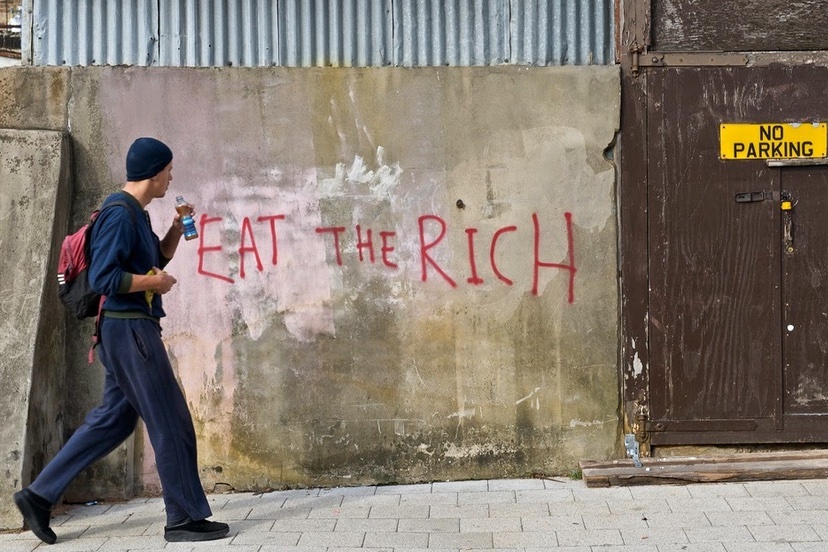
My fourth grade teacher, Miss Paradis, had immigrated from Quebec — or so she claimed — and she did her best to introduce us to the French language.
To this day, I can still count to “five” in French, thus illustrating the value of public education.
Most of my elementary school teachers labeled themselves as “Mrs.” rather than “Miss”, suggesting that they were married and weren’t burdened with paying the rent by themselves, on a meager teacher salary.
When a teacher went by “Miss”, we understood that she was still looking for a husband and hadn’t yet found Mr. Right. Or else, Mr. Right hadn’t yet found her.
Still, the salary was just as meager.
One phrase that Miss Paradis could have taught us — but didn’t — is commonly attributed to famous philosopher Jean-Jacques Rousseau.
Quand le peuple n’aura plus rien à manger, il mangera le riche.
Translation:
When the people have nothing left to eat, they will eat the rich.
Jean-Jacques Rousseau may have said this, but if so, very few people heard him say it. Statements get attributed to famous people to make them sound more important that they probably were at the time. This happens even in France.
From what I can tell, the attribution dates back to 1793, during the French Revolution. It’s possible that the person who came up with this idea — poor people, eating rich people — was an ordinary man-on-the-street, not the least bit famous. Maybe a butcher, or a baker. Or a candlestick maker.
Or the wife of a candlestick maker. “Mrs. de Bougies.”
Certainly, if the French lower classes had decided to eat the rich — during the tumultuous French Revolution when so many were starving — they would have come up with a decent sauce to serve alongside. Few nations are as proud of their cuisine.
Here in America, we’d simply toss them on the grill with some salt and pepper, and call it good.
These days, eating the rich is easier said than done, because the rich tend to live in gated communities, protected by security features like video cameras and motion detectors. They might even live on a private island, depending on how rich they are.
I’m writing about this topic, not because Miss Paradis failed to teach us an important lesson in fourth grade, but because young people have begun carrying protest signs at demonstrations, bearing the slogan, “Eat the Rich”.
From the Swiss news outlet, Le Temps, August 2023:
«Eat the rich», le grand retour de la lutte des classes au nom de la planète…
Alors que les inégalités se creusent, les militants écologistes multiplient les actions visant spécifiquement les personnes fortunées et leur train de vie. La lutte des classes renaît-elle de ses cendres?…
“Eat the rich”: the great return of the class struggle in the name of the planet…
As inequalities widen, environmental activists are stepping up actions specifically targeting wealthy individuals and their lifestyles. Is the class struggle being reborn from its ashes?…
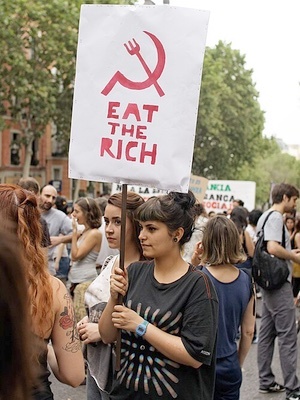
This woman, shown above, carried her “Eat the Rich” sign at a protest in Madrid, Spain, in 2012. Obviously, the slogan has gone international. We probably wouldn’t see the “Fork and Sickle” symbol at an environmental protest here in the U.S. — even though it’s a damn clever idea to replace the “Hammer” with a “Fork”. People are less fearful of class-struggle humor in Europe.
The original expression — whoever may have said it — was a simple prediction about the future: what will happen when we have nothing more to eat. But in the hands of the environmental movement, the expression has become an imperative. Something we are told to do, even if we’ve already eaten a big breakfast. “Eat the Rich”. For the good of the planet.
…l’expression est devenue «Eat the rich» en traversant l’Atlantique deux siècles plus tard, et elle fait un tabac auprès des générations Y et Z, fleurissant sur les réseaux sociaux (665 millions de mentions sur TikTok) et sur les pancartes de manifestations…
…the expression became “Eat the rich” after crossing the Atlantic two centuries later, and it has become incredibly popular with Generations Y and Z, flourishing on social media (665 million mentions on TikTok) and on protest signs…
That’s a lot of mentions on TikTok.
If I were a rich person — say for example, if I owned a tech company like Oracle or Dell Computers — I would probably want to acquire ownership of TikTok and attempt to erase all those mentions.
Underrated writer Louis Cannon grew up in the vast American West, although his ex-wife, given the slightest opportunity, will deny that he ever grew up at all. You can read more stories on his Substack account.