
According to the news over the weekend, it looks like 2025 might not have been so bad after all… compared with what’s coming in 2026…
…considering that the U.S. government staged an attack on Venezuela on Saturday morning and kidnapped its president, Nicholas Maduro. Perhaps the Trump administration was jealous of Russia conducting its four-year war with Ukraine, and wanted to keep up with the Joneses… by starting its own nasty war?
Will this new violation of international law directly affect us here, in The-Middle-of-Nowhere Colorado? That remains to be seen.
But regardless, we have certain struggles to contend with.
Five years ago — on December 29, 2020, to be exact — I began writing a ten-part editorial series entitled “One Hell of a Year.”
As you might guess, the story focused on some recent events in Pagosa Springs that struck me as unfortunate, beginning with some actions taken by the Town of Pagosa Springs aimed at making our community “better”… but which were probably making it worse…
…as sometimes happens, when governments start throwing their weight around.
My series began with a brief discussion about “gentrification”, an ongoing process in many American cities like Denver and Boulder, where we’re watching low-income neighborhoods overtaken by wealthy developers and investors and replaced with upper-class high-rises. It’s not always clear where the lower-income families — often, people of color — are displaced to.
We haven’t seen much of that particular type of gentrification in Pagosa Springs, partly because wealthy people relocating to southwest Colorado are often looking for scenic, isolated ranches rather than luxury urban apartments. Such ranches have become harder to find, however.
I also wrote, in that article series, about the efforts by the Town of Pagosa Springs to control development within its municipal limits, beginning with the creation of a new “Comprehensive Plan” in 2004 and 2005.
From a short article by reporter Tess Noel Baker in the weekly Pagosa Springs SUN, August 2004:
The Town of Pagosa Springs has received just over $60,000 in grant monies to help kick off an 18-month comprehensive planning process.
Julie Jessen, town special project director, said Pagosa Springs’ home rule charter, adopted in the fall of 2003, requires the town to update its comprehensive plan every five years.
“The town had a plan — ‘Plan for Progress’ — created in 1979, but it was never formally adopted,” Jessen said. The new comprehensive plan will address housing, economic development, health and safety, natural environment, public infrastructure, transportation, parks, recreation, trails and open space, community facilities, and growth and development. Currently, the town is considering different consulting packages. Whatever the final schedule, Jessen said, “intense public input,” will be sought from as many people as want to participate…
…”The plan will also include a general history of Pagosa Springs, how it has developed, and a vision of the future,” Jessen said.
The plan was later updated, and the version the Town Planning Commission was working with in January 2020 was… well, it was complicated.
I happened to be serving on the Town Planning Commission in January, and if anyone took the time to try and understand the 363 “goals” that the Plan professed to be working toward, they might have come to the same conclusion I had come to: that the Plan was attempting to do two contradictory things:
- Preserve the character of our historic downtown, as it currently exists.
- Change the historic downtown, and the rest of the town, into something ‘better’ than what it is.
As I said: it’s complicated.
Another event was taking place in January 2020, of course. Some readers may remember hearing about a newly discovered virus causing respiratory illness in China. It was soon to be declared a ‘pandemic’.
But many of us in Pagosa Springs had other things on our minds. Wolf Creek Ski Area was celebrating its 80th year of operation. Pagosa Springs Medical Center was planning its annual ‘Heartbeat Ball’ for February 29. The Town Council listened to a presentation urging the Town to install more charging stations for electric vehicles.

LPEA was posting new, higher electric rates.
I also had other things on my mind. As a newly-appointed member of the Town Planning Commission, I was hoping to help the Commission make some changes in two important documents: the Land Use and Development Code, and the Town’s Comprehensive Plan.
The Comp Plan had been updated three years earlier by out-of-town consultants whose main concern, it seems, was to list every possible community “upgrade” that might conceivably happen over the next 10 or 20 years. They had come up with 363 goals, just waiting to be achieved. In other words, the 2017 Comprehensive Plan was not a “plan”, in any real sense of the word. It was a collection of hypothetical ideas, most of which could not possibly see the light of day.
An organization the size of our Town government is lucky if they can achieve half a dozen community-wide goals in a given year. A dozen would be a real stretch.
But the Town Council and the Planning Commission had been handed 363 goals.
Also, the Comp Plan was not internally consistent. For example, one of the goals in the plan’s <em>Economic Vitality</em> section was:
14. Attract and retain a balance of tourism and non-tourism-dependent industries and businesses to increase economic resiliency and minimize the seasonality endemic in the local tourism economy.
A fine idea, which has been kicked around by our local leaders for at least the past 20 years — like a can kicked down the road. The Comp Plan likewise kicked it down the road — because the Plan included literally dozens of “tourism-dependent” goals… but included maybe two mentions of one theoretically-viable “non-tourism-dependent” industry:
“Alternative energy”.
Where were all the other “non-tourism-dependent” industries that the Town government could work at promoting? I was unable to find them described in the 2017 Comp Plan — which suggested, perhaps, that the Town government was actually planning for a lot more “tourism”… and not much “non-tourism”.
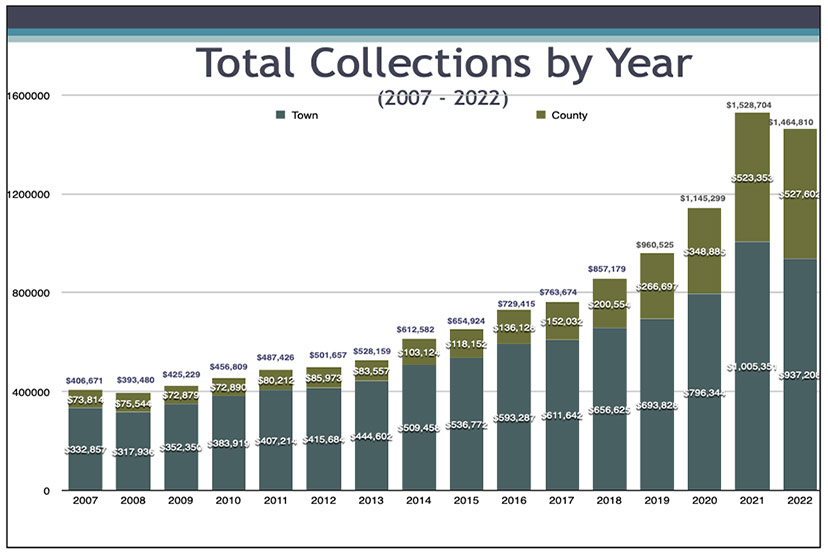
This has in fact, turned out to be the case. Lodgers tax collected from tourists doubled between 2017 and 2022. No new “non-tourism industries” have appeared.
Here’s another instance of “complicated” (contradictory) goals, sitting right next to one another on the same page in the Comp Plan’s Culture, Heritage and the Arts section.
13. Design and locate buildings to respect the characteristics of the surrounding natural landscape. Buildings should follow the local architectural pattern and be located at the toes of slopes or edges of meadows…
14. Promote and provide diverse housing types and opportunities for housing choices for all, understanding that housing type and densities are context sensitive to rural and urban areas…
If you read these two goals separately, they each seem sensible. But unfortunately, our existing buildings and our “local architectural pattern” in downtown Pagosa Springs reflected a bygone era, when lumber was cheap, labor was cheap, concrete was cheap, and people weren’t charged thousands of dollars in permit fees so the Town Planning Department could tell them what could and could not be built within the town limits.
Basically, what was once “affordable” to build in Pagosa Springs was no longer affordable. In order to realistically provide “diverse housing types and opportunities for housing choices for all”, future housing for working families would probably need to be very different — architecturally and materially — from what was build here in the past.
Unfortunately, the 2017 Town Comprehensive Plan gave us no guidance regarding these two goals.
Which future was the Comp Plan aiming to create?
Because, as I understand the world, you can’t have your cake, and eat it too.