
This story by Allen Best appeared on BigPivots.com on January 4, 2026 as part of “Three glimpses of pivots underway in Colorado”
In early October, while in Grand Junction, we took the opportunity to say hello to Gene Byrne and visit him and his wife, Maggie, and their geothermal system amid the peach orchards overlooking the Colorado River near Palisade.
We have known Gene since the 1990s when he was in Glenwood Springs and helping assemble plans to reintroduce the Canada lynx into Colorado. That project has been a huge success.
Retiring to Palisade, Gene decided he wanted to do his part in shedding the need for fossil fuels. Solar has been part of that journey. More recent has been addition of an electric induction stove and now an electric car, too. Gas is still part of the infrastructure at the Byrne home, such as for grilling and the hot-water heat, but its use is much diminished.
Mostly the couple heat with geothermal, and because this is Palisade and it gets hot, they use the coolness of the ground for cooling, too. “Instead of taking the heat out of the ground and bringing it into the house, it takes the heat out of the house and puts it back into the ground,” Gene explained after our dinner. “That’s what makes it work.”
Geothermal was installed the same time the house was built in 2004. Although the location is served by Xcel, the Delta-Montrose Electric Association then had a program to help homeowners who wanted to adopt geothermal.
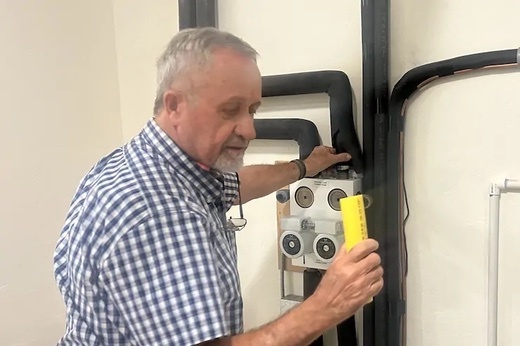
“While we were not in their service area, they wanted to install 200 systems as a demonstration to show how well geothermal works,” Gene explained as we toured his home’s mechanical room after dinner.
Paul Bony, who ran the program for Delta-Montrose Electric, most recently has been an apostle of geothermal in the Yampa Valley in the employ of the Western Resilience Center, formerly the Yampa Valley Sustainability Council.
In many places, geothermal uses vertical wells. That would be necessary on a city lot. Gene and Maggie have 14 acres. The six polyethylene pipes were laid in trenches in a field 100 yards long and 20 yards wide. The pipes are four to five feet below ground where the year-round temperature varies between 52 and 57 degrees. Peach trees have been planted on top. Water augmented by 15% glycol solution to prevent freezing is circulated through the 3,600 feet of piping.
Electric-powered compressors allow the heat, or coolness, to be delivered at desired temperatures, much the same way that an electric freezer uses a condenser, in that case to create coldness. This takes energy, but Delta-Montrose estimated that this system would deliver $4 of energy for every $1 of cost. It cost them $23,000 to install.
“We are incredibly happy with the system,” said Gene.
In 2012, the couple also invested in a solar system. Installed by Atlasta Solar of Grand Junction, the cost of $29,785 was defrayed by an $8,085 rebate from Xcel, a federal tax credit of $6,510, and further savings when Xcel purchases excess electricity for its use. In this, Gene estimates he and Maggie have accrued a gross profit of almost $14,000. It provides 91% of their electricity.
Most recently, the couple purchased a Chevrolet Equinox and an EV charger. About 95% of the charging is done at home. For these 11,400 miles of home-charged driving, the total cost was $362.
All of this sounds almost too good to be true, Gene says. Much of it was based on tax credits. But even without tax credits, it is better than the old ways. And if you’re building a home to use for 30 years, going all-electric with at least some of these systems needs to be part of the equation.
“You know, if everybody did a little bit of this it would make a huge difference,” he said.
As for those peach orchards of the Talbott Farms outside their door, they will soon become probably Colorado’s most spectacular display of the marriage of agriculture and PV panels. It is, of course, called agrivoltaics.
As for geothermal, we have been gathering notes since 2022. We had a couple of big stories in 2025 about geothermal and schools. During 2026, it’s time to get a lot more of these stories over the finish line and shared with our media partners across Colorado.
Allen Best publishes the e-journal Big Pivots, which chronicles the energy transition in Colorado and beyond.