
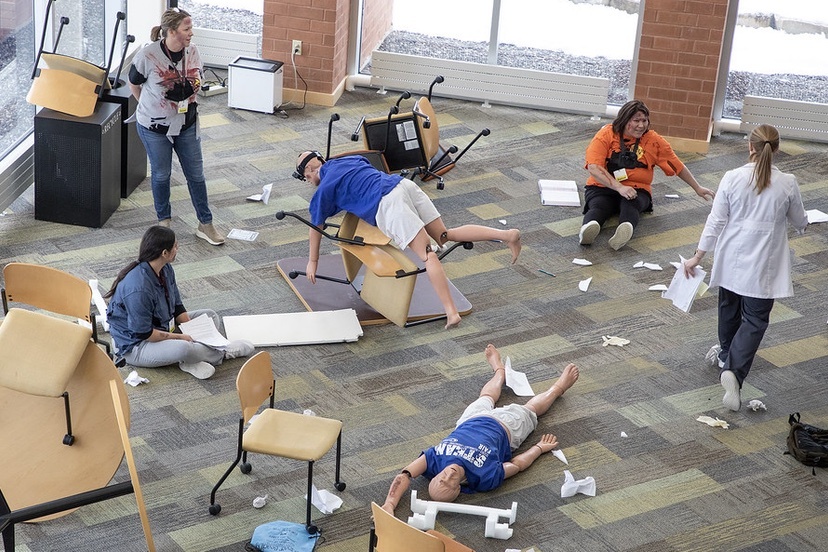
Photo: 2nd Annual Red Hawk Rescue Simulation, Kenosha Campus, March 2023.
I’ve been reading the news lately. And watching the news. And listening to the news.
Like many other people, I’ve come to the conclusion that we’re living in a computer simulation. Nothing that’s going on right now could possibly be real.
Dr. Melvin M. Vopson, Associate Professor of Physics, University of Portsmouth, agrees with me. Or maybe I agree with him. Either way, we agree.
But for different reasons.
Dr. Vopson argues that we’re living in a simulation because the mathematics behind how the universe functions doesn’t match up with how the universe actually functions.
Either the mathematics that explain the physical universe are wrong, or else we live in a computer simulation. Obviously, mathematics can’t be wrong.
His theory (which I totally don’t understand, having earned a “C” in high school physics class) has something to do with entropy, and also with “the quantification, storage and communication of information.” He outlined his theory more fully in the American Institute of Physics journal called AIP Advances, in October 2023. I don’t recommend reading it, unless you did a lot better in high school physics than I did.
But we don’t need physics professors to tell us we’re living in a computer simulation. (Thankfully.)
Most of us learned about this whole “living in a computer simulation” when we watched the 1999 movie The Matrix, starring Keanu Reeves as the computer-hacking hero, who went by his hacker name “Neo”. His real name was Thomas Anderson, but after he swallowed the red pill, it became obvious that he preferred to be called “Neo”. (In 2014, we learned that he had taken the name “John Wick”.)
The Matrix was directed by brothers Larry and Andy Wachowski, who later changed their names to Lana and Lilly Wachowski.
Lana announced her gender transition in 2008, and Lilly came out as a woman in 2016.
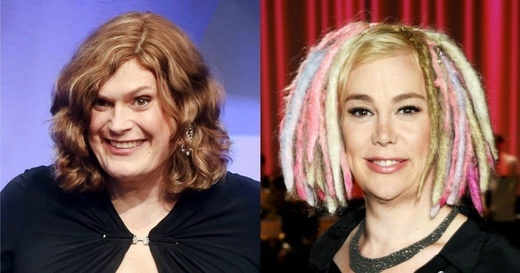
Obviously, people changing names, and even genders, is an important part of the computer simulation we’re living in.
In a 2023 summary of his theory, published on TheConversation.com, Dr. Vopson wrote that people have been considering this idea for centuries.
The earliest records of the concept that reality is an illusion are from ancient Greece. There, the question “What is the nature of our reality?”, posed by Plato (427 BC) and others, gave birth to idealism. Idealist ancient thinkers such as Plato considered mind and spirit as the abiding reality. Matter, they argued, was just a manifestation or illusion.
The article displays a detail from a painting by Raffaello Sanzio da Urbino — a fresco created for Pope Julius II for the Vatican library.
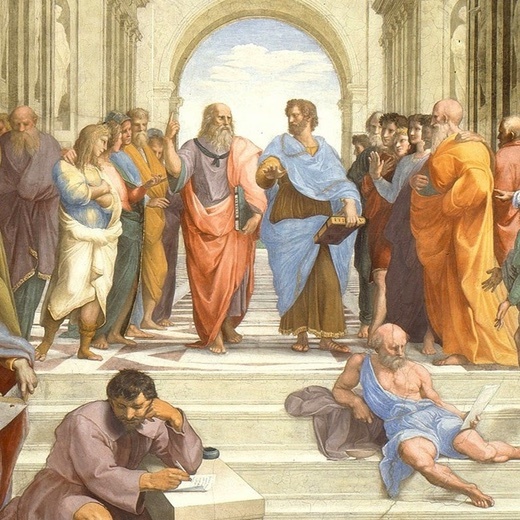
The artist is better known these days by the easier-to-pronounce name “Raphael”. I haven’t discovered yet who initiated this name change. Just another part of the simulation.
In the center of the painting, pointing at the sky, is Plato, and the guy to his right is Aristotle, and they’re walking through a Roman mall where where numerous famous philosophers and teachers are philosophizing and teaching. Plato and Aristotle were, however, Greeks, and presumably never had an opportunity to walk through a Roman mall.
This type of virtual-reality glitch — people appearing in places where they have no business being — is what is referred to these days as “hallucinating”.
Hallucinating is nothing new, but we now know that even computers can hallucinate.
Dr. Vopson has proposed that — assuming that everything in the universe is a simulation — then protons and electrons and other elementary particles must be carrying bits of information telling them how to behave, and if so, this ‘information’ must have physical qualities such as weight. So the weight of an electron is partly the little instruction manual it’s carrying around.
He writes:
“I’ve devised an experiment that proposes a way of extracting this information to prove it’s there.”
His experiment proposes to detect and measure the information contained in elementary particles by using particle-antiparticle collisions — the type of collisions that happen every day of the week at particle accelerators like the CERN Large Hadron Collider in Switzerland. Pretty ordinary stuff, really.
“This experiment is highly achievable with our existing tools, and I’m hoping the crowdfunding site will help us achieve it.”
Yes, the good doctor established a crowdfunding page and raised about $8,000 to fund the test. (That’s £5,965.00, which was the crowdfunding goal.)
As I stated, Dr. Vopson and I agree that the entire universe might be a computer simulation, but we have different reasons for holding that opinion.
He has proposed to prove his theory by smashing particles into antiparticles, and has apparently raised enough money to fund the experiment.
My theory? Only in a computer simulation could a physics professor crowdfund £5,965.00 to prove that we live in a simulation.
I ran across a recent video interview with Dr. Vopson (which you can view here) and it sounds like his proposed experiment has not yet taken place. It also sounds like his employer, the University of Portmouth, would prefer that Dr. Vopson stop talking about the experiment. But he was willing to talk about it anyway.
More proof.
Underrated writer Louis Cannon grew up in the vast American West, although his ex-wife, given the slightest opportunity, will deny that he ever grew up at all. You can read more stories on his Substack account.