
I mentioned briefly, in Part One, the struggle by the non-profit ‘Pagosa Springs Community Center’ organization to fund the operations and mortgage payments for their facility on Hot Springs Boulevard, following its opening in 2002. Estimates from state-funded consultants had suggested that user fees and grants would be sufficient to cover the facility’s operating costs.
That didn’t happen. Soon after the facility opened, it became apparent that the Town of Pagosa Springs would have to pay the facility costs out of its tax revenues. Eventually, the non-profit was dissolved and the Town officially became responsible for operating the Community Center.
I’m not able to determine, from a cursory review of the Town’s annual budget, how much it costs the community’s taxpayers to run the Community Center. I assume most people never give it a thought. It’s simply another government expense, like so many expense items that make our community more livable, or safer, or more profitable to certain businesses.
During the December 10 presentations by the recently-formed Pagosa Area Recreation Coalition (PARC) held in the Community Center’s South Conference Room, the packed audience was shown a series of 33 slides, indicating responses to a non-scientific survey on the subject of recreational needs and issues in Archuleta County.
I refer to the survey results as ‘non-scientific’ because PARC did not control the population sample to achieve what would normally be considered an accurate representation of the entire community. In other words, the survey results might be meaningful, or they might not. But they’re what we have, so far.
Here’s one of the slides.
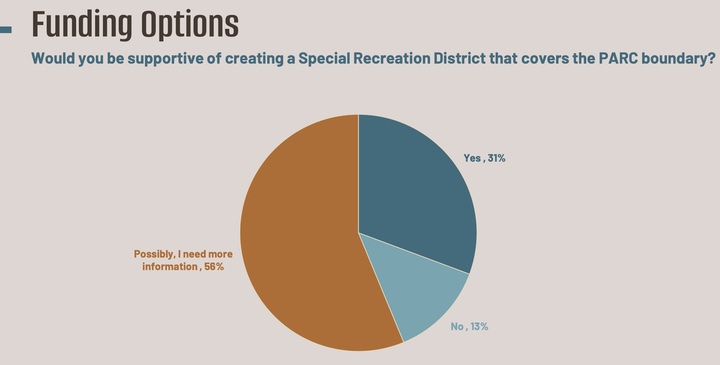
Of the people participating in the survey, slightly less than a third indicated support for a “Special Recreation District”.
According to the map at the Department of Local Affairs website, there are three “Park & Recreation Districts” in southwest Colorado: the Montezuma-Dolores County Metropolitan Recreation District, the Norwood Park & Recreation District, and the D Mountain Park & Recreation District in Montrose.
Essentially, a ‘Park & Recreation District’ is a government entity with an elected board and with the ability to extract property taxes from the properties and businesses within the district, or to be funded through sales taxes. When the survey mentioned the ‘PARC boundaries’, it meant this area:
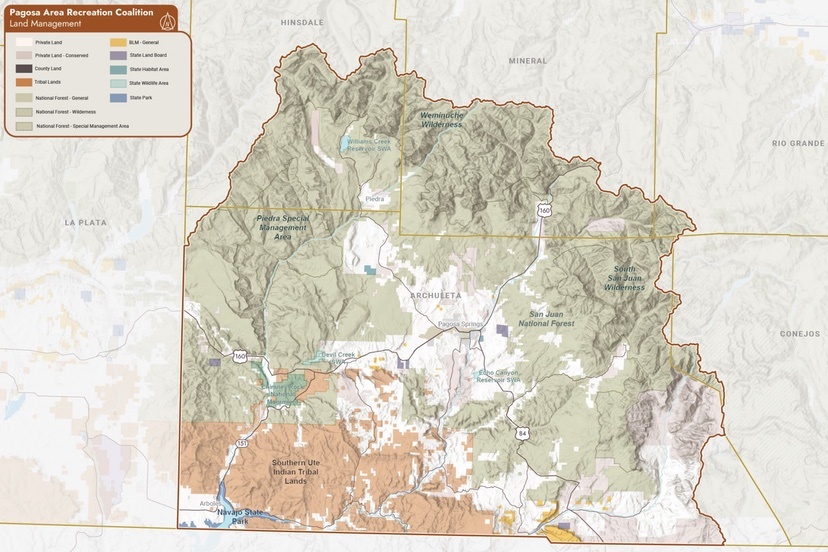
Looking at this map, we can see that about half the property within the PARC boundaries is federally owned (green), and another 20% is under the administration of the Southern Ute Indian Tribe (brown). Naturally, much of the “outdoor recreation” in this area is conducted on National Forest lands. Our “government-organized” recreation is handled almost exclusively by the Town government’s Parks & Recreation Department. Both the Town and County offer financial support to certain non-profit recreation groups.
Here’s a bit of somewhat amusing history.
Back in 2014, the Archuleta Board of County Commissioners were considering the need for a Park & Recreation Special District, and made a decision to do a particular type of community survey — by placing two “advisory questions” on the November ballot.
To take the community’s temperature, so to speak, on the creation of another tax-funded government agency.
Nonbinding, advisory question 1A:
“Would you be in favor of the Town of Pagosa Springs and Archuleta County combining their park and recreation efforts and programs through the creation of a Parks and Recreation District?”
Yes/for: 3,375.
No/against: 1,815.
So, basically, a 3-to-1 vote in favor of creating a new collaborative district.
But then, question number two:
Nonbinding, advisory question 2A:
“If a Parks and Recreation District is formed it has to be funded. Would you support a permanent sales tax not to exceed 1 cent as the sole source of funding?”
Yes/for: 2,047.
No/against: 3,173
So, basically, a 3-to-2 vote opposing the use of local taxes to fund such a recreation district.
Yes, the community favored a collaborative recreation district, in concept, so long as they didn’t have to pay for it.
Do we think our community has changed significantly since 2014, in terms of its willingness to tax itself? Maybe not for recreation. Maybe not even for better roads.
This same idea may have been evidenced by the PARC survey itself, despite of its lack of scientific validity.
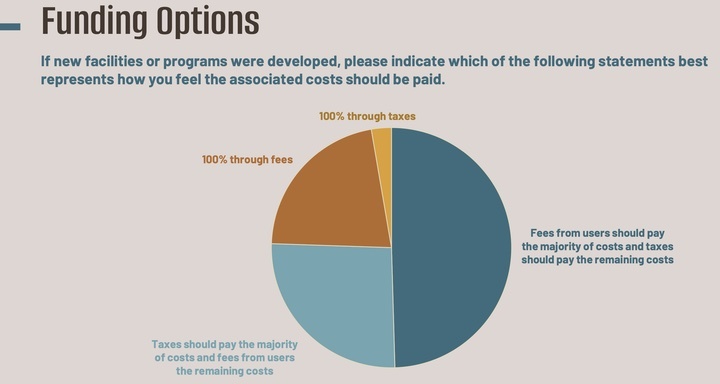
Only a tiny sliver of the respondents thought a new recreation coalition should be funded entirely through taxes. Close to 75% thought “user fees” should be the main, or only source of funding for recreation programs.
This December marks 21 years of writing my editorials for the Daily Post about our local governments and the people who influence them. It’s been a fascinating ride, in part because our governments find certain needs and desires worthy of support, and other needs and desires less worthy.
And at the same time, we have needs and desires that the voters will support with higher taxes, and some they won’t.
Lately, our two primary governments — Archuleta County and Town fo Pagosa Springs — have been subsidizing the local tourism industry to the tune of about $1.5 million a year.
A total of about $10 million in subsidies, over the past ten years.
There’s no doubt these subsidies have helped to attract additional tourists, and boosted the profits of certain tourism-related businesses.
There’s also no doubt that the housing crisis for working families has worsened over the same period of time.
But investments by our two primary governments into solving the housing crisis? To make sure our workforce has housing they can afford?
Relatively little, by comparison.
Obviously, our governments want certain groups to benefit from tax revenues, and others, not so much.
I wonder which side of the ledger PARC will land on.