
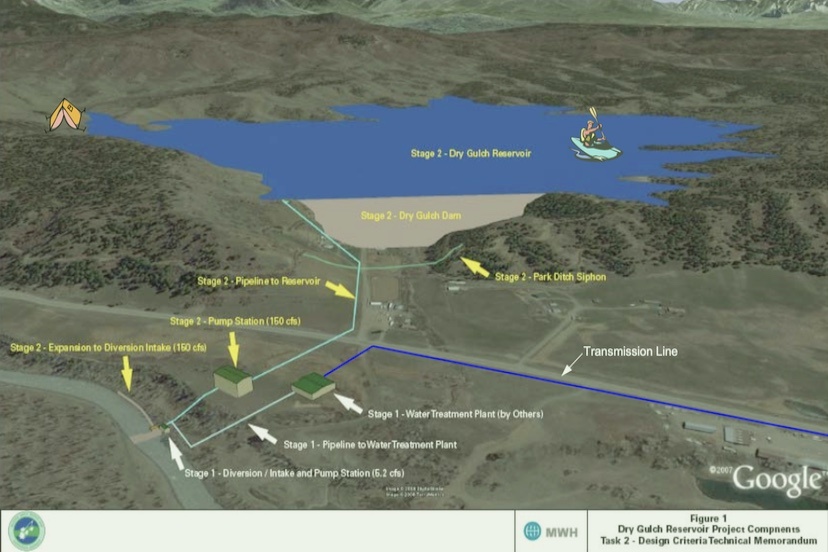
Image: PAWSD drawing from 2009 of a proposed $357 million Dry Gulch Reservoir project.
Nothing goes viral like conflict…
— Casey Fiesler, a professor of information science at the University of Colorado at Boulder, quoted by reporters Will Oremus and Tatum Hunter in The Washington Post, December 15, 2025.
In Part Three, we noted that the San Juan Water Conservancy District (SJWCD) hopes to build an 11,000 acre-foot reservoir in the Dry Gulch Valley, north of downtown Pagosa Springs. The planned reservoir would flood much of the existing Running Iron Ranch, which is jointly owned by SJWCD and the Pagosa Area Water and Sanitation District (PAWSD).
According to a map published by SJWCD in 2012, the proposed reservoir would also flood land owned by the San Juan National Forest and by the Laverty family. The San Juan National Forest and Laverty properties are shown in purple on this map:
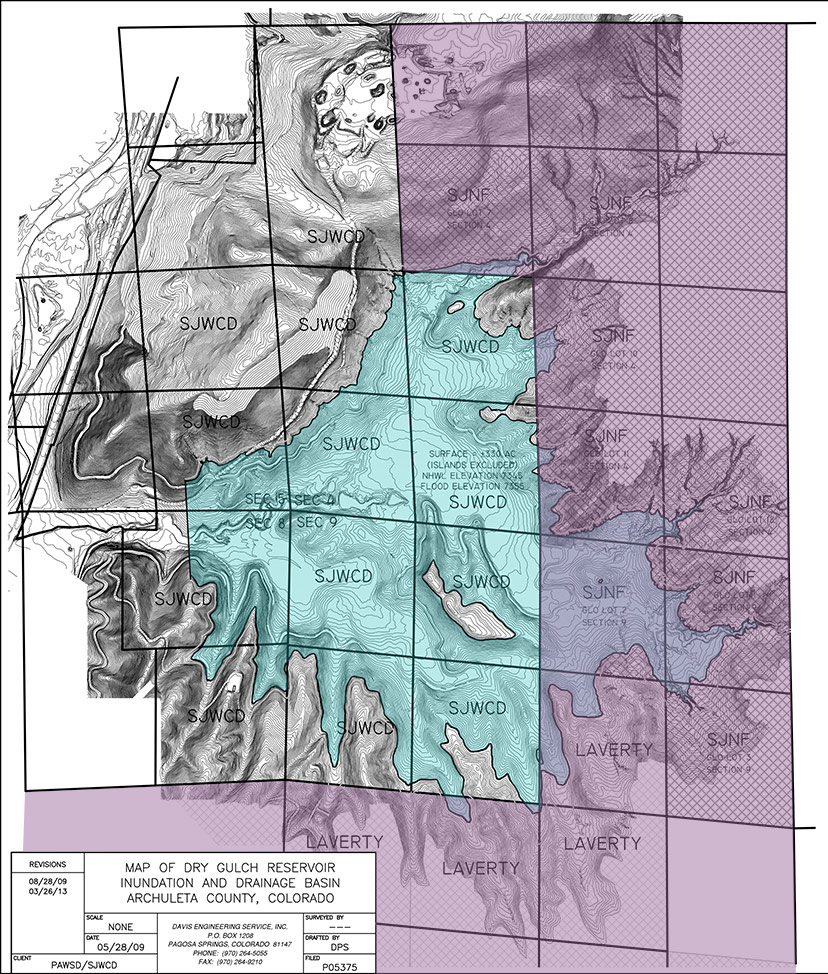
Since that map was published in 2012, neither San Juan National Forest nor the Laverty family have indicated an interest in providing land to SJWCD, as far as I know. Yet SJWCD has spent hundreds of thousands of taxpayer dollars in legal, engineering, and consulting fees to plan a reservoir for which they do not own sufficient property.
Since 2012, the co-owner of the Running Iron Ranch — PAWSD — has consistently expressed its position that an 11,000 acre-foot reservoir is neither feasible nor prudent. PAWSD would like to sell the Ranch, and has met with a potential buyer who has expressed an interest in helping construct a smaller reservoir on the Ranch, perhaps in the 3,000 acre-foot range. That’s larger than Lake Hatcher — the Pagosa community’s primary reservoir.
If such a reservoir were constructed, it could provide PAWSD with additional water security during drought years.
One big advantage to this smaller reservoir proposal: the taxpayers would not need to obtain additional property from San Juan National Forest and the Laverty family.
Disclosure: I currently serve on the PAWSD Board of Directors, but this editorial reflects only my own opinions, and not necessarily the options of the PAWSD Board as a whole, or the PAWSD staff.
I’m not a lawyer, but it’s my understanding that SJWCD cannot construct a reservoir on the Ranch unless they have PAWSD Board approval.
But can PAWSD sell the Ranch without SJWCD’s approval? That’s the question PAWSD posed to District Court in December 2024. A trial to address that issue is scheduled for May 2026.
According to a statement recently published by the SJWCD Board, SJWCD has thus far spent around $90,000 contesting PAWSD’s right to sell the Ranch. That cost will increase substantially if the two districts engage in a trial, which could conceivably be followed by an expensive appeal process.
The December 10 statement by the SJWCD Board mentions a December 5 Court Order denying portions of SJWCD’s request for a Summary Judgement:
The Conservancy District continues to work diligently to advance the reservoir project. The Conservancy District recently engaged RJH Consultants Inc. to support the Conservancy District with planning, design, and construction services. RJH has begun work on materials the Conservancy District plans to submit to the federal Bureau of Reclamation’s small storage grant program.
The District Court’s Order concludes a year in which the Conservancy District has spent almost $90,000 to pay lawyers, experts, and other litigation-related expenses. PAWSD is spending ratepayer funds on this lawsuit as well. A trial will multiply the costs for both Districts.
The Conservancy believes the Court’s Order and the WestWater Research financial analysis answer fundamental questions that have divided the Districts, and it hopes PAWSD is willing to engage with the Conservancy District in good faith discussions to end the costly litigation. Settlement would better serve the constituents of both Districts.
Speaking as one member of the PAWSD Board, I would be delighted to engage with the SJWCD Board in “good faith discussions to end the costly litigation.”
But I’m not sure I have the same definition for “good faith discussions” as the SJWCD Board has.
Back in Part Two, I quoted from a Daily Post editorial I wrote in 2020:
There is something to be said for consensus decision making, where everyone gives up a little, and everyone gets a little of what they want. Shoving things down peoples’ throats is the opposite of ‘consensus’ — but it’s all too often a government’s mode of operation…
What are the issues that “good faith discussions” might resolve, between these two taxpayer-funded districts?
My personal ideas:
1. Even though the long-range planning and demographic documents published by PAWSD since 2012 suggest no need for additional reservoir storage between now and the end of the 21st century, I believe the PAWSD Board could be talked into supporting a potential 3,000-acre-foot reservoir on the Running Iron Ranch, as an emergency source of water during extended drought. PAWSD has been presented with a proposal by Zipper Valley Ranch that could lead to the construction of precisely such a reservoir.
2. The 2019 demographic assessment funded by SJWCD, which you can download here, projected a relatively modest population growth rate of less that 2% annually for Archuleta County. That approximate population growth rate has been confirmed by actual demographic evidence since 2019, although the growth rate of summer tourism has been considerably higher.
3. Looking at the issue from a national perspective, the U.S. population growth rate has been on a downward trend since 1960, when the growth rate was about 2% annually. 2000 was the last year during which year-over-year population growth was above 1 percent, and the U.S. Census Bureau does not anticipate that population growth will exceed that level again. Instead, the Bureau projects that the population growth rate will continue to decline over the coming decades — from 0.5% in 2025 to 0.1% in 2055.
4. SJWCD probably does not have sufficient tax revenues to maintain a legal fight for an 11,000-acre-foot reservoir, especially if PAWSD denies them the right to build such a reservoir on the Ranch. It’s possible that 3,000-acre-feet is the largest reservoir that could arise from “good faith discussions”.
But that remains to be seen.
In the meantime, nothing goes viral like conflict.