

There is something to be said for consensus decision making, where everyone gives up a little, and everyone gets a little of what they want. Shoving things down peoples’ throats is the opposite of ‘consensus’ — but it’s all too often a government’s mode of operation…
— from ‘EDITORIAL: Your Thoughts About Water? Part Six’ by Bill Hudson, in the Pagosa Daily Post, September 2020.
Yesterday in Part One, I shared a public statement approved by the San Juan Water Conservancy District (SJWCD) Board of Directors on December 10. The statement makes reference to Pagosa Area Water and Sanitation District (PAWSD) — co-owner with SJWCD of the 660-acre Running Iron Ranch north of downtown Pagosa Springs.
The statement reads, in part:
The District Court’s Order concludes a year in which the Conservancy District has spent almost $90,000 to pay lawyers, experts, and other litigation-related expenses. PAWSD is spending ratepayer funds on this lawsuit as well. A trial will multiply the costs for both Districts.
The “trial” mentioned here is scheduled for spring, 2026. This trial — if it moves forward — will address the conflicting interpretations of a 2016 agreement between PAWSD, SJWCD, and the Colorado Water Conservation Board (CWCB).
Such a trial is indeed likely to be lengthy and expensive, if I know anything about legal battles and attorney fees. The trial has not yet begun, and SJWCD has already spent $90,000 on “litigation-related expenses.”
In 2008, PAWSD borrowed $9.2 million from CWCB to purchase the Running Iron Ranch, but due to deferred payments and interest resulting from a revised agreement in 2016, PAWSD currently owes about $10.2 million on the loan.
I’ve been following the story of the proposed, and controversial, ‘Dry Gulch Reservoir’ since 2008, when the Archuleta Board of County Commissioners waived a subdivision application requirement for PAWSD and SJWCD, to allow an expedited purchase of the Running Iron Ranch from the Weber family, for $10.2 million.
Disclosure: I currently serve on the PAWSD Board of Directors, but this editorial reflects only my own opinions, and not necessarily the options of the PAWSD Board as a whole, or the PAWSD staff.
My preliminary research, in 2008, convinced me that the purchase of the Running Iron Ranch was a corrupt boondoggle perpetrated on the Archuleta County taxpayers. 18 years later, I still hold the same belief. I shared some of my reasons for that conclusion in a previous Daily Post editorial, back in 2009. You can read that analysis here.
The recent December 10 statement from SJWCD continues:
The Conservancy believes the Court’s Order and the WestWater Research financial analysis answer fundamental questions that have divided the Districts, and it hopes PAWSD is willing to engage with the Conservancy District in good faith discussions to end the costly litigation. Settlement would better serve the constituents of both Districts.
It’s quite possible that a “settlement” would better serve the constituents of both districts. In fact, the two districts share many the same Archuleta County constituents, although the SJWCD district is somewhat larger than the PAWSD district, but includes the PAWSD District. This map shows the two overlapping districts.
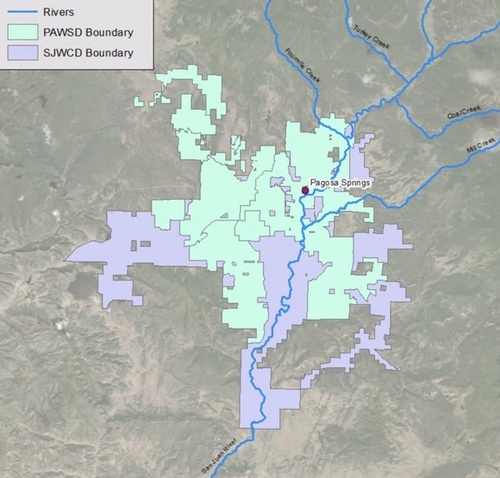
In other words, many of the same taxpayers are funding both sides of this legal battle.
There is — in my humble opinion — zero chance that the two districts can reach a settlement. PAWSD customers are paying $250,000 annually towards the Running Iron Ranch mortgage, and accruing a similar amount of additional interest debt annually, to repay a loan for a project that the current PAWSD Board believes is neither feasible nor prudent.
PAWSD would like to sell the Ranch and relieve its customers of these annual financial obligations. PAWSD has received an offer from a potential buyer willing to pay off the $10.2 million still owed, and also allow — and help facilitate — the construction of a reservoir on the Ranch.
SJWCD meanwhile believes the project is both prudent and feasible, and apparently has no problem watching PAWSD customers accrue $500,000 in annual financial obligations, partly because SJWCD pays not one penny towards the mortgage.
SJWCD, as a joint tenant of the Ranch, has refused to allow the sale of the Ranch and after ten years of failing to line up a financial partner to help build the reservoir, has outright rejected an offer from the only potential reservoir partner to step forward.
Meanwhile, the December 10 public statement from SJWCD suggests that “settlement would better serve the constituents of both districts.”
What could such a “settlement” look like? After spending four years previously serving on the SJWCD Board and a similar amount of time since then on the PAWSD Board, I cannot imagine any kind of reasonable consensus “settlement” being approved by the SJWCD Board.
There are couple of interesting aspects to this unpleasant and expensive conflict that we might want to consider.
The 2016 agreement between PAWSD, SJWCD, and CWCB states:
…As Project leader, the SJWCD, in consultation with the CWCB and PAWSD, shall:
4.5.2.2. have the authority to use its best efforts, given the resources available, to take steps and actions to move the Project forward, including to attempt to acquire land necessary for the Project pool basin or to facilitate a land exchange with the U.S. Forest Service or others, pursuant to Paragraph 1.5.3 below; and
4.5.2.2. promote and develop additional Project stakeholders; and
4.5.2.3. take the lead on future water court proceedings in applications for reasonable diligence and other measures reasonable and appropriate to proceed with the Project; and
4.5.2.4. provide day-to-day management and Project facilitation as needed.
4.5.3. Given that the value of the Running Iron Ranch directly affects the CWCB’s future reimbursement of its investment with the PAWSD, the SJWCD shall consult with and obtain written approval from the CWCB and the PAWSD before proceeding with any future land exchanges with the U.S. Forest Service or any other entities.