
The Council on Criminal Justice, a nonpartisan think tank, on Thursday released the first comprehensive national analysis of arrests since federal authorities stopped publishing detailed arrest statistics in 2020.
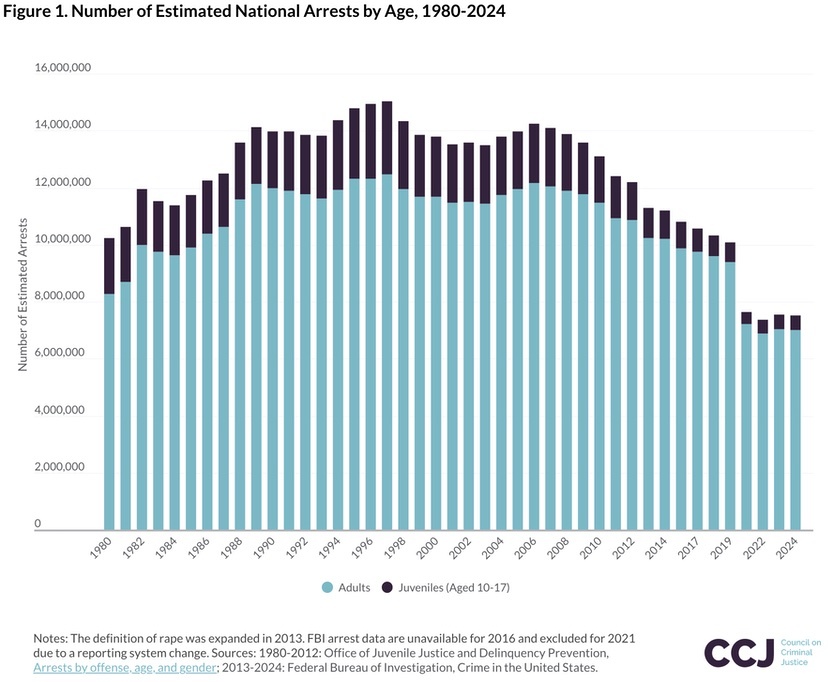
The United States has experienced sweeping shifts in arrest patterns over the past four decades. Following substantial increases in the 1980s and 1990s, national arrest rates declined steadily and dropped sharply in 2020 amid the widespread disruptions associated with the COVID-19 pandemic, including changes in public activity and law enforcement operations. Since 2020, arrests for both adults and juveniles have remained far below their historical peaks and below 2019 levels.
While some age, sex, and racial groups experienced modest increases from their 2020 lows, none have returned to pre-pandemic arrest levels.
These arrest patterns mirror long-standing reductions in crime nationwide, but they also reflect shifts in enforcement practices and broader social changes. They also occur as rates of reported violent and property crime return to pre-pandemic levels and as homicide rates in many cities fall back to low levels not seen since the early 1960s.
Arrest data are vital for understanding public safety, enforcement priorities, and how communities experience the justice system. But the nation has lacked a reliable picture of arrest trends in recent years. The federal government stopped publishing demographic arrest rates after 2020, leaving policymakers, researchers, and the public without a consistent way to track changes across age, sex, race, and offense type.
The brief — which is available here — restores that visibility. By combining historical federal estimates with recent FBI data, it rebuilds national arrest rates from 1980 through 2024 to provide a clear, comparable picture of how arrests have changed across demographic groups and offense categories. For the first time since federal reporting ended in 2020, decision makers can again monitor national arrest trends using a consistent, historically anchored dataset.
Periodic updates of this resource will be published in CCJ’s online data library, The Footprint: Tracking the Size of the American Criminal Justice System, as new FBI figures are released. For details, see the Supplemental Methodology Report.
Key Takeaways
The total number of arrests in the U.S. fell sharply in 2020 during pandemic-driven shifts in public activity and enforcement—and it has changed little since then. The 2024 arrest total was 25% lower than in 2019, the year before the pandemic, and half the number in the peak year of 1997.
The combination of falling arrests and rising resident population has driven down the national arrest rate, which in 2024 was 30% lower than in 2019 and 71% below its peak in 1994.
Drug arrests, in particular, have cratered. In 2024, the drug offense rate for both adults and juveniles was roughly half the 2019 level.
Juvenile arrests now make up a much smaller share of national arrests. In 1980, 19% of arrests were of juveniles. Since 2018, this share has been at or below 7%. This drop marks a generational shift in youth exposure to the justice system.
Juvenile arrest patterns are shifting. In 2024, the juvenile drug crime arrest rate fell below the juvenile violent crime arrest rate for the first time since 1993, reflecting a change in the composition of youth arrests.
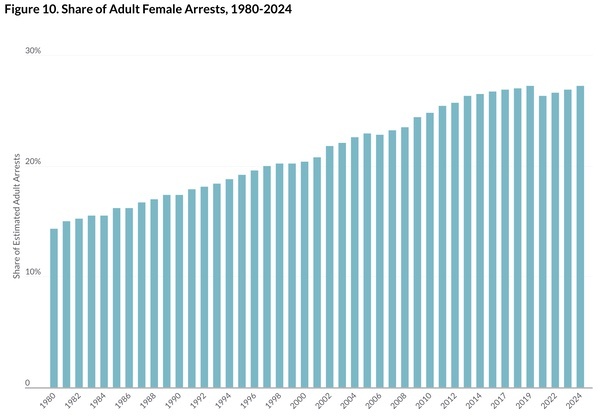
Arrest rates have fallen sharply across age and sex groups, though recent trends—particularly among juveniles—differ from long-term patterns. In 2024, the adult male arrest rate was 8% lower than in 2020 and 66% below its 1989 peak; the adult female rate was 3% lower than in 2020 and 42% below its 2009 peak. Juvenile arrest rates for both sexes peaked in 1996 and remained far below those levels in 2024—85% lower for boys and 77% lower for girls—even as rates increased 10% for boys and 23% for girls between 2020 and 2024.
With male arrests falling more steeply over time, females now account for a larger share of arrests than four decades ago. Adult women’s share rose from 14% in 1980 to about 27% since 2020, and girls’ share of juvenile arrests increased from 18% to about 31%.
Arrest trends by offense type follow long-term declines, but recent juvenile patterns diverge. Violent, property, and drug crime arrests for adults and juveniles all peaked in the late 1980s to mid-2000s and remain below 2019 levels. Drug offense rates fell the most sharply, falling by about half for both adults and juveniles from 2019 to 2024.
Adult rates for all offense categories continued to fall or remained flat after 2020, but juvenile trends shifted: Between 2020 and 2024, boys’ violent and property arrest rates rose 13% and 9% (while drug arrests fell 13%), and girls’ violent, property, and drug arrest rates rose 29%, 13%, and 7%, respectively.