
Already December. Gosh, time flies when you’re having fun.
Thanksgiving is over. Black Friday has passed, and so has Small Business Saturday. Today is Cyber Monday, offering still more shopping deals as we barrel towards the Christmas holidays.
In Part Two, I shared comments from Pagosa Springs Town Council member Leonard Martinez during the November 18 Council’s discussion about increasing — or not — the $71 per month sewer fees paid by downtown residents. He characterized the fee increase — as recommended by Town staff — as a “slap in the face'” to the supporters of Ballot Measure 2A.
Council member Brooks Lindner agreed that the households who voted overwhelmingly to pass 2A, to establish a new 1% sales tax to address needed sewer repairs and upgrades, should not be saddled unfairly with higher monthly fees as well.
“I came to the meeting tonight thinking that I did not want to support the increase on this rate, mainly because the voters didn’t vote in favor of 2A also expecting a rate increase. There certainly wasn’t any messaging specifically towards that, saying, ‘Hey, help us out. Give us this 1% tax increase and we’re still going to need to raise your rates as well.’ In fact, it was probably the opposite. Most folks probably thought, well, if we support this sales tax, then they aren’t going to keep raising the rates.
“So I just think it’s a really bad look for us, if we pass this increase. At this time.”
The Council did, however, approve an increase to the sewer district’s ‘CIF’ — the Capital Investment Fee — from $6,500 to $7,500. That fee is paid by new construction within the Pagosa Springs Sanitation General Improvement District (PSSGID). I suppose that could be considered a slap in the face, for newcomers and home builders who will also be paying the new 1% sales tax.
For comparison, the CIF for building within the Pagosa Area Water and Sanitation District (PAWSD) sewer service area was recently saw a huge increase — from $1,179 to $16,168. This fee is on top of a connection fee of $545, plus a Tap Fee based on the actual cost of facilitating the sewer connection.
Disclosure: I currently serve as a volunteer on the PAWSD Board of Directors, but this editorial reflects only my own opinions and not necessarily those of the PAWSD Board and staff.
Prior to the establishment of the Colorado Water Quality Control Commission, circa 1950, homes and businesses in Pagosa Springs and Archuleta County relied on individual outhouses and septic systems. But around 1950, Colorado began to finally enter the 20th century, and small towns started developing sanitation systems, which — as one might expect — became ever more expensive to maintain and run, as additional water quality rules were established.
Case in point: PAWSD was recently required to reduce the amount of organic nitrogen in its sewer outflow, and this requirement has cost the district about $10 million to upgrade the Vista Wastewater Treatment Plant. Thus, the increased sewer bills for PAWSD customers, and much higher PAWSD CIF for new construction.
The Town’s PSSGID system pumps its sewage seven miles uphill to have the wastewater treated by the PAWSD Vista plant, and PSSGID recently agreed to pay one-quarter of this $10 million upgrade. That’s $2.5 million.
My great grandchildren (if I have ultimately have any) will likely be raising my great great grandchildren by the time this mandated 2025 Vista upgrade is fully paid for. But we can be reasonably confident that additional upgrades will be required in the meantime. I hope my great grandchildren find high-paying jobs.
We’re witnessing a good deal of face-slapping here in the U.S. lately. But the Town Council unanimously agreed with Mr. Martinez and voted not to increase the monthly sewer fees. “At this time”.
 In Part One of this editorial, I mentioned some ideas I’d run across in the book, Paper Girl: A Memoir of Home and Family in a Fractured America, by journalist Beth Macy. I’d come across the book title during my explorations on the Internet, and was able to borrow the book through an inter-library loan.
Her comments about President Clinton and the NAFTA agreement of 1994 caught my attention. Like Ms. Macy, I’m curious about how we got to where we are today, here in America, and I recognize that actions by the federal government play an important role. In Ms. Macy’s case, she specifically wanted to better understand what had happened to her hometown of Urbana, Ohio —pop. 11,000 and the home since 1933 of Grimes Manufacturing Company, where her mother worked on the assembly line. The company is now owned by Honeywell.
To read Ms. Macy’s account, things have gotten worse in Urbana. Drug abuse is rampant. Folks are unemployed. Politics has devolved into a fractured landscape. Hopelessness seems to be on the rise.
Ms. Macy points to a couple of key changes that helped bring about the loss of hope in places like her former hometown. College education — once held by American leaders to be a road to upward mobility, and to a better world — has become much more expensive, while receiving less support from taxpayer subsidies, with resulting long-term student debt now estimated at $1.8 trillion.
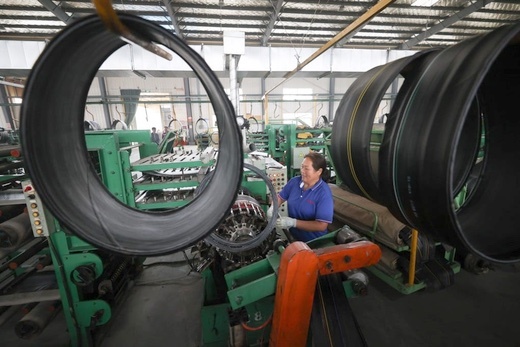
And America’s once-dominant manufacturing sector has been ‘off-shored’ to China, India, Vietnam, Mexico, Thailand, etc.
While frustration around recent educational, economic, and political trends in America are certainly understandable, the story, as always, has at least two sides.
Globalization and the reduction of education funding may have been a bad deal for Urbana, but they may have been a great benefit for China, India, Vietnam, Mexico, Thailand, etc.
How about… for Pagosa Springs, Colorado?
I’ve spent the past 20 years writing about my hometown of Pagosa Springs, as a journalist. My writing hasn’t produced a bestselling book, but it has helped me understand some of the educational, economic, and political trends here.
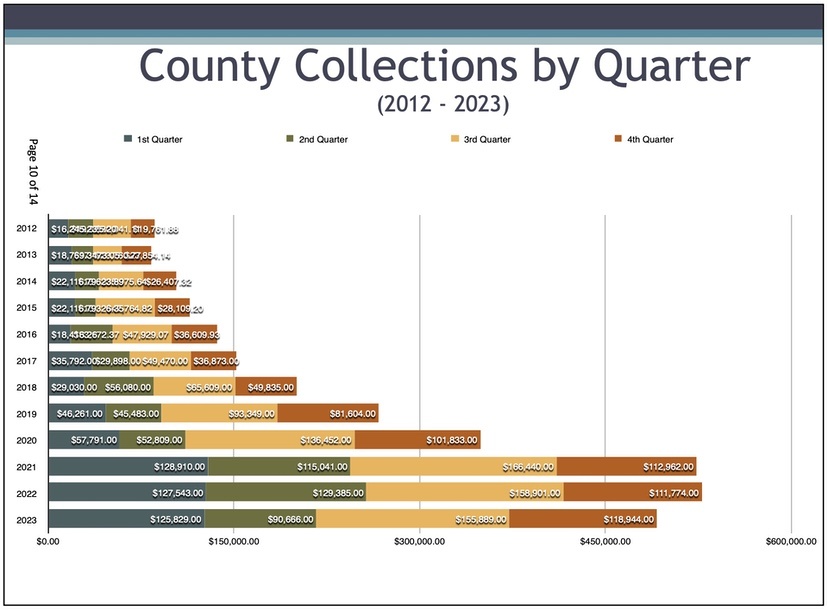
The amount of Lodgers Tax brought in by tourism, for example. It’s easy to spot the trend.
I don’t mean to be harsh, but, politically, our community is run by amateurs. Very few of the elected leaders who sit on our local governing boards — the Town Council, the Board of County Commissioners, the Pagosa Area Water and Sanitation District, the School Board, etc. — have experience in governing multi-million-dollar organizations. They often govern by ‘common sense’ rather than by experience.
I include myself in this group, of course, because I serve on the PAWSD board, and on the Pagosa Peak Open School board.
As board members, we rely heavily on the organization’s staff, who usually — but not always — have relevant experience. But let’s be honest. No one has experience with what is currently happening in America at the federal government level.
We’re all navigating without a map, and without any stars to guide us.