
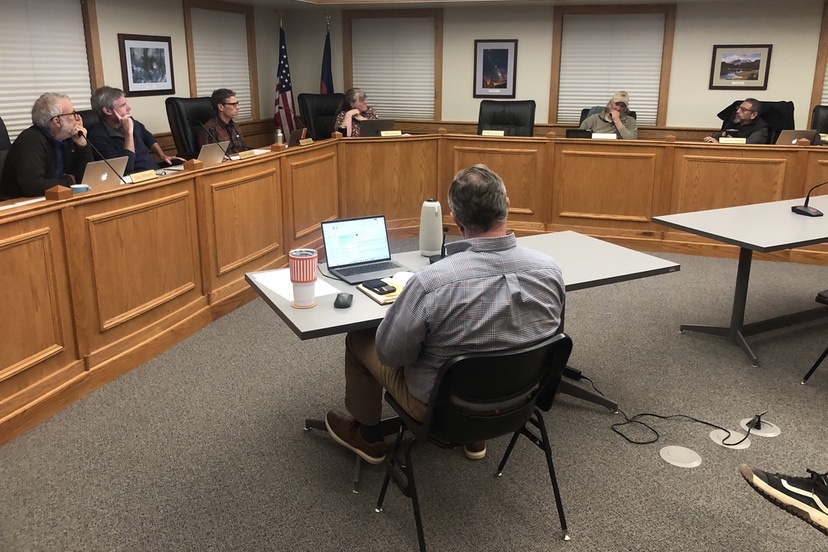
Photo: The Pagosa Springs Town Council and Town Manager David Harris listen to comments by Council member Leonard Martinez, far right, November 18, 2025.
The Town Council asked the voters, earlier this month, to establish a 1% sales tax to be used to address a serious need for municipal sewer repairs and upgrades for the Pagosa Springs Sanitation General Improvement District (PSSGID), in the downtown area east of Piedra Road. The Town’s financial advisors conceded that the tax will cost a typical family $12 – $15 a month in increased grocery expenses. No calculation was provided for the added cost of other necessary purchases.
In response to that information, the Town Council passed Resolution 2025-18 on October 7, indicating that they might — might — feel comfortable holding PSSGID customer bills at the current $71 a month, instead of increasing the bill to $76 a month as previously scheduled.
The increase to $76 was calculated by consultants well before a 1% sales tax was even considered. To address rising maintenance and repair costs.
Those calculations caused a sharp increase in sewer service for town residents. In 2020, households were paying about $47 a month — about the same amount Pagosa Area Water and Sanitation District (PAWSD) sewer customers are currently paying.
But by 2023, the Town’s fee had increased to $53 per month. By 2025, it hit $71…
The impacts were also felt by our downtown schools and certain businesses that pay a multiple of the $71 “per EU” fee.
Considering that PSSGID will soon be collecting maybe $3.5 million in additional income from the new sales tax — thanks to an overwhelming approval of Measure 2A by town voters — perhaps the monthly fees can now actually be lowered to be more in line with PAWSD fees?
More in line with 2020 fees? To make up for the extra taxes downtown families will be paying for food and necessities?
From Resolution 2025-18:
3. Rate Stabilization. The Town Council acknowledges that the scale of the required wastewater infrastructure investment is significant. Any future rate adjustments will be determined based on the PSSGID’s financial needs and operational requirements. The Town Council is committed to exploring all possible options for rate stabilization.
This idea — “rate stabilization” — was discussed at the November 18 Town Council meeting at Town Hall.
When the topic of sewer fees came up at the PSSGID board meeting (the Town Council also serves as the PSSGID board) it was obvious that Town Manager David Harris and Town Clerk April Hessman were making the case for increasing sewer fees to $76 a month, regardless of Resolution 2025-18 and its promise to “explore all possible options” — and regardless of the additional $3.5 million that would now be flowing into the PSSGID budget as the result of the new sales tax.
I will admit to feeling slightly embarrassed by the staff presentation. I wonder if the Council was similarly embarrassed?
Manager Harris summarized the staff’s reasons for wanting sewer customers to pay a higher $76 a month fee.
“It should be noted that, at the time we created the budget [for PSSGID] we decided, as staff, to go with the [previous] rate study, which applied a $5 a month increase to the sewer service fees. We also have a recommendation to increase the Capital Investment Fee to $7,500.
“Part of the discussion that April and I have had about the finances and the new sales tax that’s coming in — we’re largely going to be dedicated that sales tax towards capital projects, as a general rule, and use some of the money to pay down the bonded indebtedness that we took on at the GID earlier this year.”
Last December, the GID was authorized to sell revenue bonds worth about $4.8 million to address some of the failed sewer pipes downtown. That debt was going to be financed by current and future sewer fee increases.
Obviously, the bonds can now be repaid using some of the new sales tax revenues, as Mr. Harris notes. So… no need to increase the fees on that account?
Mr. Harris:
“And we will be taking some of the [sales tax revenues] to repay the Town for its loan to the GID.”
That debt repayment was also scheduled to come from increased customer fees. So… no need to increase fees on that account?
Mr. Harris said the staff envisioned the monthly customer fees as paying for maintenance and operations, including an expansion of the GID staff.
I presume the added staff is necessary, only because of the greatly increased ‘capital projects’ budget and accelerated repair schedule? Paid by the sales tax?
Mr. Harris:
“If we don’t increase the fees to $76, it will be cutting things pretty tight.”
Really? We a
Perhaps you can see why I was feeling embarrassed by this presentation. The Town adds $3.5 million to what was previously a $1.3 million budget… and they’re “cutting things pretty tight”?
It’s a common problem. Government bureaucracies wanting more and more money, more and more staff, more and more buildings. We all can find ways to spend more and more money on more and more things and in that sense, government bureaucracies are no different from the rest of us. Nevertheless, they have the power to reach into our pockets.
Governing councils and boards occasionally disagree, however, with staff requests for more and more money — by taking a broader view of the community, and by taking into consideration struggling households.
We then heard from Council member Leonard Martinez.
Mr. Martinez helped spearhead the ‘Pagosa Sewer Solutions’ campaign committee that encouraged the overwhelming ‘Yes’ vote on Measure 2A. He had some thoughts about increasing sewer fees.
“Based on the feedback that our committee got, going door to door, there would… that increase would amount to a slap in the face, speaking of the people who supported 2A.
“So, on behalf of the committee, our strong recommendation is… you’re at the very beginning of this, not knowing what the [revenues] will be. At a very minimum, we should hold the fees flat, and look seriously at never increasing them again.”
Council member Martinez also recommended the establishment of a voucher program, to assist households that struggle to pay even $71 a month.
Disclosure: I also served on the Pagosa Sewer Solutions committee.
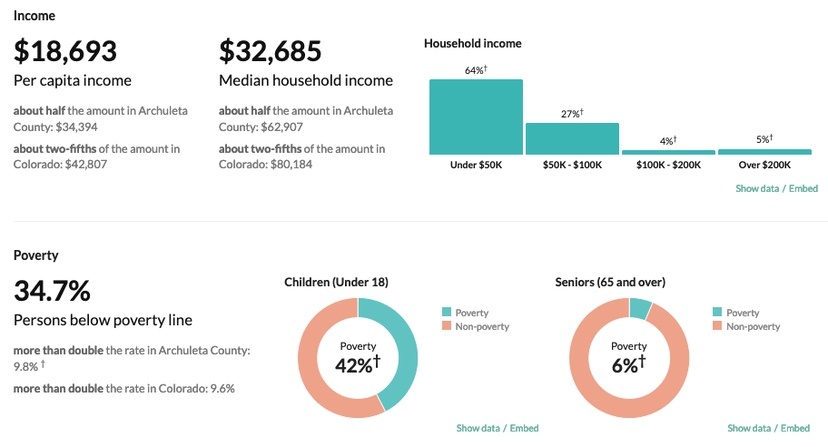
I’ve shared the following chart before, which displays homogenized, impersonal data. But it represents real live people, trying to make ends meet.
Town Clerk April Hessman noted that the GID serves a range of customers — schools, businesses, condos, homes, apartments, second-homes, vacation rentals — and she urged the Council to increase the fee to $76 a month, because “that will help the budget next year.”
Mayor Shari Pierce recommended “holding the rate for now” at $71, and then reviewing the revenues in the spring.
Council member Matt DeGuise commented that the $71 rate was originally calculated to help fund the massive repairs needed, and that those repairs are now able to be funded by the 1% tax increase. If the monthly customer fees are indeed directed at funding operations only… it’s quite possible they will be more than sufficient. (Maybe we can even go back to the $47 rate from 2020?)
At the conclusion of the Council discussion, the unanimous vote was to hold the monthly fees at $71 for the time being.
Which helped me feel much less embarrassed for our Town government.