
On the morning of November 5, 2025, the Archuleta County Clerk reported unofficial results of the previous day’s election, showing that Pagosa Springs voters had overwhelmingly approved a new 1% sales tax to be collected within the town limits. The resulting revenue would be used to address needed repairs and upgrades to the sewer system operated by the Pagosa Springs Sanitation General Improvement District — PSSGID, often fondly referred to by Town staff as “The GID”.
Tax increases in Colorado must be approved by the voters. In this case, only the voters living within the municipal limits saw the 1% sales tax measure on their ballots. 85% of the community’s residents, living outside the town limits in the unincorporated parts of Archuleta County — and who will pay the new tax, starting in January, whenever they shop in Pagosa Springs — were not allowed to vote ‘Yes’ or ‘No’ on the measure.
A decade ago, the Town built a seven-mile sewer pipeline to replace a failing lagoon treatment system, and currently pumps millions of gallons of sewage uphill the wastewater treatment plant near the Vista subdivision. That plant is operated by the Pagosa Area Water and Sanitation District (PAWSD), a separate governmental district that helped design the pipeline and loaned the Town money to help finance the project.
The pipeline has been nothing but headaches for the Town GID.
But that’s not the only sewer issue the Town has been struggling with. Many of the underground sewer lines within the town limits are in dire need of repair or replacement. A year ago, the Town estimated the GID repair bill at about $40 million, following a process of videotaping the underground pipes. Then, last spring, the Town determined that the seven-mile pipeline needed to be replaced with a Town-owned-and-operated treatment plant, at a cost of perhaps $50 million.
The new 1% tax is estimated to generate maybe $40 million over the next 10 years. Maybe more, depending on inflation. That should make a start on possibly $100 million worth of repairs and upgrades at the GID.
As some readers of the Daily Post may have noticed — and as I have concluded, based on covering Pagosa politics for many years — the cost of government infrastructure has become incredibly inflated over the past decade or so, beginning around the time of the Great Recession and the passage of the American Recovery and Reinvestment Act of 2009.
I wrote earlier this month about a plan by the Archuleta School District to build a new PreK-8 school building to replace the existing Pagosa Springs Elementary School and the Pagosa Springs Middle School. The architect consultants estimated the cost at around $125 million.
When we compare that to the cost of the Pagosa Springs High School — built in 1997 for $12 million — we get a sense of that cost inflation.
We’re going to discuss the November 18 meeting of the Pagosa Springs Town Council later, where the Town staff encouraged the Council to increase the monthly sewer fees on the same voters who had just voted to saddle themselves with higher grocery and shopping costs with a 1% sales tax.
The staff arguments in favor of increased sewer fees were certainly interesting.
But first, a slight detour.
I picked up a book at the Sisson library last week, by noted journalist Beth Macy.
Paper Girl: A Memoir of Home and Family in a Fractured America.
The title is a reference to the fact that, as a young girl, Ms. Macy had a job delivering newspapers — and then, after receiving her bachelor’s degree in journalism, became a reporter for The Roanoke Times in Roanoke, Virginia, from 1989 to 2014. She won numerous national honors during her years as a reporter, and three of her previous books became three bestsellers: Factory Man (2014), Truevine (2016), and Dopesick (2018)
In Paper Girl, her Exhibit A for a fractured America is her rural hometown of Urbana, Ohio, where the outlook for the future has become, in her view, increasingly bleak for people of all ages.
In Chapter Three, she refers to the mass exodus of American manufacturing jobs to Mexico, China, and other foreign lands as a result of federal government free-trade policies during the 1990s and onward.
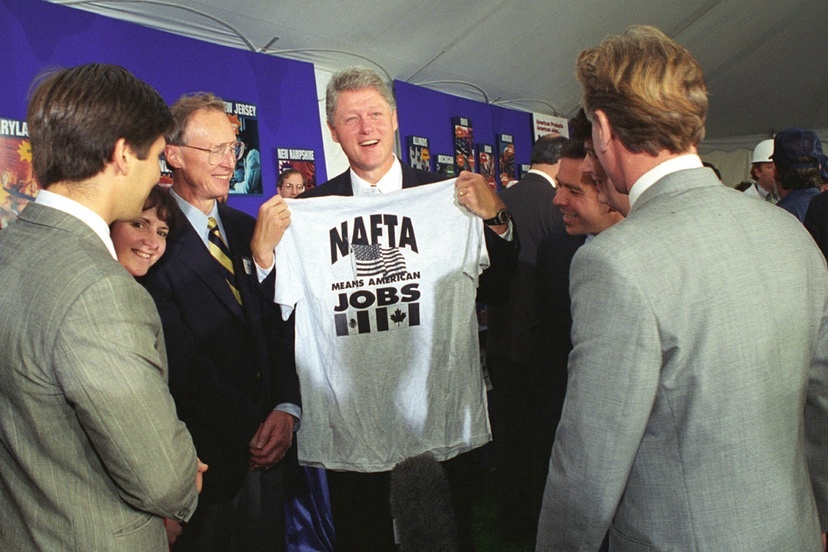
That same decade, Clinton oversaw the country’s catastrophic entry into NAFTA [North American Free Trade Agreement] in 1994 and paved the way for China’s admission into the World Trade Organization in 2001. [Clinton] predicted that offshoring would eventually prove to be a “win-win” for American workers…
NAFTA took nearly a million jobs away, and the trade agreements that followed it were responsible for the loss of a staggering four million more jobs, most of them in manufacturing…
Cheaper furniture and blue jeans not withstanding, displaced American workers are still waiting on Clinton’s win-win to land. In the transition to a “twenty-first century economy”, hollowed out communities and even whole regions were largely treated as collateral damage…
From what I can tell, these are all truthful statements. Decisions by the federal government often change the way Americans live, and the way they view their future prospects. The “free trade” efforts since the 1990s were supposed to “lift all boats.” Instead, they lifted a lot of yachts.
But there is another side to this story — as sad as it may be for Americans. In 1994, when NAFTA was approved by Congress, an estimated 34% of the world’s people lived in “extreme poverty”, defined as living on less than $2.15 per day.
By 2018, that percentage had fallen to 10%. Over 25 years, roughly two billion people had been lifted out of extreme poverty. (Our World in Data.)
“Free trade” may have been a disaster for many American communities. It may have made survival possible for 2 billion men, women and children.
But my main point is this: the world is not the same as it was in 1994, or in 1974, or in 1954. America is not the same place it was.
However, our expectations might still be the same.