
At the conclusion of my recent editorial series on “walking in quick-drying cement” I briefly mentioned that the Archuleta School District (ASD) is funded based on student enrollment.
That comment about enrollment generated a letter from a Daily Post reader:
I find the Post’s continuing coverage of the PreK-8 school issue to be interesting and informative. My wife and I attended the MPAC meeting of Monday, 17 November.
In the closing paragraphs of the “Walking In Quick-Drying Cement” editorials [Part 4], Mr. Hudson mentions Colorado public-school funding being based on enrollment. I would very much appreciate a Post article detailing exactly how our public schools are funded.
Thank you for your service to our community.
Vic Lucariello, P.E.
Archuleta County
Revealing how our local governments are funded is a dirty job, but I suppose someone has to do it.
The state of Colorado requires school districts to post information about their finances on a publicly-available website — recent budgets, staff salary schedules, etc. — and ASD posts that information here.
But the finer details about “where the money comes from” is not necessarily explained in those documents. It’s complicated.
Here are the primary sources of money flowing to ASD:
1. Local property taxes.
2. State “per pupil” contributions or adjustments.
3. Grants from state and non-profit sources.
4. Local fundraising, primarily for extracurricular athletics.
The lion’s share of the funding for Archuleta School District comes from Archuleta County property taxes, which are then augmented with State funding according to a complex formula defined by the state legislature. Here’s an illustration from “School Funding in Colorado 2024”. You can download that document here.
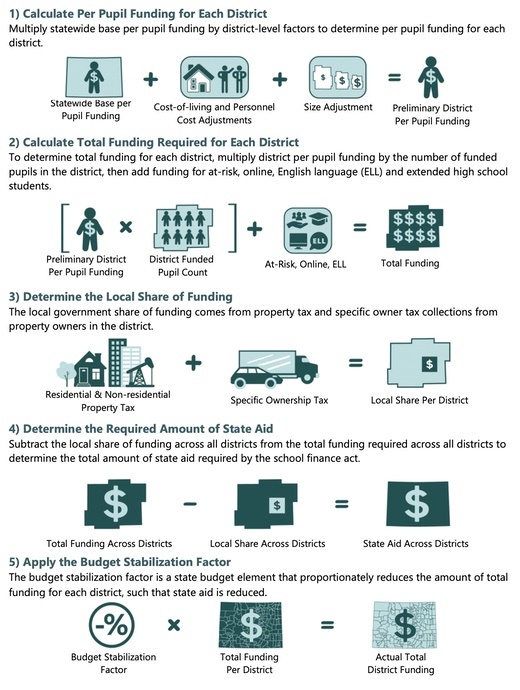
Basically, the state legislature defines the amount of funding a school or district receives based on the number of students… plus certain “at risk students” and “English language Learners” and other adjustments.
Archuleta County property taxes are collected by the County Treasurer and distributed to ASD, and the Colorado Department of Education (CDE) contributes a smaller amount to fulfill the “Per Pupil Revenue” amount allotted to ASD by state law.
ASD’s “PPR” is based solely on number of students enrolled, calculated into the state formula.
The dramatic increase in Pagosa Springs property valuations — and thus, in property taxes — in recent years did not increase the amount of PPR funding received by ASD. It merely resulted in less money coming from the state.
Property owners also contribute a “Mill Levy Override” on top of the “PPR”. The MLO was approved by local voters in 2018 and renewed in 2023. This additional funding from the community is a fixed annual amount, not based on enrollment.
Partly as a result of the 2018 MLO approval, the salaries at ASD increased substantially. The salary for a first-year teacher with a BA increased by almost $17,000, or by about 50%, between 2015 and 2023. And the hourly rate paid to school bus drivers increased by about 70% over those 8 years. Salaries also increased at our local publicly-funded charter school, Pagosa Peak Open School.
According to ASD documents, here are some published salaries for 2015, 2021, and 2023.
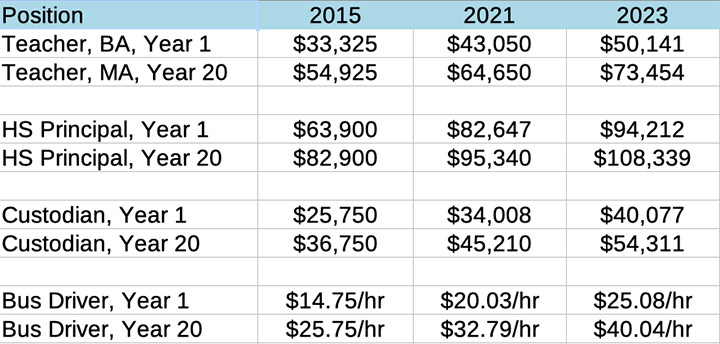
A starting salary at ASD — Teacher, BA, Year 1 — is now $53,194. (Still not enough to afford a typical Pagosa Springs home mortgage.)
Local property taxes are also the source for repaying ASD’s General Obligation Bond debt for capital projects, such as the Pagosa Springs High School construction in 1997. Those High School bonds have now been repaid, and ASD has no General Obligation Bond debt remaining.
According to the 2025-2026 ASD Budget (which you can download here) the district has a “Gross Debt Capacity” of $124 million. That’s an amount of debt the district is legally allowed to create — with voter approval.
Curiously, that’s almost exactly the estimated cost of the new PreK-8 school that’s been under consideration, lately, by the Master Plan Advisory Committee and the ASD School Board.
The ASD staff and Board plan to submit a grant proposal to the BEST (“Building Excellent Schools Today”) grants program at CDE. If ASD receives such a grant, it could cover perhaps 45% of the cost of a new school. Local taxpayers would then need to pay the remaining 55%.
An alternative approach, which has not been seriously considered by the MPAC or the School Board, is to ask the voters for a bond to repair and upgrade our existing school buildings instead of building a totally new school at a cost of $125 million… ($220 million when including interest payments). Repairs and upgrades can also be funded through the BEST program. In fact, nearly all of the BEST grants awarded this year were not for new school building, but rather for repairs and upgrades.
The ASD Board made it clear, last spring, that they did not plan to put a $220 million bond proposal in front of the voters at the November 2025 election.
But they have indicated their intention of putting some type of bond measure on the November 2026 ballot.
So we have that to look forward to.