
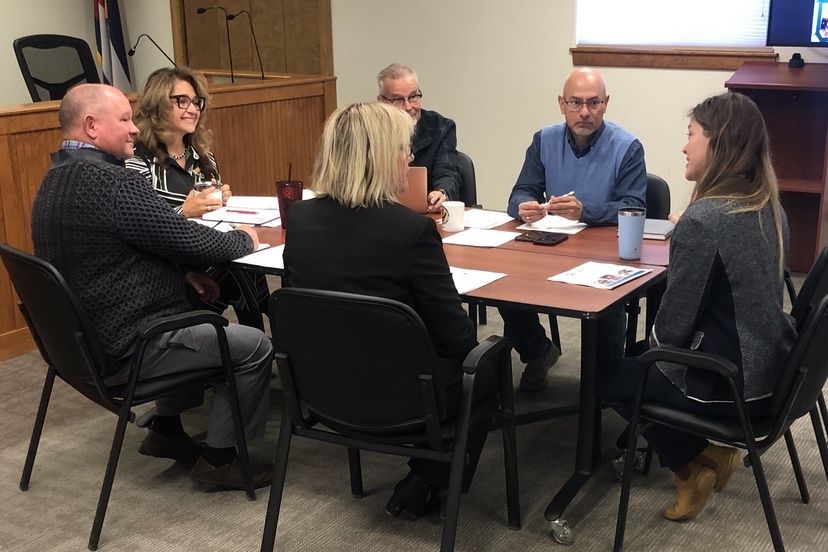
Photo: Habitat for Humanity Executive Director Leah Ballard, right, presents to the Archuleta Board of County Commissioners and staff, November 2025.
At their November 18 work session, the Archuleta Board of County Commissioners heard several reports, including one from the Executive Director of Habitat for Humanity, Leah Ballard.
All the reports were interesting. But I honestly paid closest attention to the Habitat report, because it concerned what I believe is the most serious social problem in Pagosa Springs: housing for our workforce.
Our large retiree population is not as stressed by the housing shortage, generally speaking.
And just to be clear, we don’t actually have a “housing shortage” at all. Estimates suggest that on any given day, for most of the year, maybe a quarter of our residential homes are vacant.
The actual shortage relates almost exclusively to a certain type of housing:
Housing that’s affordable to workers and their families.
Not everyone agrees with this assessment, of course, but I believe a majority of the community’s government and business leaders understand that we have a problem on our hands.
And the leadership at the state level understands that as well, as did a slight majority of Colorado voters (53%) who approved ‘Proposition 123’ back in 2022, creating the State Affordable Housing Fund. Prop 123 will figure in this editorial series.
The Archuleta BOCC is included in that group of concerned leaders. Over the past couple of years, the BOCC has offered several dozen tax-lien properties to local housing organizations, including Habitat for Humanity of Archuleta County, the Pagosa Springs Community Development Corporation, and the Archuleta County Housing Authority.
This editorial series will focus mostly on non-profit Habitat for Humanity of Archuleta County, and a November 18 presentation to the BOCC.
Habitat’s housing efforts are focused on households than earn less than 80% of the Area Median Income (AMI). Due to the fact that the local Pagosa economy generally provides rather low-paying jobs except in the government and construction industries, while a sizable number of residents are drawing healthy retirement incomes via pensions earned in higher-paying economies elsewhere — Texas, Arizona, California, etc. — a significant portion of employed households qualify as “less than 80% AMI”.
To keep housing costs low, Habitat relies on low-interest-rate USDA Rural Development mortgages, sweat equity from the home buyers, volunteer labor, in-kind donations from contractors, money donations from the rest of the community, and — in recent years — modular construction.
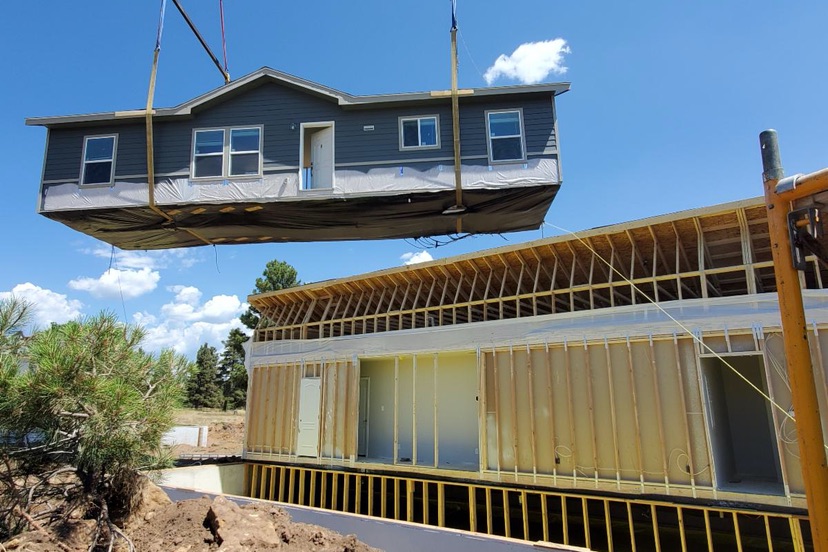
Ms. Ballard began her presentation by noting that, five years ago, Habitat was building one home per year. But as the housing crisis became more severe, the organization re-tooled their ambitions and set their sights on “15 Homes in 5 Years”. This year, they are completing three of those homes, and next year, the plan is to complete four homes, to meet the projected total of 15.
They’ve added paid staff along the way. And over the past year, Habitat became a dealer of modular homes manufactured in Albuquerque.
Ms. Ballard:
“So far, we haven’t [sold any modular homes] outside of our organization. We’re growing slowly. We don’t want to try and sell modular homes until we’re really ready to facilitate that process. But it has translated into lower costs for our homeowners when we deal directly with the factory, as opposed to going through another dealership. So we’re excited about that.
“So we have our buyers for 2026 more or less lined out. We’ll start applying for their mortgages in January; it takes several months to work through the eligibility process. And then starting in the spring, they will put in 250 hours of ‘sweat equity’ per adult. So they’re very much involved with the construction.
“So we are ‘turn-key’. We do everything, starting from qualifying all of our applicants; we meet one-on-one will every applicant, whether they’re qualified or not, just to give people a picture of where they are at with qualifying for a Habitat home or a conventional purchase or a CDC home, whatever. Whatever they want to buy.”
She here mentions “CDC homes”. Those are homes available through the Pagosa Springs Community Development Corporation; the CDC. That government-subsidized non-profit built their first ten homes in 2024, and for various reasons struggled to find qualified buyers. They did not build any homes in 2025, although they had originally promised to build an additional ten this year. They are currently planning to build five next year.
Recently, Archuleta County has been adding around 100 new single-family homes per year, but the average selling price has been in the $600,000 range. That’s about twice what a typical working family can qualify for, in terms of a conventional mortgage.
40 years ago, a young Pagosa couple just starting their family and their careers would typically purchase a mobile home as a starter home, or perhaps a ‘fixer-upper’ home. But it’s been 40 years since Archuleta County added a new mobile home park, and most of the fixer-uppers have been fixed up. Along the way, our local governments determined that mobile homes should be discouraged, as part of making the community “more attractive”.
More recently, about 1,000 of our residential homes and condos have been purchased by investors and converted into Short-Term Rentals — vacation rentals in support of the government-subsidized tourism industry.
In a very real sense, local government decisions have helped create the housing crisis. But market forces and the ongoing retirement of the Baby Boomer Generation have also played a significant role in creating the current situation.
Can local and state government help solve the crisis? Hand in hand with the non-profit sector?
I ask those questions partly because I suspect the federal government might not be offering much help over the next four years, except through a limited number of understaffed programs.
Thus, the November 18 meeting between Habitat and the BOCC. Can we work hand in hand, locally?
Ms. Ballard:
“We partner with [Durango-based non-profit] HomesFund to provide homebuyer education. Homebuyer education is required for a ton of first-time buyer programs. You can take the classes on Saturdays, or self-paced online, and that comes with a certificate.
“And then the mortgages, we actually do in-house. These are USDA Rural Development 502 direct loans. They are not a USDA guaranteed loan. Buyers have to go through a non-profit to get these loans…”
Fortunately, we have a few non-profits in Archuleta County.