

Colorado’s tourism industry surged to unprecedented heights in 2025, shattering previous records and establishing new benchmarks for visitor numbers, revenue generation, and economic impact across the state. This remarkable achievement follows years of strategic investment, innovative marketing approaches, and a perfect alignment of favorable conditions…
This encouraging report was posted by Blaine Howerton on NorthFortyNews.com on March 24, 2025. We’re not clear why Mr. Howerton felt so sure — already in March — that Colorado’s tourism in 2025 would shatter previous records?
But we understand that online sources of information can contain inaccuracies.
Also, things can change. By August 4, reporter with ColoradoSun.com was telling a slightly different story, using data from the Colorado Tourism Office.
After several years of record-setting traffic, it appears Colorado’s Western Slope tourism economy has hit a plateau. Some communities are even reporting declines in visitor traffic and spending, marking the first slowdown since the pandemic…
That’s a first slowdown in overnight visitors for Colorado’s statewide tourism economy since 2014, excluding the pandemic-triggered global collapse in travel in 2020 and 2021. For more than a decade, visitation and tourist spending have set records every year. That record-setting trend appears poised to end in 2025.
Closer to home, we had heard about apparent declines in motel bookings in Pagosa Springs, already in early June. The Pagosa Lodgers Association LLC had submitted a printed sheet to the Pagosa Springs Area Tourism Board that stated, in part:
Current Market Conditions
Our member properties are experiencing significant year-over-year declines in business:
April and May bookings were down approximately 22-25% compared to last year…
Our goal is to understand what strategies the Tourism Department has in place to address the current slowdown…
We discussed this “tourism turbulence” in a previous editorial, back in July.
It’s standard operating procedure for businesses — and governments — to compare the current year to the previous year. The commonly accepted goal for business — and government — is to bring in more revenue with each passing year. And indeed, the Tourism Board has presented generally positive reports of Lodgers Tax revenues, year after year after year.
Those revenues are spent to try and further increase local tourism, and put more money into the pockets of tourism-related businesses.
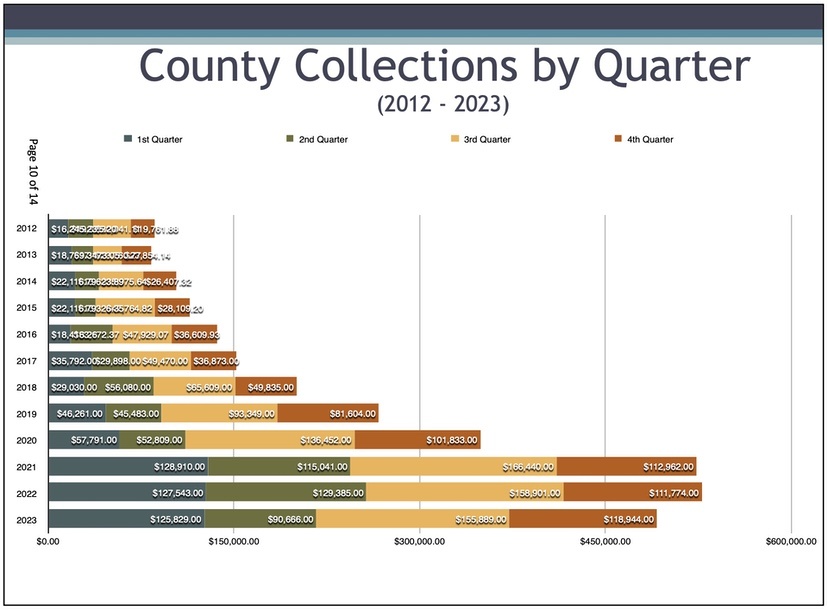
Some tourism destinations in Colorado saw a drop in tourist visits during the 2020-2021 years of the COVID crisis. Not Pagosa Springs. Tourism was through the roof, as reflected by the Archuleta County collections of Lodgers Tax,
Things slowed down slightly in 2023. Thank heavens. But even 2023 was more than triple the tax collection compared to 2017.
2024 tax collections were up about 9% over 2023. If you had to pick a word to describe the Pagosa Springs tourism industry, you might choose the word, “flourishing”.
We might assume that the employees working in the tourism industry are now earning triple what they made in 2017. But that’s just an assumption.
But we also know — without needing to assume anything — that the Pagosa Lodgers Association LLC believe they can do a better job at marketing Pagosa Springs than the Tourism Board has been doing. We heard that idea clearly expressed at the November 5 Board of County Commissioners work session. One option discussed at that meeting was to redirect revenues from the Tourism Board to the Lodgers Association. At least one commissioner — John Ranson — sounded enthusiastic about providing tax subsidies to the Lodgers Association LLC.
Commissioner Veronica Medina sounded less eager. Her first question was: how much funding was the Association asking for? To which Springs Resort Marketing Director Jesse Hensle replied that the amount has not yet been determined. But it would apparently need to be a sizable amount.
Commissioner Medina:
“Then I guess my second question is, if funding were available, and you received it, would this be a yearly ask, or would you eventually become self-sufficient and be able to [conduct your marketing effort] on your own?”
Mr. Hensle:
“I think it would have to be a yearly ask. I don’t know what our funding mechanisms would be, internally, to generate any type of funds like this. Uh… membership fees or dues or anything like that would never come close to the amount of potential tax funds that we could get.”
Well, that clarifies the situation somewhat. A lodging industry, which has seen its revenues triple since 2017 cannot manage to find enough money — from Association members themselves — to conduct an effective marketing campaign. At least, not nearly as much money as they are expecting to get in tax subsidies.
Mr. Hensle:
“If we’re talking about marketing impact, we would need way more than membership dues would be able to contribute.”
A few hours later on November 5, the Tourism Board convened for a regular meeting, and the members heard from Sarah Mashue that the Lodging Association had presented a plan to the BOCC, whereby tax money would be directed to the Lodgers Association for a competing marketing effort. Possibly, the money would be redirected from Tourism Board funding.
Some Tourism Board members seemed rather surprised to hear that two of their fellow Board members — Sarah Mashue and John Ranson — were engaged in previous discussions about the possible diversion of funding away from the Tourism Board.
There’s a commonly accepted principle among government and business Boards called “fiduciary duty”.
This general principle demands that Board members make every effort to protect the financial condition of the Board of which they are members.
Things can get weird particular Board members start putting the interests of a separate group above the financial stability of the Board they serve on.
Did such a transgression occur on November 5?