
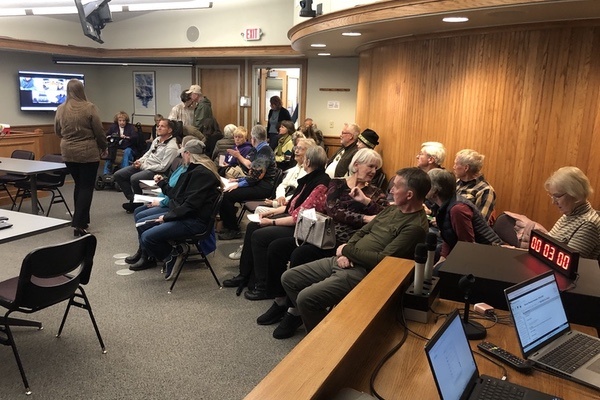
Photo: Nearly 60 members of the public, in attendance in person or via Zoom, witnessed the October 28 Town Planning Commission meeting.
Post Opinions wants to know: How do you find meaning and purpose? Do you have suggestions for how others can do the same?
— from The Washington Post, October 26, 2025.
Good question.
How do we find meaning and purpose?
Some Americans, these days, have found meaning and purpose working at food pantries, or helping disabled veterans, or marching in protest demonstrations. Others have found meaning and purpose by posting photos of their dog on social media.
Different strokes for different folks.
A few of us find purpose and meaning in working towards lawful, transparent and competent government. I’ve often compared that work to washing the dishes. The job is never done. There are always more dirty dishes.
Last month, Spencer Cox, the Republican governor of Utah, and Ian Marcus Corbin, director of the Public Culture Project at Harvard, submitted a joint op-ed to The Washington Post.. “The consequences of America’s moral drift.”
In July 1926, President Calvin Coolidge delivered a speech near the Liberty Bell to mark the 150th anniversary of the Declaration of Independence. At the heart of his oration was a striking claim: The Declaration is a “great spiritual document,” composed of principles such as equality, liberty, popular sovereignty and the rights of man, hashed out in church meeting halls over generations, whose origins lay in “the unseen world” of American religiosity. Unless anchored by these deep “things of the spirit,” he warned, “all our material prosperity, overwhelming though it may appear, will turn to a barren sceptre in our grasp.”
The op-ed goes on to note that, according to a 2023 Harvard study conducted by the School of Education, “58 percent of young adults reported lacking meaning and purpose in their lives.” You can read that study here.
The “lack of meaning and purpose” reported by a majority in a survey of 709 young adults age 18-25 years old, is certainly concerning. Also concerning is the statistic that 36% reported anxiety and 29% reported depression. A similar percentage — 30% — cited worries that our political leaders are incompetent or corrupt.
It’s one thing to be incompetent. It’s another thing to violate the law. Does this government incompetence and corruption play into the anxiety and depression our young people are experiencing? I would assume that to be the case.
Many of us suspect the problem is only getting worse. According to various surveys from the 1950s and 1960s, around 75% of Americans believed the government “would do the right thing most of the time.” Current surveys indicate that number has dropped to about 22%.
Has government really gotten so bad, that three out of four young adults believe government generally does the wrong thing?
Or are we simply misinformed and misled, these days, about the reality of the situation?
Speaking as a journalist who has focused on writing about Pagosa Springs governments for the past 20 years, I have a slightly different take. In my humble opinion, our local governments nearly always “do the right thing”. In my humble opinion, when you consider the thousands of small and large decisions that local governments handle in a given year, 95% of those decisions are handled competently and reasonably and without violating the law.
It’s the remaining 5% that require our attention. But relatively few people find “meaning and purpose” in scrubbing the dirty dishes in the government kitchens. Although we, the taxpayers and voters and citizens, are ultimately the ones for whom our governments were created — the governments “of the people, by the people, and for the people” — we don’t always take seriously our responsibility to challenge wrong decisions.
Our responsibility to pay attention, and take part in washing the dishes.
The dishes don’t wash themselves. We have to do it.
A couple of new friends have joined me in tackling a particularly troublesome decision made on Tuesday, October 28 at Town Hall, when four members of the Town Planning Commission wrongly approved a “Sketch Plan” for the proposed Pagosa West subdivision.
In my experience, the Town Planning Commission does a fine job 95% of the time. In this case, they screwed up. They acted incompetently and probably illegally.
Certainly spiritual and moral values are important, as Governor Cox stated in his op-ed. But what can ordinary citizens do, when the elected or appointed officials — who appear to hold the reins — screw up?
Is it a spiritual and moral value to step up and challenge them?
The two Pagosa residents have become my friends, as part of a shared effort to question the wisdom of a proposed Pagosa West subdivision. That proposal would convert a 100-acre undeveloped, pine-covered parcel across the highway from the City Market shopping center into a mixed-use commercial and residential subdivision.
With the intention of balancing private property rights with its responsibility to protect the community’s health, safety and welfare, the Town of Pagosa Springs codified many of the goals of the Town’s Comprehensive Plan into its Land Use and Development Code (LUDC)… the word “Code” meaning a collection of legal requirements. The Pagosa Springs Town Council is responsible for adopting the Code and, ultimately, for enforcing the legal requirements it specifies.
The LUDC includes a number of sections that relate to the creation of a new subdivision project. (You can read the LUDC here, online.)
The provisions of this Land Use Code shall apply to all land, buildings, structures, and uses thereof located within the Town of Pagosa Springs, unless an exemption is provided by the terms of this Land Use Code. The provisions of this Land Use Code are the minimum requirements adopted for the promotion of the public health, safety, and welfare.
While it might feel upsetting to watch a developer begin building a new house on the adjacent 1/4-acre parcel, once you’ve become accustomed over several decades to the parcel being vacant… the feelings can be much more intense when you imagine 100 acres of tree-covered, wildlife-friendly property threatened with careless mixed-use development.
The LUDC provides a method for ordinary citizens to challenge a Planning Commission decision.
It’s called, “appealing the decision”.