
This story by Allen Best appeared on BigPivots.com on October 23, 2025. We are sharing it in two parts.
After the story appeared, FERC rejected Tri-State’s proposal for a large load tariff, saying that it did not have jurisdiction. Tri-State would have to file with the regulatory bodies in Colorado and other states in which it does business.
Data centers in Colorado have been almost exclusively located along the Front Range, more narrowly yet between Colorado Springs and Boulder County. In other words, they have arrived at exactly those places within the state that have prosperous economies, jurisdictions even struggling with the challenges imposed by growth.
Might data centers make their way to rural areas of Colorado?
Leaders of several electrical cooperatives offer mixed responses. Some report getting interest already, others not.
Tri-State Generation and Transmission Association, Colorado’s second largest electrical provider, hopes to prime the pump. It has filed a proposal with the Federal Energy Regulatory Commission for a tariff that it believes will interest developers. It’s called HILT, which stands for high-impact load tariff. It is designed for demands of 45 megawatts or more.
Meanwhile, several state legislators continue to hone bills they expect to introduce into the next legislative session. In the last legislative session, one bill proposed incentives for data center development in some locations. Others thought that the state needed guardrails to ensure that other customers — as well as land and especially water resources — are not imperiled.
“Absolutely,” said Duane Highley, the chief executive of Tri-State, in an interview with Big Pivots on October 7 when asked about potential for data centers in places like Craig or Fort Morgan. “Our members have actually had quite a bit of interest across our entire footprint. So definitely not just the urban areas.”
The Westminster-based cooperative provides wholesale power to 40 electrical cooperatives and public power districts in Colorado and three adjoining states.
“Some of our high-elevation members get a lot of interest because of the cool air and less need for cooling a data center,” he said. This, he added, is particularly true in Wyoming, where Tri-State has 10 member cooperatives. It supplies electricity to 16 cooperatives in Colorado.
Tri-State does not deliver electricity to Craig and Hayden, although it does operate three coal-burning units at Craig. It plans a gas-fired power plant there after the coal units get retired. The first unit is scheduled to retire later this year and the final two before the end of 2028.
At 6,200 feet in elevation, Craig is consistently cooler than the Front Range. It is often below zero during winter nights, sometimes far below.
“I guess Craig would be an excellent spot,” said Highley. He cited the existence of a “really big substation” as well as transmission.
“So if anybody wants to start a conversation around Craig, we will have the tariff in place to allow that to happen. ”
Highley reported that Tri-State has had four gigawatts of requests on its system from data centers. Tri-State has a generating capacity of 2.5 gigawatts from Wyoming to Arizona. Not all that demand will materialize, Highley hastened to add. “A lot of them are just shopping, but I have to think that some part of that is real.”
A spot check by Big Pivots of electrical cooperatives in Colorado reveals little of substance — yet.
“We really haven’t had any inquiries about data centers in the Mountain Parks service territory to date,” said Virginia Harman, the chief executive of Granby-based Mountain Parks Electric. “That doesn’t mean they won’t happen.”
In Buena Vista, Jon Beyer, the general manager of Sangre de Cristo Electric, has the same report. “We are not getting any inquiries anywhere in the Arkansas Valley. Land prices are pretty expensive, and electrical infrastructure is probably not robust enough for stuff of that size. Finding employees is a challenge as well,” he said.
“Coops along the Front Range — Poudre Valley, United Power, Mountain View, maybe even San Isabel, I would guess they have all received inquiries, folks kicking the tires.”
In western Colorado, Delta-Montrose Association has at least heard a little bit of interest via upstream electrical providers but “nothing to take to the bank,” said Kent Blackwell, the chief administrative officer. “The fact that we have even heard any out there is shocking to me, this far removed from urban centers.”
Different sizes
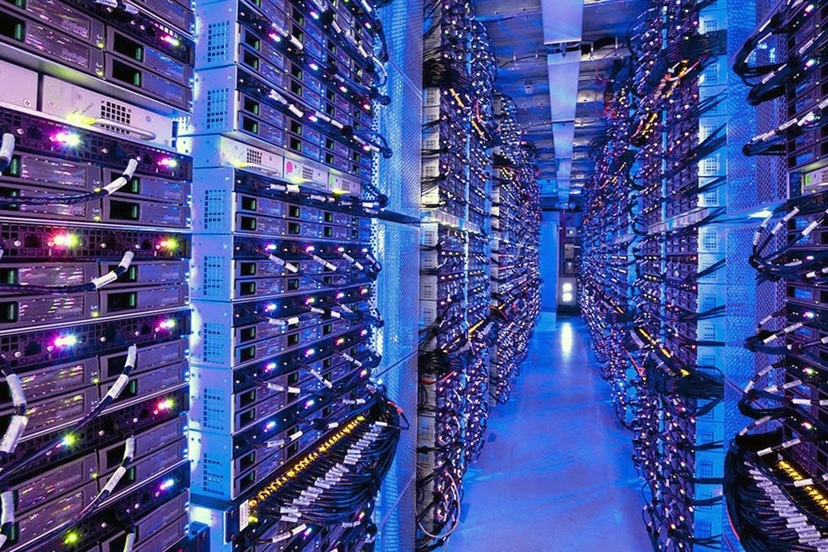
Data centers do come in different sizes and flavors. Micro data centers generally are those in places of 5,000 square feet or less. Small comes in at 20,000 square feet. Hyper-scale data centers are classified as those with over 100,000 square feet and consuming 100 megawatts.
QTS, Colorado’s most high-profile data center, seems not to have divulged its square footage but has a 67-acre campus in Aurora, near the intersection of I-70 and E-470, and a demand of 177 megawatts. However, it still ramping up, with a 10-year expansion.
The QTS hypescale data center in Aurora occupies a campus of 67 acres and is still ramping up.
Many data centers are even larger. Meta (aka Facebook) has a data center in Oregon that covers 4.6 million square feet. A data center in Inner Mongolia covers 10.7 million square feet.
These definitions and other information, by the way, come in part from Google AI reports (which makes those of us who are actual providers of diminished relevance — or at least uncompensated.) They could be wrong — as AI often is.
Of course, newspapers were never wrong, were they?
Allen Best publishes the e-journal Big Pivots, which chronicles the energy transition in Colorado and beyond.