
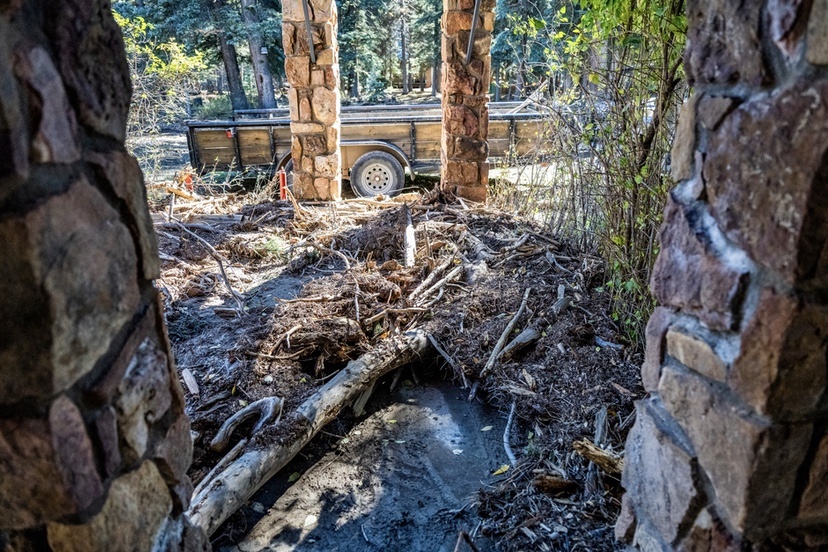
Technically speaking, Pagosa Springs and Archuleta County suffered two floods this month, resulting from two different tropical storms, Priscilla and Raymond.
Priscilla swept into town on Saturday, October 11, dumping more than 6 inches of rain atop Wolf Creek Pass and pushing the San Juan River to a near-record high water mark of about 12.7 feet at the downtown gauging station.
Raymond arrived on Monday, October 13, determined to out-perform Priscilla, and teh San Juan peaked in the early morning hours of Tuesday, reaching 12.8 feet and flowing at about 8,560 CFS (cubic feet per second).
But it may have seemed like one continuous flood event to most of us, especially those with homes overlooking the rivers and creeks.
A week later, our local governments were trying to get a handle on how much damage had been caused — now that the trauma was less water-based, and more money-based.
The Pagosa Springs Town Council met jointly with the Archuleta Board of County Commissioners on Monday, October 20. Interim County Manager Mike Torres kicked off the conversation.
“There was a lot of flooding up in San Juan River Village and all the way down County Road 500 and County Road 335… Our County staff has been working with Emergency Management, trying to come up with an assessment of the damage, just trying to put everything together to create a story for the state…”
The hope being that the state and federal governments can provide financial relief to local governments — the Town, the County, Pagosa Area Water and Sanitation District (PAWSD) — and to homeowners affected by flood damage and debris. Something I didn’t realize: when applying for disaster funding, there’s apparently a limited window of time for submitting your application. And you then go to the “end of the line” and wait your turn to get any money that may be available.
If disaster relief funding is, in fact, available…?
Mr. Torres:
“The Town has set up a location for wood debris, down by the softball fields [near the High School]. We have a second location at the [County Fairgrounds]…”
These drop-off areas are for wood debris resulting from flooded properties. No other materials are permitted to be mixed in or dropped off at these locations.
Archuleta County is also accepting flood-damaged items at the Transfer Station located at 2140 County Road 500:
- Appliances
- Personal Items
- Dry Wall – Must be separated from other materials before arrival.
NOTE: Drywall mud and tape from older homes may contain asbestos, which is a health hazard if handled without proper personal protective equipment. It’s highly recommended that you hire professionals that have experience removing asbestos materials.
Mr. Torres:
“We’re working on the estimate, and the response is officially done. Now we’re just working with everybody and trying to get feedback from residents and find out what exactly they need from us, and where we can help.”
Town Manager David Harris:
“Our teams have put together similar ‘resources’ pages on our websites, so if you wish to volunteer, we encourage you to work with COVOAD… we’ve also had Samaritan’s Purse and Team Rubicon in town… they specialize in removal on private property.”
COVOAD, Colorado Voluntary Organizations Active in Disaster, coordinates the alignment of community agencies and services to ensure a strategic, community-led response and recovery. The organizations working with COVOAD:
Active Voluntary Agencies:
American Red Cross (Sheltering/Feeding)
Crisis Cleanup (Cleanup Requests)
211 Colorado (Community Resource Connection)
Team Rubicon (Debris Cleanup)
Colorado Baptist Disaster Response (Debris Cleanup)
Samaritan’s Purse (Debris Cleanup)
The Salvation Army (Provided Cleanup Supplies)
Reportedly, the Red Cross is currently set up at the County Road and Bridge offices, handing out clean-up equipment.
To learn more about recovery efforts, visit https://www.covoad.org/sw-colorado-floods-2025/.
For anyone wishing to donate funds to the disaster relief efforts, the Community Foundation serving Southwest Colorado, with the Town of Pagosa Springs and Archuleta County, has activated the Archuleta Community Emergency Relief Fund (CERF) to provide a safe option to donate funds and assist in the distribution of those funds to support the community.
Mr. Harris:
“In the public realm, we’ve been meeting today to compile a list of how much estimate cost there would be within town limits. And this is an incomplete number, but we’re looking at 200 cubic yards of debris removal, landscaping damage…
“And damage to river improvements that the Town invested in over the years. Right now, we’re assuming it would be a total replacement. Just as an assumption of how much money we’re looking at.
“Sewer line replacement on the 1st Street bridge. Dredging the River Center ponds. Repairing the wetlands. Restoring the Riverwalk trails. The cost to the Sanitation District for all the water incursion. Replacing a culvert on 10th Street. Replacing the irrigation pump at Town Park.
“We’re getting close to $9 million, right there.
“This is a very fluid list… no pun intended. What we don’t yet have quotes on are riverbank stabilization at the Overlook, the Museum and at 1040 East Highway 160. We had some questions about the number we received from PAWSD, that doesn’t seem right… maybe it was lost in translation, of what we were looking for…”
1040 East Highway 160 is the 3.6-acre riverfront property at the junction of Highways 160 and 84, previously occupied by Bob’s LP until the Town government bought it earlier this year.
Mr. Harris:
“Anyway, we’re looking at a lot of items in the public realm that we’re going to need to address. These were two tropical storms that might be considered two separate incidents. And add to that, our disaster management from the state emergency operations standpoint, is Archuleta County, La Plata County and a couple of other counties. So collectively, we’re trying to reach about a $12 million threshold, as I understand it, to seek a federal disaster recommendation.
“So that’s up in the air, pending the assembling of all these numbers…”
“Up in the air” might be the right term to use.
President Trump and Homeland Security Secretary Kristi Noem have repeatedly signaled their desire to overhaul, or completely eliminate, the 46-year-old Federal Emergency Management Agency (FEMA). There has been bipartisan support for reforming the agency, but some experts say dismantling it completely would leave gaps in crucial services and funding.
Disaster response is already locally led and state-managed, but FEMA supports efforts by coordinating resources from federal agencies, providing direct assistance programs for households, and providing money to states for repairing public infrastructure.
“It just causes more concern on how states should be planning for the future if the federal government’s not going to be there for them,” said Michael Coen, FEMA chief of staff during the Obama and Biden administrations, last June…