
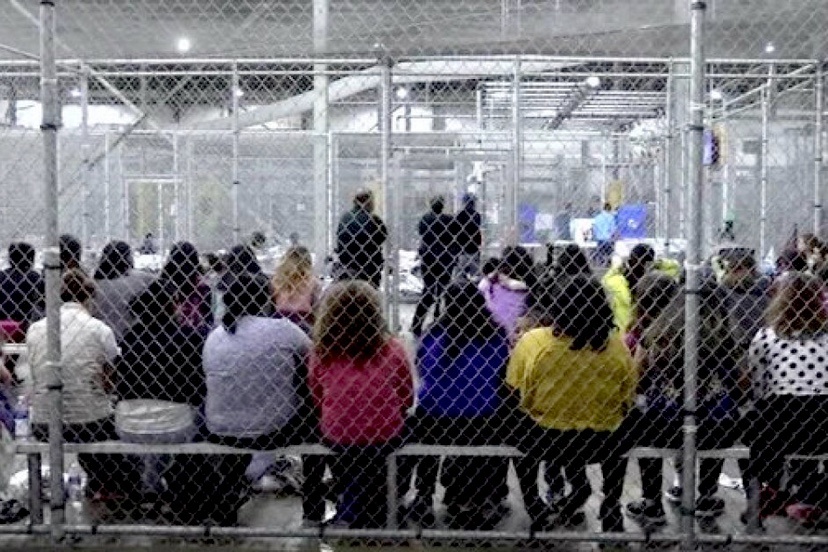
Photo: From a video provided by U.S. border officials showing conditions at an immigration detention facility in McAllen, Texas.
As mentioned in Part One, I was made aware of the White House memorandum, “Countering Domestic Terrorism and Organized Political Violence”, through an email from the Colorado Health Foundation — the nonprofit foundation that provided the bulk of the funding for our new public playground at Pagosa Peak Open School.
As the CHF leadership interprets the White House memorandum, the Trump administration plans to continue investigating, defunding, and prosecuting certain nonprofit and educational organizations, based on the claim that these organizations are promoting organized political violence and “the overthrow of the United States Government.” The administration’s attacks on nonprofits and educational institutions are already well underway — we note in particular the gutting of the Corporation for Public Broadcasting, The National Endowment for the Arts, and various research and workforce centers.
A May 2025 Urban Institute report found that nearly 1 in 3 federally-funded nonprofits had already laid off staff or shut down services. And the attacks are accelerating. A June DOJ memo floated additional cuts to nonprofits deemed “ideologically biased” — a clear signal that civil rights, reproductive health, and legal advocacy organizations are next in line.
Is our American way of life threatened by nonprofit organizations?
From the memo:
By the authority vested in me as President by the Constitution and the laws of the United States of America, I hereby direct the following…
…(j) The Commissioner of the Internal Revenue Service (Commissioner) shall take action to ensure that no tax-exempt entities are directly or indirectly financing political violence or domestic terrorism. In addition, where applicable, the Commissioner shall ensure that the Internal Revenue Service refers such organizations, and the employees and officers of such organizations, to the Department of Justice for investigation and possible prosecution.
(k) All Federal law enforcement agencies with investigative authority shall question and interrogate, within all lawful authorities, individuals engaged in political violence or lawlessness regarding the entity or individual organizing such actions and any related financial sponsorship of those actions prior to adjudication or initiation of a plea agreement…
In my experience, social change takes place in a couple of ways.
1. Through violence — physical violence, extortion, incarceration, riots, wars, revolution…
2. Through non-violence — debate, free speech, peaceful assembly, voting, civil disobedience, a free press…
Do we want to embrace non-violent change… or violent change?
While it’s clear that the United States of America was born out of a violent revolution, the authors and signatories of the 1787 Constitution of the United States included, as a principal goal of the new nation, “domestic Tranquility”.
The Preamble
We the People of the United States, in Order to form a more perfect Union, establish Justice, ensure domestic Tranquility, provide for the common defense, promote the general Welfare, and secure the Blessings of Liberty to ourselves and our Posterity, do ordain and establish this Constitution for the United States of America.
Did the new nation achieve these lofty goals? Partially. Justice is sometimes provided, sometimes not. A trillion dollars a year is spent by our federal government for “Defense”. Generally, the Welfare of the citizens has been promoted, but not necessarily for all segments of the population.
For the most part, “domestic Tranquility” has been ensured. Not always, but for the most part.
Back in the early 1780s, the U.S. was kind of a mess. The Articles of Confederation — the country’s first attempt at government — weren’t working. The federal government was weak; states were acting like their own little countries; the economy was in turmoil. One big warning sign was Shays’ Rebellion, a protest by angry farmers in Massachusetts that turned violent. The federal government couldn’t handle the rebellion, and it fell to the state government to negotiate peace. It’s easy to understand why the phrase “ensure domestic Tranquility” made its way into the new Constitution.
The country’s leaders wanted to make sure the federal government could keep order, resolve disputes, and prevent things from falling apart every time there was a disagreement.
Ensuring domestic Tranquility was basically about saying: We don’t want to live in constant panic mode.
I mentioned on Friday, in Part Three, a national survey conducted by Marquette University Law School which looked at how Americans are feeling about current political conditions in the U.S. The survey pointed out numerous instances where Democrats tend to blame conservatives for current conditions, and Republicans blame progressives.
Independent voters tend to blame both Democrats and Republicans.
For example, when asked about political violence:
Asked which is a bigger problem, 27% of respondents say left-wing violence while 22% say right-wing violence. Just over half, 51%, say both are equally a problem. Perception of this is dramatically different for each party.
Among Republicans, 57% say left-wing violence is the bigger problem and just 3% say right-wing violence is more of a problem.
Democrats see a near mirror image, with 50% who see right-wing violence as the bigger problem and only 4% who say left-wing violence is the greater problem. Independents see equal blame for both sides, with 87% saying left and right are equally a problem…
And when asked about the use of violence to achieve political ends:
A very large majority, 89%, say violence is never justified in order to achieve political goals, and 11% say violence can sometimes be justified. A majority of each partisan group, age group, and ideological group also say violence is never justified…
There are three types of untruth, according to Mark Twain.
Lies. Damned lies. And statistics.
In this case, the survey question, about whether violence is justified — “in order to achieve political goals” — did not define what we mean by ‘violence’.
For example, does our definition of ‘political violence’ include violently entering a building with the intention of preventing a scheduled political process?

Is the concept of ‘extortion’ included in our definition of ‘violence’? Is it ‘extortion’ when a government demands that charitable nonprofit organizations adopt certain conservative political views, or have their tax-exempt status revoked and be subjected to investigations?
Does our definition of ‘violence’ include arresting peaceful adults and children, and incarcerating them in crowded detention centers without the right to a fair and legal judicial process…?