
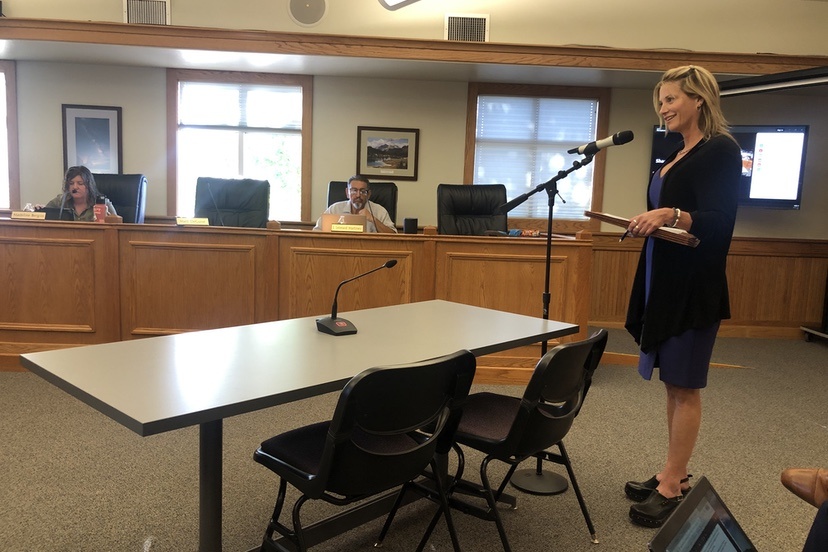
Photo: Springs Resort attorney Amy Huff speaks to the Pagosa Springs Town Council on September 16, 2025.
As noted in Part Two, on Friday, the Town Council had scheduled a presentation of a new ‘Geothermal Rate Study’ for their September 16 public meeting. The rate study presentation was handled by Maggie McHugh with Roaring Fork Engineering, and the Council could make a decision that evening to adopt the study. Or not…
The report suggests a couple of approaches to setting acceptable customer rates for businesses, schools and homes using the geothermal hot water from the Town’s ‘PS-5’ geothermal well.
We’re not talking here about a one-page memo. The study is 62 pages long, including a study of the municipal geothermal heating system produced in 2020 by the environmental engineering company Plummer and heat exchanger company Tranter. Reportedly, the Roaring Fork Study cost the Town more than $25,000.

You can download the main study here.
You can download the appendices to the study here.
Before the Roaring Fork presentation took place, however, Springs Resort attorney Amy Huff requested that the adoption of the report be delayed, to allow the Springs Resort and its investors — the real estate investment trust EPR — to advise the Council on recommended changes to the report.
“…To just make sure we don’t see a dispute, down the road,” Ms. Huff proposed to the Council.
“This would be for the purpose of preventing future litigation, and to consider whether the Town wants to adopt the report as written, or to amend it, in three or four weeks after my clients have had the opportunity to fully vet the report and provide written comments for the Town’s consideration…”
“…My clients and investors are concerned that, if the Town adopts the Geothermal Report as presented, that could set the stage for litigation. My client has worked with the Town for many, many years, and values the cooperative relationship that the Springs Resort has had with the Town.
“And in order to continue that relationship, we would like to be involved in reviewing the Rate Study, providing comments, and having our consultants confer with the Town’s consultants before the Town adopts the Report. Thank you.”
The Council then heard public comments from the operator of another hot springs establishment: Jeff Greer, owner of the Overlook Spa. The Overlook is located both inside and atop the roof of a commercial building in the 400 block of Main Street (Highway 160) and makes use of water from the Town’s Rumbaugh well — a separate geothermal well from the PS-5 well. Liek the Springs Resort, the Overlook pays a fee for use of the Town’s municipal geothermal water.
We have a third hot springs establishment — the Healing Waters Resort — located across the street from the Springs Resort, but Healing Waters has its own private well, and does not take water from any of the Town’s municipal wells. There’s something of a tradition of litigation around Pagosa’s geothermal aquifer, and the Healing Waters is no stranger to the complexity of geothermal-water-related lawsuits.
Mr. Greer didn’t seem to have an issue with the Roaring Fork study, and he didn’t directly mention “future litigation”.
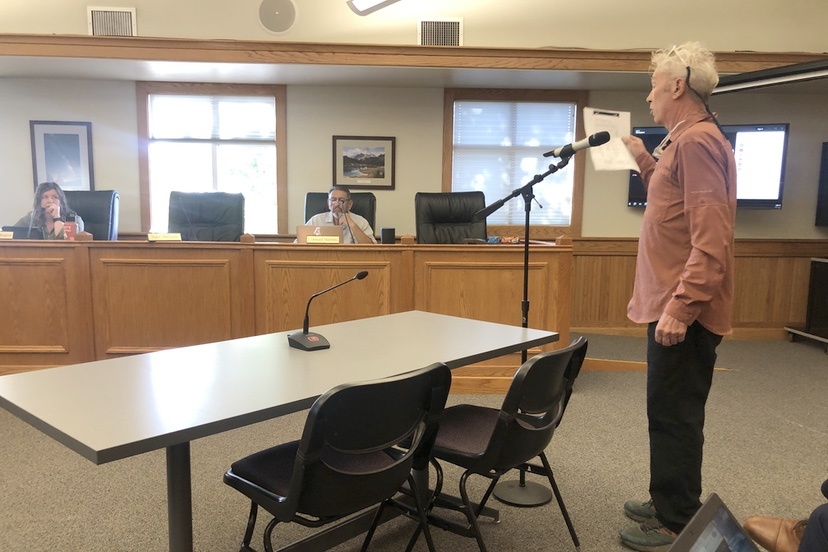
From his comments:
“Healing Waters and I share the same water attorney, and they sent me the previous [water-related] filings that the Springs Resort has done. There’s almost 4,000 [gallons per minute] of filings of hot geothermal mineral water that they have filed on, but never perfected their claims. My water attorney has asked Ms. Huff numerous times to clarify why they have filed on these, but never perfected those rights and put them to use. That would be my question for the Town Council to explore, as well as answers from Ms. Huff and the Springs Resort. Thank you.”
An interesting number, to be sure. 4,000 GPM translates to about 9 CFS (cubic feet per second). For comparison, Pagosa Area Water and Sanitation District (PAWSD) delivers, on average, supplies its entire base of 9,000 customers with less than 3 CFS.
When a water user obtains ‘rights’ to a certain amount of water in Colorado, those rights are ‘conditional’ until the user ‘perfects’ the rights by putting them into actual use. Mr. Greer is implying here that the Springs Resort is acquiring massive water rights without any evidence that they intend to perfect those rights. We might well ask why. As mentioned previously, Colorado allows private and public applicants to put the state’s publicly-owned water to ‘beneficial use’. As I understand Colorado water law, acquiring rights simply to prevent future water users from having access to that water is not a ‘beneficial use’.
A bit later in the meeting, we finally heard Maggie McHugh with Roaring Fork Engineering give a brief overview of the 2025 Report, noting that her company developed two possible rate schedules based on expected long-term repairs and maintenance of the Town’s geothermal system. A 2020 report had estimated the future costs to the system at between $4 million and $7 million, depending on the rate of inflation over the next decade. The system has about 35 ‘heating system’ customers, and two ‘hot springs’ customers.
Scenario 1 has the residential ‘heating’ customers costs increasing from $62.42 to $83.09 per month over the next 4 years. Big commercial users would pay higher fees.
The two ‘mineral bath’ users — the Springs Resort and the Overlook Spa — would pay for ‘BTUs’ (amounts of heat) as well as a separate ‘Mineral Fee’.
In Scenario 1, the rate paid by the Springs Resort for year-round municipal water use would increase from $3,759 per month to $18,891 per month.
Then we have Scenario 2.
We’ll look more deeply into the projected cost increases tomorrow in Part Four.
I suggested, previously, that corporations can get accustomed to government subsidies, and can easily feel ‘injured’ when asked, later, to pay ‘fair market value’ for the benefits they receive from the community.