
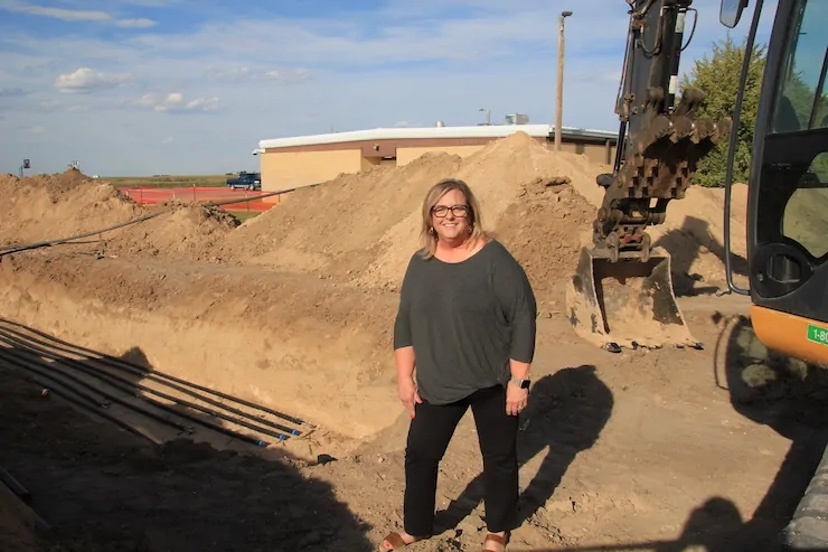
Photo: Rhonda Puckett, the school district superintendent and principal at Liberty High School stands near trenches where loops from geothermal wells are laid. Photo by Allen Best.
This story by Allen Best was originally published by Big Pivots on September 16, 2025. We are sharing it in two parts.
Northern Colorado’s Poudre School District may have been the first school district to give this geothermal a try. That was in 2002, a few years after the district began exploring energy and cost-efficient designs for new buildings. The pilot was at an operations building.
Eleven years later, Stu Reeve, then the energy manager for the district, estimated that the geothermal heat-pump-driven system had required 50% less energy. It needs more electricity but no natural gas.
Unlike some places, Poudre does have natural gas available for the buildings in case the geo-exchange systems go down. So far, they have not.
Poudre in 2004 used geo-exchange again at Kinard Core Knowledge Middle School in Fort Collins. Recently, it has used the technology at an elementary school in Loveland; a middle school in Timnath; and the middle-high school in Wellington.
“It is very energy efficient technology,” said Trudy Trimbath, the district’s energy and sustainability manager. She reports little fluctuation in energy use related to extreme changes in weather as compared with a traditional mechanical cooling system. It also provides even heating throughout the buildings.
Up-front costs of geo-exchange systems typically pose the single largest barrier to adoption of the technology. It depends on whether the geo-exchange is designed for a new or existing building. It also depends upon the available land.
Geo-exchange will cost more up front than natural gas in any situation, but in a new building, says Erik Jeannette, director of engineering at Denver-based Iconergy, the extra costs of the $2 million to $5 million well field can be recovered within a decade because of lower fuel costs. He has designed geo-exchange systems for about 12 schools around Colorado.
Simplified designs have narrowed up-front cost differences. A design team working on a new community building in Fort Collins recently concluded that a geo-exchange system would cost only slightly more than alternatives.
Colorado now has several dozen schools, most in rural areas, with geothermal heating and cooling. A few have had problems, but Jeannette believes those problems were caused by flawed initial designs. He believes the technology has become far easier to deploy.
Retrofitting existing buildings to use geo-exchange can be far more difficult. Ground-source technology should always be evaluated, although rarely does replacement of boilers and chillers justify the added costs.
In small school districts, state grants have made all the difference. That was true at Liberty. It is also true at the Karval School District, which this year has 30 students from pre-kindergarten through 12.
Karval lies in one of Colorado’s most sparsely populated areas. Located 80 miles east of Colorado Springs, the school is 10 miles away from a state highway by way of county roads. If school is dismissed for snow, older students will likely be out on horseback rounding up cattle.
“Everybody has plenty of elbow room here,” says Sarah Nuss, a graduate of the school and now the district superintendent.
In late July, a test bore was drilled for a geo-exchange well field that is to come in early 2026. As with Liberty High School, the building itself is structurally sound. It needs updated electrical systems, so a breaker doesn’t get tripped when plugging in a computer, says Nuss.
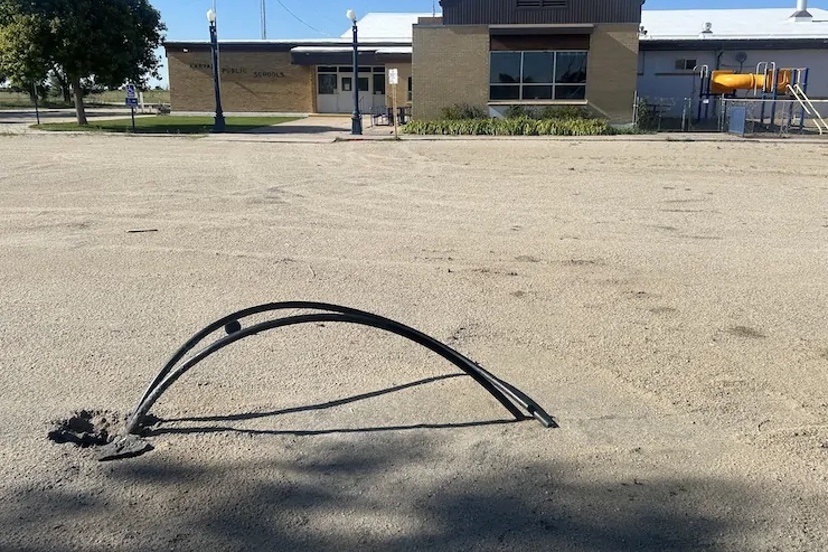
For this geo-exchange work the Colorado Energy Office awarded Karval nearly $500,000. Another $3.5 million was delivered by the Colorado Department of Education’s Building Excellent Schools Today program.
Grants will pay nearly 100% of the upgrades.
Grants were also crucial to Liberty’s geothermal work. The Liberty district has a thin property tax base consisting almost entirely of farms, many of them dryland. It lacks even a giant dairy or feedlot. Crucial has been the $1.865 million in state grants, the most recent from the Colorado Energy Office in April. Total project costs are $5.4 million.
Aaron Tilden, a mechanical engineer assigned to work with Liberty High School, says that without the grants, it’s very unlikely Liberty would have had a business case for the ground-source system.
Drilling of the 25 wells began in late July, two weeks before classes resumed August 13. The 500-foot holes lie about 20 feet apart. They are connected by loops in two trenches that are about five feet deep. The system has about five miles of piping. A house heated and cooled by geothermal may need only one or two wells.
School districts have various motivations. The Fort Collins-based school district has energy goals of being good community stewards and protective of natural resources while being fiscally prudent. “The two go hand in hand,” says Poudre’s Trimbath of the ground-source heat pumps and the district policy.
The Liberty school board was aware that geothermal heat pumps will have far fewer emissions. But that did not drive the approval.
“It really was not anything about emissions,” says Rhonda Puckett, Liberty’s superintendent. “It was about options, doing something that would be sustainable for a long time for us.”
A standardized metric of a building’s energy consumption relative to its size is called energy use intensity, or EUI. Typically, the lower the EUI, the more efficient the building is.
Energize Denver, in its evaluation of 127 Denver school buildings, found almost two dozen secondary schools above 80 and the majority from 41 to 80. Only 17 scored 40 or less. At Liberty, using a variety of energy efficiency tools, Tilden aims to deliver an EUI of less than 20 once the project is completed this autumn.
As for new buildings, Tilden agrees that geo-exchange always represents a viable option. Sadly, he says, it has sometimes been rejected in favor of architectural niceties.
“New construction projects are often led by architects that sometime prioritize construction dollars for architectural features rather than spending additional dollars on the mechanical systems,” he says. “We have seen buildings with grand entryways, fancy lighting and expensive construction materials in lieu of high-efficiency heating and cooling systems that will benefit owners for many years to come.”
As for Liberty High School, they may never again have enough students to field a basketball team, let alone one capable of besting all others in Colorado. Soon, though, it will have classrooms, hallways and a cafeteria comfortable in all seasons.
Allen Best publishes the e-journal Big Pivots, which chronicles the energy transition in Colorado and beyond.