
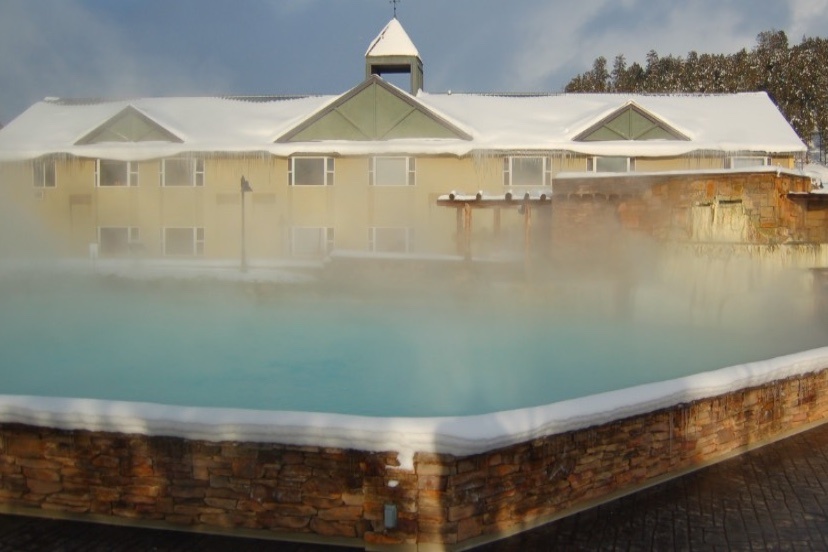
Photo: The geothermal ‘Mother Spring’ located on the property of the Springs Resort in Pagosa Springs.
20 years later, I still don’t fully understand the ‘ownership’ of the hot water that bubbles up, or gets pumped up, from Pagosa’s underground geothermal aquifer.
It might be more than one aquifer, but I’m going with the theory that all of the geothermal water users in downtown Pagosa Springs are drawing from the same (limited?) source.
The question of ownership is not insignificant, even though it’s complicated and confusing. But this particular question — about ownership — was not the one placed before the Pagosa Springs Town Council at their September 16 regular meeting.
The question was much simpler. Did the Town Council want to approve of, and accept, the new ‘2025 Geothermal Rate Study’ created by Roaring Fork Engineering?
At least one person in the audience on September 16 felt it necessary to warn the Council that approval of this particular rate study could possibly result in a lawsuit.
More about that in a moment. To fully appreciate the warning, we need to have a bit of history.
The practice of water law in Colorado is a massively profitable industry, as one might expect, considering that water is one of a very few things absolutely essential to human survival… other absolute necessities being oxygen, food, and shelter during extreme weather events such as winter in Colorado.
For comparison, here are a few things that are nice to have, but not absolutely necessary:
1. Soaking pools filled with hot geothermal mineral water.
2. Heated sidewalks that melt winter snow and reduce the need for shoveling.
3. Expensive hotels.
4. Expensive restaurants.
5. Expensive attorneys.
The state of Colorado felt so strongly about access to water, that it was written directly into the state constitution.
According to the Colorado constitution, water is a public resource, owned by the public. Water must be used only for beneficial uses, and (supposedly) must not be sold for private profit. (“Supposedly,” because many things supposedly not allowed are done anyway, often with the blessing of a court of law.)
From the Colorado State University website:
In the 1860s, Colorado adopted a set of laws regarding water use and land ownership known as the Colorado Doctrine. This doctrine established four essential principles of the state’s water law that helped distinguish it from Riparian Law, which is the water law framework commonly followed in wetter, humid portions of the U.S. where there is less concern for reduction of overall flows…
- The state’s surface and groundwater is a public resource for beneficial use by public agencies, private persons and entities;
- A water right is a right to use a portion of the public’s water supply;
- Water rights owners may build facilities on the lands of others to divert, extract, or move water from a stream or aquifer to its place of use;
- Water rights owners may use streams and aquifers for the transportation and storage of water.
The ‘Prior Appropriation Doctrine’ gives priority — when water flows are insufficient to serve all users of a water source — to the water rights holder who first put the water “to beneficial use”. Generally speaking, the beneficial use is clearly defined in the water right decree.
It seems to me that almost any type of water use can be defined as a ‘beneficial use’ — but one particular prohibited use is worth mentioning. No person or business or government can acquire water rights merely for the purpose of preventing other people (competitors, for example?) from using the water.
Such a prohibited use might play a role in this story at some point.
Back in the early 1980s, in the midst of an oil crisis, the U.S. Department of Energy provided a sizable grant to the Town of Pagosa Springs to develop a municipal geothermal heating system. The grant paid for the drilling of two geothermal wells, behind the old County Courthouse in Centennial Park, plus the construction of a system of underground pipes to carry hot water to schools, businesses and homes in the downtown core. Those wells, a heat-exchanger building, and the system of pipes were intended to reduce the use of fossil fuels for two downtown schools and about four dozen businesses and homes.
We didn’t know much about ‘greenhouse gas’ in those days, but we understood something about America’s dependence on foreign oil.
The water rights for Pagosa’s geothermal wells specifically state that the water must be used for “municipal heating purposes.”
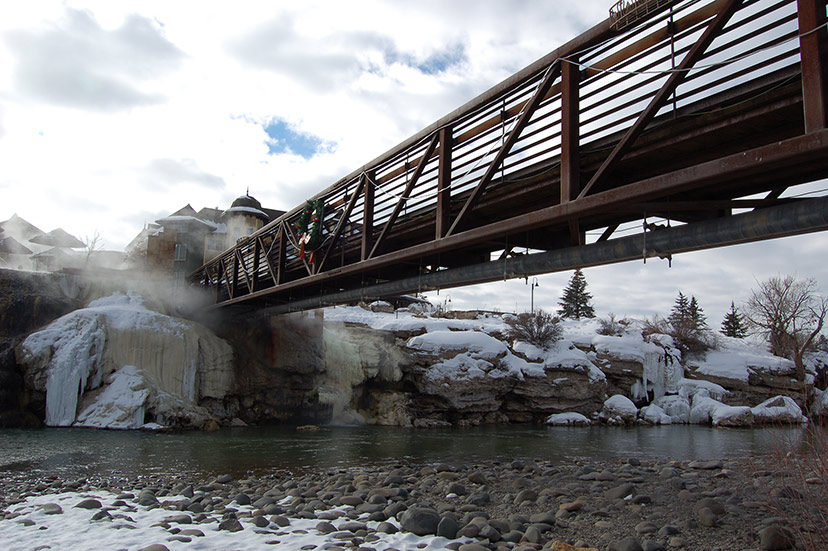
In the early 1990s, the Spring Inn — to be known later as the Springs Resort — made a deal with the Town government to install a pedestrian bridge leading from Centennial Park to the Spring Inn, under which was hung a large black pipe to transport municipal geothermal water from Centennial Park to the Spring Inn. The taxpayers paid for the bridge, because it made Pagosa more “pedestrian friendly”.
When town residents inquired about the propriety of providing municipal hot water specifically allocated for a ‘municipal heating system’, to a private business for use in geothermal soaking pools, the attorney for the Springs Resort explained that “heating people” in soaking pools was obviously a “municipal heating purpose”.
The Springs Resort also managed to negotiate a special (and very attractive) deal for up to 450 gallons per minute of the Town’s geothermal water, year round.
We should be clear that the Springs Resort also has other water rights granting them access to various geothermal water sources, but few of those water rights have been developed, as I understand it. The Springs Resort continues to depend, to some degree, on water rights owned by the people of Pagosa Springs.
How much are those water rights worth?
To answer that question, the Town Council hired Roaring Fork Engineering to develop a document, justifying the rates the Town should be charging the users of the winter-time-only municipal heating system — and that one special year-round user: the Springs Resort.
Thus, the appearance of one of the Springs Resort’s water attorneys at the September 16 Town Council meeting.