
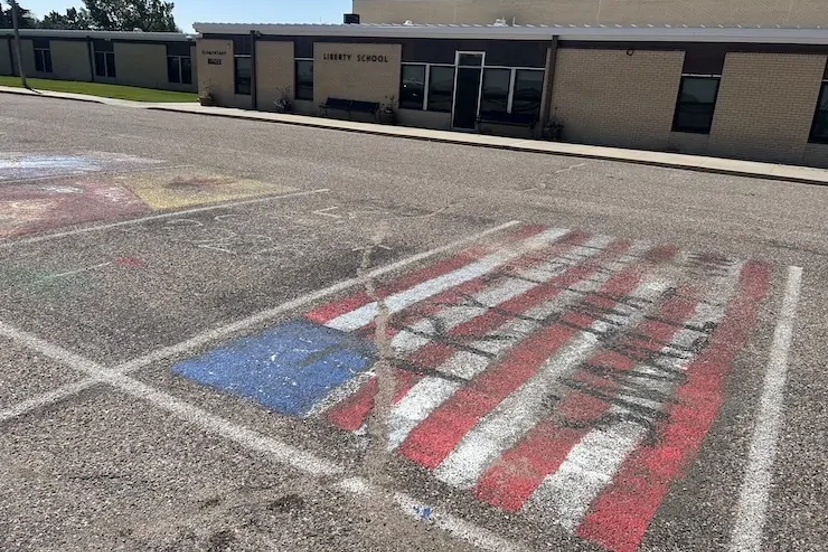
Photo: The parking lot of Liberty School District’s K-12 school in Yuma County has an American flag painted over one parking space. Photo by Allen Best/Big Pivots.
This story by Allen Best was originally published by Big Pivots on September 16, 2025. We are sharing it in two parts.
Liberty High School has a proud heritage associated with basketball, but has too few students for a basketball team.
It does have a gymnasium, though.
That gymnasium, which is located on Colorado’s plains east of Denver, was flooded with water in January 2024 when aging copper coils associated with natural gas heating ruptured. School district officials decided their money was best spent on a new heating and cooling system that taps the relatively constant year-round temperature 500 feet below ground.
Year-round temperatures at that depth fluctuate between 55 and 60 degrees. Ground-source heat pumps deliver air inside buildings at 68 or 74 degrees, the comfort level for most people. On a hot summer day, when the temperature outside is 100 degrees, the same technology can deliver cooler air. The technology uses principles similar to those of a refrigerator’s compressor to keep leftover dinners cool.
The geothermal technology — variously called geo-exchange and ground-source heat pumps — has been rapidly gaining favor in schools and other public buildings in Colorado during the last 25 years. Poudre Valley, a school district based in Fort Collins, installed geo-exchange for an administrative building in 2002 and recently in several new buildings.
Most ambitiously, Colorado Mesa University, in Grand Junction, embarked on a geo-exchange system in 2008 that now includes 16 buildings. University officials there identify the 2.5 miles of coils buried below soccer fields and other places being a key reason they have been able to save $1.5 million annually in utility costs. This, in turn, allows it to offer the third-lowest combined tuition and fee rate among Colorado’s 12 public colleges and universities.
Now, with the aid of $12 million in grants scattered across Colorado in the last two years, adoption of the technology has been accelerating in both cities and small towns — and in some schools, too.
Getting to the Liberty school requires driving on U.S. 36, the same highway that splices Boulder and Estes Park on its way across Rocky Mountain National Park. East of Denver, the highway traverses 140 miles across undulating and sparsely populated landscapes before descending to Joes, population 82.
Just beyond Joes lies Liberty’s K-12 school. Erected in 1966, the building houses all students in the district. This year Liberty had a single graduating senior. Two more will graduate next year and 10 or 11 the year after. Total district enrollment this fall was 80. For two decades, it has had a 100% graduation rate.
Joes is a footnote in basketball history. In 1929, when basketball was still in its relative infancy and the world was stumbling into the Great Depression, a team from Joes High School bested all the other basketball teams from Colorado high schools.
The Joes team then went to a national tournament in Chicago hosted by the famous coach Amos Alonzo Stagg. There, in the national tournament, the boys from Joes placed third. They were bestowed with three basketballs to commemorate the accomplishment, as was recounted in “The Boys from Joes,” a 1987 book by Nell Brown Propst. Now deflated, the balls can be seen in a showcase outside the gymnasium that was flooded.
The gymnasium gleams with a polished wooden floor. Banners of six-man football and other athletic achievements of decades past drape the walls. On one side is a stage, “Home of the Liberty Knights,” and on the other, bleachers. They still get filled at times, but not necessarily for sporting events. Many funerals are held at the gym, as no local churches can accommodate larger crowds.
Rhonda Puckett, the school district superintendent who doubles as principal of the schools, says the flooding occurred at a good time, if there could be one. The building was still occupied. Teachers and others grabbed towels, art-class T-shirts and whatever they could find to mop up the water. No permanent damage occurred.
That crisis also left Puckett with an opportunity. The 36,000-square-foot building was structurally sound but deficient in other ways. Window air conditioners kept the classrooms so-so but not the building’s interior spaces. During winter, the cafeteria was cold enough to require jackets.
Millig Design Build, a Centennial-based company, responded to the school district’s call for ideas.
Aaron Tilden, a mechanical engineer who was assigned to work with Liberty, had already worked with many rural school districts in Colorado and Kansas. He declares himself no purist. He always looks at the options through the lens of long-term costs and human benefits.
The economics of schools, even small ones, can differ from those of homes or even office buildings because schools must heat or cool air from the outside frequently to maintain adequate indoor air quality. Think about the needs of a 20-by-20-foot classroom, with 25 students and a teacher in it, he says.
“A 35,000-square-foot office building probably needs a quarter as much outdoor air as a 35,000-square-foot school,” he said.
Air-source heat pumps have soared in popularity in Colorado and elsewhere. They can be quite effective in homes, even in colder mountain towns. And in some specific circumstances, they can work in schools. For example, Millig installed an air source system at a school in Akron, also on Colorado’s Eastern Plains.
Tilden sees ground-source heat pumps being superior to many alternatives. One school in Kansas was closed for several days because its air-source heat pumps, afflicted by ice buildup and high winds, were insufficient.
“I have 100% confidence with ground-source heat pumps providing heat no matter what is going on outside,” says Tilden. “I am less confident in recommending that an air source pump can provide heat during those very cold, very windy and icy days.”
Ground-source heat pumps do have a problem for buildings used almost exclusively for heating. Over time, the available heat underground can diminish.
Ground-source systems work most effectively when used both for heating and cooling. At Colorado Mesa, for example, the diversity of buildings and their uses allow maintenance of this thermal balance. And for that matter, with schools now opening in early to mid-August, they also need to be cooled.
For Liberty, Tilden recommended a ground-source system coupled with a backup boiler fueled by natural gas. The gas boiler is expected to be used less than 10% of the time.
Read Part Two… tomorrow…
Allen Best publishes the e-journal Big Pivots, which chronicles the energy transition in Colorado and beyond.