
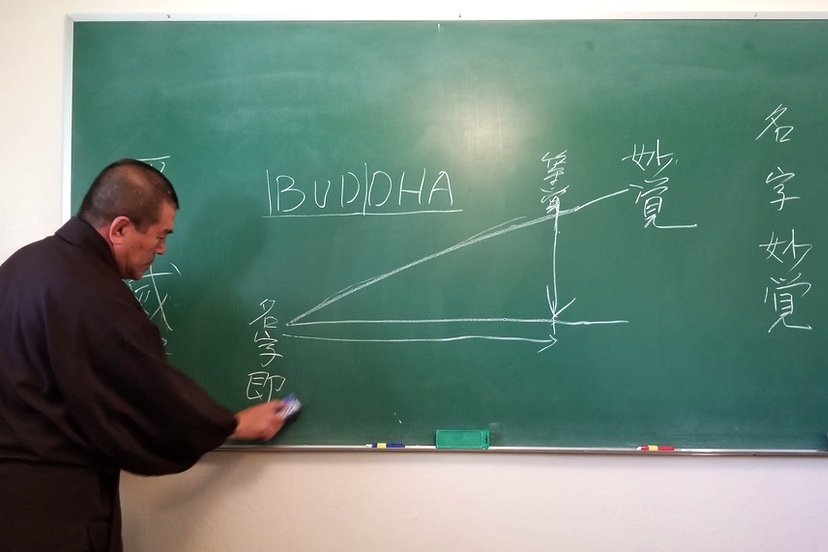
Photo: The path to Enlightenment, graphed on a chalkboard by Ven. Kenjo Igarashi.
Once upon a time, much of the instruction in American schools made use of chalk and a chalkboard, but not so much any more. It’s more common to find erasable ‘white boards’ and digital projectors and computer-driven ‘smart boards’ in a modern classroom.
For kids these days, chalk is typically something used for drawing on the sidewalk.
But for those of us who grew up with chalkboards — that is to say, those of us responsible for funding public schools, and teaching in public schools, and writing about public schools, and complaining about public schools — chalk and chalkboards will forever remain potent symbols of the education process.
Back in 2013, a couple of fledgling news organizations — a website called GothamSchools, based in New York, and a magazine called EdNews Colorado, based in Denver — decided to merge their efforts, and eventually chose the name ‘Chalkbeat.org’ as the website name.
As the organization grew to include reporters in Pennsylvania, New Jersey, Michigan, Indiana, Illinois, Tennessee, and Washington DC, they sought to better define their mission. Education is an extremely complex industry, made even more complex by the fact that public schools are controlled, to some degree, by locally-elected school boards and locally-appointed superintendents, and are also funded largely by local taxpayers. This means that schools are expected to reflect their home community’s values to some degree, even when much of the regulatory control comes from state and federal bureaucracies.
We understand that a nonprofit news website may have different goals from a for-profit media organization. For one thing, a nonprofit organization — in order to maintain its tax-exempt status — is limited in how ‘political’ it can be. As Chalkbeat searched for the right mission, and the right ways to fulfill that mission, they were initially guided, to some extent, by other nonprofit news websites such as ProPublica.org
ProPublica had published a white paper in 2012, “Issues Around Impact”, analyzing the proper way for a nonprofit news organization to behave, and how to measure its value as a source of information. One of the central questions from that white paper concerned how a nonprofit news website can properly seek to have a meaningful impact on society.
What would it mean to have an “impact”?
Some comments from that white paper (that might speak to a small-town investigative reporter like myself):
From its inception, and in accord with its stated mission, ProPublica has quite self-consciously measured its own success by the impact of its journalism, i.e. by the change and reform that journalism has spurred…
If impact is the aim, what distinguishes journalism from advocacy? This is a complicated question, and it admits of many answers, but, in short, there are profound differences between journalism and advocacy. The most profound of these may begin with process, but culminate in much more: Journalism begins with questions and then progresses, as facts are determined, to answers.
Advocacy begins with answers, with the facts already assumed to be established. In short, advocates know before they begin work the sort of impact they are seeking, while journalists only learn in the course of their work what the problem is, and only after this can they begin to understand the kind of impact their work might have.
Advocates seek impact based on their opinion of societal needs; journalists may identify possible steps toward reform, but should do so only from facts they have established.
From what I can tell, Chalkbeat took some ideas from ProPublica and created their own ‘impact’ white paper, “What We Talk About When We Talk About Impact”.
From that Chalkbeat white paper, discussing the internal debate about the website’s mission:
The changes forced us to face questions that we had previously answered incompletely, at best, or punted, at worst. What were we doing? How did we do it? And how could we know if we were having the effect we wanted?
Our effort to answer these questions has spanned multiple years and strategies as we’ve sought to describe our mission to ourselves and others. It has also thrust us into the heart of a growing discussion about the “quest for measurement” in nonprofit journalism…
…Unlike some journalists we knew, we had no problem saying that we thought education should improve, especially for the poorest children. But we were adamant that the best way for us to contribute to educational improvement was to remain neutral on the question of how it should happen — and even neutral on the question of exactly what improvement ought to look like.
As we saw it, education had a surplus of people supplying answers to these questions, including a growing number of advocacy groups that existed solely for that purpose. What education had too little of, we thought, was people asking questions, offering context, and acknowledging nuance. We could make the biggest difference, we thought, if we served as independent mediators, not advocates…
Naturally, the idea of “making a difference” with one’s reporting is an issue facing nearly every journalist and editor. And I have to agree with the idea that the education industry — and education truly is an industry, as well as a profession and a public service — could use more people asking questions, offering context, and acknowledging nuance.
For Daily Post readers interested in those questions, and that context, and those nuances, you could do worse than subscribing to one or more of the Chalkbeat newsletters, which are available here.