
We often share articles, here in the Daily Post, written by the folks at Chalkbeat.org, a national 501c3 nonprofit that publishes online news about education in the U.S. — mainly, about ‘public education’. They maintain offices in Colorado, New York, Pennsylvania, New Jersey, Michigan, Indiana, Illinois, Tennessee, and Washington DC. As a nonprofit, Chalkbeat is highly dependent upon donations to fund its work.
The organization has a mission beyond simply reporting interesting news. Its staff is committed to informing political leaders, community organizers, and the general public about efforts to improve schools for all children, especially those who have historically lacked access to a quality education.
Our unique impact as journalists lies in our ability to tell the full and complete story, without consideration of profit, ideology, or advocacy.
But before we get into Chalkbeat’s history, we’ll consider for a moment a few minerals that have played a significant role in education.
Chalk, for example… a soft, white, porous mineral; typically almost pure calcium carbonate.
In the centuries before paper and workbooks became affordable for school use, students used chalk to scribble their lessons on a ‘slate’ — a thin sheet of dark gray metamorphic rock composed mainly of quartz, illite, and chlorite.
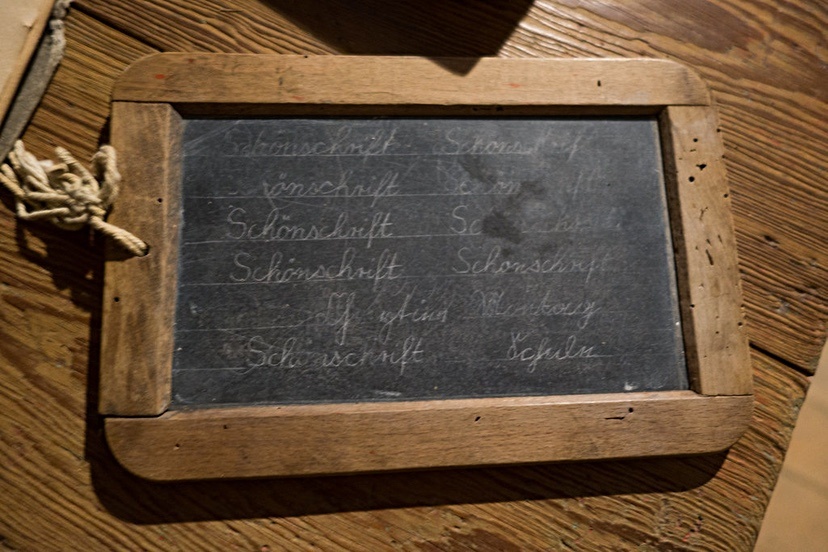
The ‘slate’ had two sides, but had to be erased each time a new lesson was written.
We can imagine how the act of completely erasing one’s work with each new lesson, taught students something important about the ways of the world. Specifically, that all things must pass.
In 1800, James Pillans, headmaster of the Old High School of Edinburgh, connected a number of smaller slates into one large board, mounted on the wall of his classroom. In 1801, George Baron, a mathematics instructor at West Point, did the same thing. By 1809, every public school in Philadelphia was using these educationally valuable ‘blackboards’.
A green porcelain surface was introduced around 1930 — to cut down on glare — and when this green colored surface replaced the old black surface, the word ‘chalkboard’ came into use.

Other minerals have since come to play an important role in American education.
Silicon, for example.
It’s no exaggeration to say that silicon semiconductors have changed the world. Within a human lifetime we’ve gone from ENIAC — the first programmable general-purpose digital computer, built in 1945 — to the very first transistor radios, to cell phones and laptop computers. You’re reading this article, right now, thanks to a device that uses a silicon CPU.
These silicon-driven devices are now ubiquitous in American schools, in the form of classroom laptops, digital projectors, tablets, ‘smartboards’, and a broadband infrastructure capable of connecting students in rural Colorado to a global information network.
Also, to a global ‘misinformation network’.
Here’s an excerpt from an email we received recently from Chalkbeat.org.
Dear Reader,
We are thrilled to have you on board with us.
Chalkbeat was founded because we believe independent journalism can help inform the decisions that lead to better outcomes for children and families, especially those in low-income communities. We do this by providing deep, local coverage of education policy and the very real impact those policies have in public school classrooms and beyond.
Our reporting puts pressure on leaders to solve systemic problems and local challenges in education. To identify what those are, we constantly return to our organizational values.
We seek:
One essential story: We believe that all children deserve access to a quality education — one that prepares them for the duties of citizenship in a democracy and connects them to economic opportunity.
Power in independence: Our unique impact as journalists lies in our ability to tell the full and complete story, without consideration of profit, ideology, or advocacy.
Going local: We put down roots in the communities we cover and work with our readers as well as for them.
Impact: We do everything we can to bring stories, people, and stakes alive for readers so they can engage in informed action and debate.
Antiracism: We acknowledge and condemn the ongoing legacy of racism in U.S. public education and in the institution we are part of: the press. We commit to standing against racism as we build our organization and conduct our work.
Openness and diversity: We write about people who have historically lacked access to a quality education.
Investing in ourselves: We strive to connect every member of our team with the opportunities and challenges they need to learn and grow…

I find it slightly amusing that a forward-looking organization like Chalkbeat uses the word “chalk” in their name, considering the rather minor role played by those calcium carbonate sticks in American schools these days. The manner in which teachers and students write their lessons has changed dramatically, during the transition from chalk and slates… to silicon.
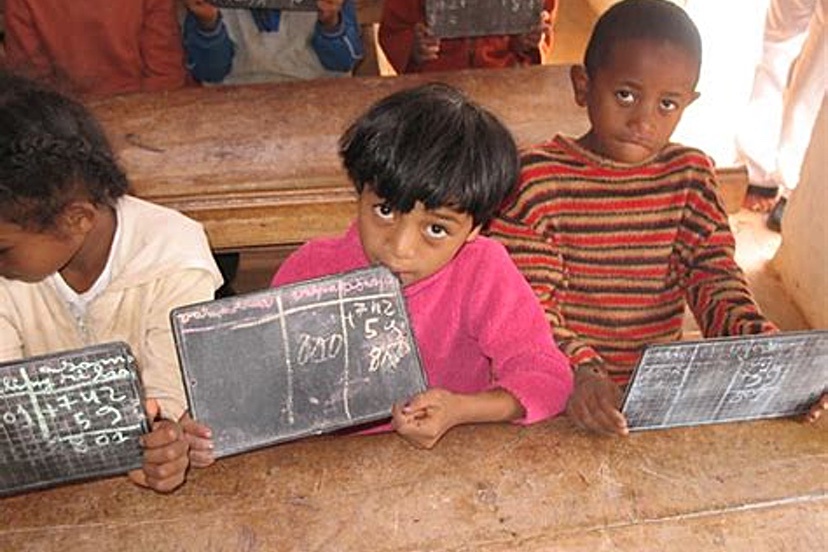
But has the lesson itself changed?
Do we still believe that all children deserve access to a quality education? Did we ever believe it?
And what about racism… openness… diversity?