
I will be writing later on, about another sad and confusing meeting — a meeting of the Archuleta Board of County Commissioners, held on September 16.
But first, let’s finish with the sad and confusing Pagosa Area Water and Sanitation District (PAWSD) meeting on September 11.
Disclosure: I currently serve as a volunteer board member for PAWSD, but this editorial reflects only my own opinions, and not necessarily those of the PAWSD Board or PAWSD staff.
As noted previously, three developers came before the PAWSD Board — Gene Tautges, Alex Boehmer, Glenn Walsh, Bruce “BJ” Jones, and myself — seeking waivers or reimbursement of Capital Investment Fees (CIFs) for workforce housing projects. The total combined water and wastewater CIF is now about $25,000 per home, much higher than it was three years ago.
PAWSD has an adopted policy specifying CIF waivers for workforce housing, especially aimed at projects serving households with incomes at 80% Area Median Income (AMI) and below, when the Board determines that the projects have broad community support. Last year, the PAWSD Board issued waivers that supported 63 new dwelling units — 13 new single family homes and 50 apartment units. All of those projects had received support from other government agencies as well.
The three developers at the September 11 meeting were Habitat for Humanity of Archuleta County, Pagosa Springs Community Development Corporation (CDC), and private builder Peter Hurley. Once again, all these projects — totaling 16 new units — had received government and community support.
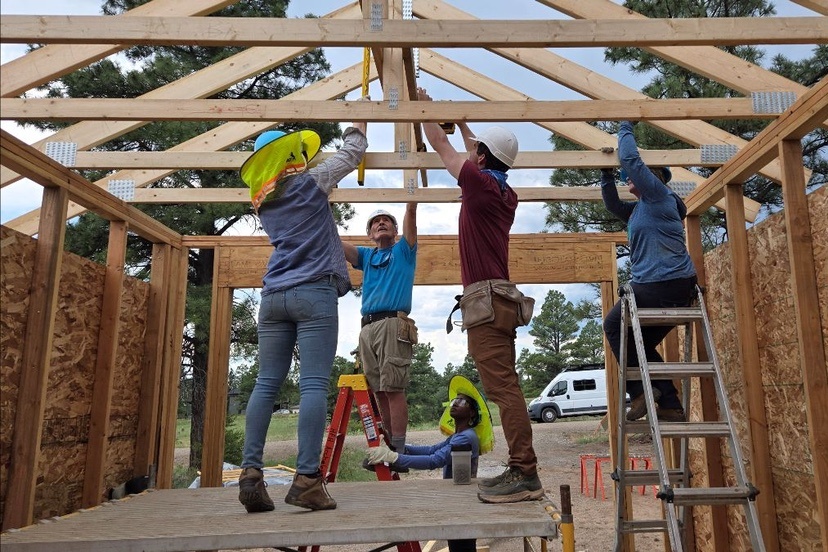
Habitat was seeking reimbursement for the three modular homes they are completing this year, to be sold to families earning less than 80% Area Median Income — a type of housing desperately needed in Pagosa Springs, according to the County’s recent 25-Housing-Needs-Assessment-smHousing Needs Assessment.
The total reimbursement requested by Habitat was about %75,000.
The CDC — a nonprofit ‘economic development’ organization largely supported by the Town of Pagosa Springs and Archuleta County — was seeking waivers for five proposed homes. So about $125,000 worth of CIFs.
Mr. Hurley, who once served on the PAWSD Board and who has built eight workforce apartment units downtown, was seeking reimbursement of PAWSD fees worth a total of about $10,000.
Call it $200,000 worth of potential assistance. Government assistance… for projects that have received other forms of government assistance, in an effort to address an increasingly dysfunctional local economy. A recent Region 9 Economic Development District report stated that Archuleta County has become the least affordable community in southwest Colorado, due mainly to the high cost of housing.
We found that in Region 9, Montezuma County is the least expensive ($91,519 annually), and Archuleta County is the most expensive place to live ($105,919 annually) for a family of four. Using housing costs specific to each community we found that Pagosa Springs is the most expensive community in the region for a family of four ($25.08 per hour for each working adult) due to the high cost of housing.
Considerable discussion had taken place between the PAWSD board members prior to the September 11 meeting. Colorado law prohibits private Board discussion that include three or more board members, but allows face-to-face discussions when only two Board members are involved. Political negotiations — give and take — are part of most any government decision process, and going into the September 11 meeting, I understood in advance that Habitat would likely receive its requested reimbursement of $75,000, and that CDC and Mr. Hurley would be denied.
But hope springs eternal.
Indeed, Habitat did win its reimbursement, by a 4-1 vote, with only board member Tautges voting ‘Nay’.
Knowing my board’s resistance to the CDC request, I made a motion to grant them a 75% waiver, rather than a full waiver. No one seconded my motion.
Board member Walsh then moved to grant a full waiver to CDC. That action was rejected by board members Tautges, Boehmer, and Jones, based on various arguments — in spite of apparently unanimous support for CDC coming from a packed audience. The audience support was expressed most eloquently by County Commissioner Warren Brown and Town Community Development Director James Dickhoff.
Most confusing to me was a repeated assertion by Mr. Tautges that “other governments’ needed to show increased support for the CDC project before he can support PAWSD waivers. The CDC has received well over $2 million in government grants, waivers and property donations in support of its ongoing housing effort.
During the audience testimony, Commissioner Brown noted that Archuleta County has provided nearly $5 million in assistance to various workforce housing projects over the past few years. He noted that $1.9 million worth of infrastructure improvements in the Chris Mountain subdivision, spearheaded by CDC, will ultimately result in millions of dollars in future customer fees to PAWSD.
But most importantly, he noted, the provision of housing is crucial to a functioning economy.
“This is about people, not about homes,” he said.
In the end, three of my fellow PAWSD Board members couldn’t find a way to support the CDC with $125,000 in waivers. Nor was my board willing to support Mr. Hurley’s $10,000 request.
I found this to be sad and confusing, considering the depth of our housing crisis. My board has — in my opinion — basically issued a statement to the community that PAWSD will not support affordable housing efforts, unless they are conducted by Habitat for Humanity.
Habitat is building three homes this year, and hopes to build four next year.
At that rate, it would take 100 years to generate the 400 workforce homes needed in our town, according to the 2024 Housing Needs Assessment.
Sad.
And confusing.