
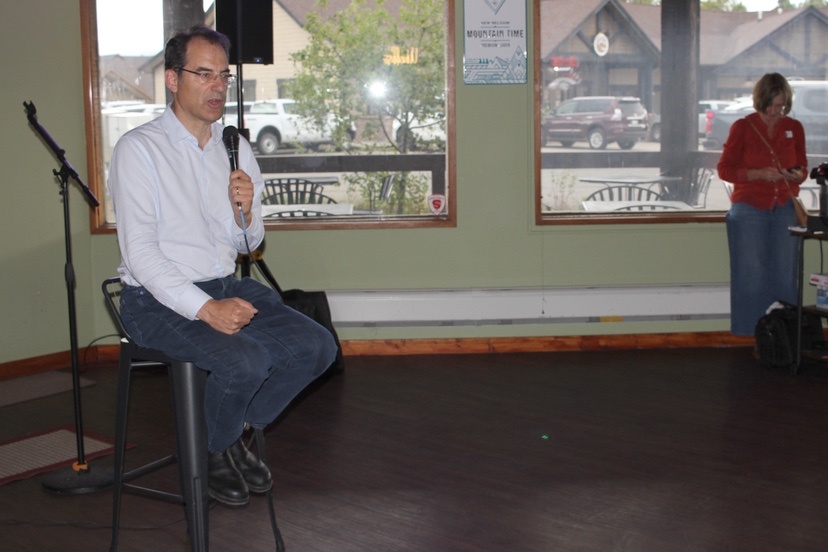
Photo: Attorney General Phil Weiser, fielding questions from a mostly-sympathetic audience in Pagosa Springs, September 10, 2025.
When Colorado Attorney General Phil Weiser showed up at Uncle’s Bar and Social Club on September 10, I sensed that the audience was generally sympathetic to the Attorney General’s Democratic Party politics, which lean towards protecting the underdog — the working family, the tenant, the consumer, the voter, the ‘man on the street’ — rather than protecting corporations and capitalists. Given this political tendency, I assume that the funding for Mr. Weiser’s current campaign — he is running for Colorado Governor in 2026 — will depend heavily on smaller, grassroots donations from working-class and middle-class Democrats and left-leaning Independents.
One of the question he fielded at the event came from my friend Alex Boehmer, who serves with me on the Pagosa Area Water and Sanitation District (PAWSD) board of directors. Mr. Boehmer is not ‘left-leaning’, but he’s definitely concerned about how government mandates, handed down by bureaucrats and legislators in Denver and Washington DC, can impact ordinary households and businesses in a rural town like Pagosa Springs. Specifically, Mr. Boehmer asked the Attorney General’s opinion of Regulation 31 — a pending wastewater rule that, if enforced, would cost Pagosa families and businesses thousands of dollars in increased fees, while providing very little benefit to the environment.
The potentially-very-expensive regulation originated with the federal EPA (Environmental Protection Agency) but the Trump administration is taking a hard look at the requirements, Mr. Boehmer said.
If Mr. Weiser were elected governor, would he work to eliminate this problematic regulation, here in Colorado, especially in rural communities that cannot afford such mandates? Or would he work to preserve the mandate?
Mr. Weiser: “Before I worked for Justice Ginsberg, I worked for a different judge, who taught me an incredibly important lesson. I’m not afraid of what I don’t know. I’m afraid of what I think I know.
“I have no idea what you just said.”
(Audience laughter.)
“But I learned… I understand that this community may be forced to do a substantial upgrade to protect water quality, and it’s possible that the reason for the upgrade — the EPA regulation — might be voided. The next question is, what would the state do if that happens? And because I don’t know what the issue is, I don’t know what the state should do.
“What I will tell you is, we need to be sensible in supporting, particularly, more rural, low-resource communities on issues that may not be easy to solve.
“I know this community has had challenges along these lines, and I want to work with you, so please make sure Mindy’s got your information and let’s talk a little more about this. I’d like very much to get ahead of this issue and figure out the best way forward.”
“Mindy” being a member of the Attorney General’s rural outreach staff. (I didn’t catch her last name.)
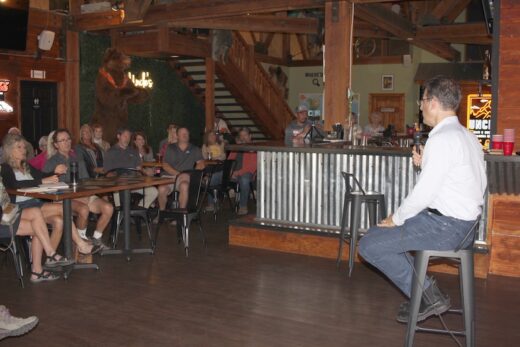
Other issues brought up by the audience and addressed by Mr. Weiser:
1. AG Weiser heard from Pagosa Springs Community Development Corporation (PSCDC) Executive Director Emily Lashbrooke, that the state housing programs are not properly designed to serve rural communities. AG Weiser agreed with that assessment, and stated that, in his position as attorney general, he is able to offer advice but not much more. If he manages to secure the Governorship in 2026, he said, he will be a more effective advocate for rural housing programs.
2. How would AG Weiser make a difference if he gets elected? He suggested that his approach to rural communities would be collaborative. “I’m very much a believer, that my role is to lift you all up — not to tell you what to do because I’ve got all the answers.”
3. Often, governments heed the needs of their bureaucracies, rather than the wishes of the larger community. How would Mr. Weiser ensure that individuals have an effective voice?
“It’s an appealing vision to say you’re committed to listening, when you’re consulting with communities. In practice, between that vision and our reality, the agency that’s on the job isn’t listening to the people… I’ve often considered myself as both a public servant, and a student of how government works… A lot of public agencies have their own bureaucratic inertia. They keep doing things the way they’ve always done them. And if you want to be a leader who makes changes to how government operates, that requires changing culture.
“For a lot of government, it doesn’t matter if there’s a Democrat in charge or a Republican in charge. The question is, do you have an innovator in charge, or someone who wants to keep operating on autopilot? Most of government is just doing what they’ve always been doing.
“I want to tell you that my mindset is 100% an innovative mindset…
“Yes, it’s hard to change the culture of how agencies operate. It’s hard to move in an innovative direction. But the answer to your question is, you have to set that tone from the top…”
4. What has the Attorney General done to protect minorities from ICE?
“This week has been a tough week. Every week has been a tough week. The U.S. Supreme Court ruled that if you are brown, and you speak Spanish, and you work at a low-wage job, you’re basically vulnerable to being taken by ICE. I believe we’re going to get to the other side, once we get through this challenging time, to a place where we will have a sensible and fair, and a legal immigration system. It’s very important that we have a secure border. It’s important that we have processes that function in a rational way, so people know what to expect, are treated fairly and are given due process, as required by the 14th Amendment.
“What’s happening right now is, people are worried about being grabbed indiscriminately and having their process be upended in ways that are unfair and violate the law… People who are U.S. citizens are asking, ‘Do I have to carry my passport around all the time? Because I could be shipped off to another country’…
“I’ve demonstrated that I’m not afraid to stand up against this federal government when they do things that are harmful and illegal. I’ve done it 35 times already, and I intend to do it again and again…”
Applause from the audience.